22990atinesh
- 143
- 1
Suppose ##f^{\prime\prime}## is continuous on an open interval that contains x = c
1. If ##f^{\prime}(c)=0## and ##f^{\prime\prime}(c)<0##, then ##f## has local maximum at x = c.
2. If ##f^{\prime}(c)=0## and ##f^{\prime\prime}(c)>0##, then ##f## has local minimum at x = c.
3. If ##f^{\prime}(c)=0## and ##f^{\prime\prime}(c)=0##, then the test fails. The function ##f## may have a local maximum, a local minimum, or neither.
I've a little doubt in point 3. I've come up with only 1 example for the possibility when
##f^{\prime}(c)=0##, ##f^{\prime\prime}(c)=0## and ##f## has neither local maximum or local minimum.
Ex: ##f(x)=x^3##
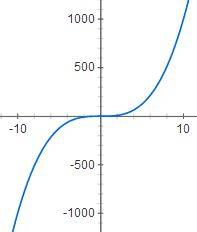
Please give examples for other two possibilities when
##f^{\prime}(c)=0##, ##f^{\prime\prime}(c)=0## and f has local maximum
##f^{\prime}(c)=0## , ##f^{\prime\prime}(c)=0## and f has local minimum
1. If ##f^{\prime}(c)=0## and ##f^{\prime\prime}(c)<0##, then ##f## has local maximum at x = c.
2. If ##f^{\prime}(c)=0## and ##f^{\prime\prime}(c)>0##, then ##f## has local minimum at x = c.
3. If ##f^{\prime}(c)=0## and ##f^{\prime\prime}(c)=0##, then the test fails. The function ##f## may have a local maximum, a local minimum, or neither.
I've a little doubt in point 3. I've come up with only 1 example for the possibility when
##f^{\prime}(c)=0##, ##f^{\prime\prime}(c)=0## and ##f## has neither local maximum or local minimum.
Ex: ##f(x)=x^3##
Please give examples for other two possibilities when
##f^{\prime}(c)=0##, ##f^{\prime\prime}(c)=0## and f has local maximum
##f^{\prime}(c)=0## , ##f^{\prime\prime}(c)=0## and f has local minimum
Last edited by a moderator: