Second Isomorphism Theorem for Rings .... Bland Theorem 3.3.1

Click For Summary
SUMMARY

The discussion centers on Bland's Second Isomorphism Theorem for rings as presented in "The Basics of Abstract Algebra" by Paul E. Bland. Participants focus on proving that the kernel of the ring homomorphism defined in the theorem is indeed the quotient ring ##I_1/I_2##. Key steps include demonstrating that an arbitrary element ##x + I_2## in ##I_1/I_2## implies ##x \in I_1##, and vice versa, confirming the relationship between the kernel and the quotient structure. The conversation highlights the importance of understanding ring homomorphisms and their kernels in abstract algebra.

PREREQUISITES
  • Understanding of ring theory and ring homomorphisms
  • Familiarity with quotient rings, specifically ##I_1/I_2##
  • Knowledge of basic concepts in abstract algebra as outlined in "The Basics of Abstract Algebra" by Paul E. Bland
  • Ability to manipulate and interpret mathematical notation used in algebraic proofs
NEXT STEPS
  • Study the definition and properties of ring homomorphisms in detail
  • Explore the concept of kernels in the context of ring theory
  • Review the proof of the Second Isomorphism Theorem for rings
  • Investigate examples of quotient rings and their applications in abstract algebra
USEFUL FOR

Students of abstract algebra, mathematicians focusing on ring theory, and educators teaching concepts related to ring homomorphisms and isomorphism theorems.

Math Amateur
Gold Member
MHB
Messages
3,920
Reaction score
48
I am reading "The Basics of Abstract Algebra" by Paul E. Bland ... ...

I am currently focused on Chapter 3: Sets with Two Binary Operations: Rings ... ...

I need help with Bland's proof of the Second Isomorphism Theorem for rings ...

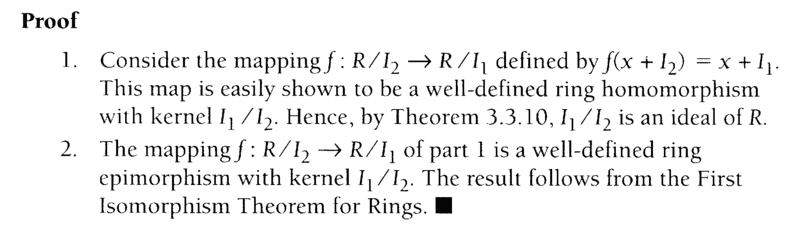
Bland's Second Isomorphism Theorem for rings and its proof read as follows:
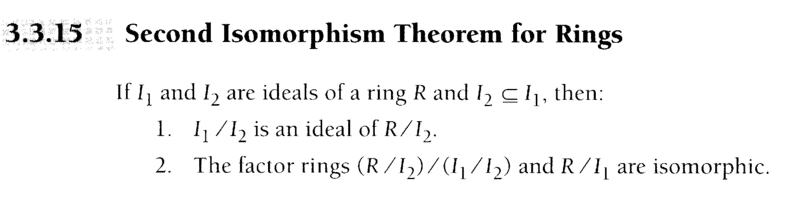
Bland - 1 - Theorem 3.3.15 ... PART 1 ... .png

Bland - 2 - Theorem 3.3.15 ... PART 2 ... .png

In the above proof by Bland we read the following:

" ... ... This map is easily shown to be a well defined ring homomorphism with kernel ##I_1/I_2##. ... ... "I can see that ##f## is a ring homomorphism ... but how do we prove that the kernel is ##I_1/I_2## ... ... ?Hope someone can help ...

Peter
 

Attachments

  • Bland - 1 - Theorem 3.3.15 ... PART 1 ... .png
    Bland - 1 - Theorem 3.3.15 ... PART 1 ... .png
    10.1 KB · Views: 919
  • Bland - 2 - Theorem 3.3.15 ... PART 2 ... .png
    Bland - 2 - Theorem 3.3.15 ... PART 2 ... .png
    18.3 KB · Views: 765
Physics news on Phys.org
Math Amateur said:
I can see that ##f## is a ring homomorphism ... but how do we prove that the kernel is ##I_1/I_2## ... ... ?
First prove ##I_1/I_2## is in the kernel. Take an arbitrary ##x+I_2\in I_1/I_2##. That means that ##x\in I_1##. Then

##f(x+I_2)\triangleq x+I_1=I_1## (since ##x\in I_1)\ =0_{R/I_1}##.

So ##x+I_2## is in the kernel.

Now prove that the kernel is in ##I_1/I_2##. Take an arbitrary element ##x+I_2## of the kernel. Then we have ##f(x+I_2)\triangleq x+I_1=0_{R/I_1}=I_1##. Hence ##x\in I_1##. Hence ##x+I_1\in I_1/I_2##.
 
  • Like
Likes   Reactions: Math Amateur
andrewkirk said:
First prove ##I_1/I_2## is in the kernel. Take an arbitrary ##x+I_2\in I_1/I_2##. That means that ##x\in I_1##. Then

##f(x+I_2)\triangleq x+I_1=I_1## (since ##x\in I_1)\ =0_{R/I_1}##.

So ##x+I_2## is in the kernel.

Now prove that the kernel is in ##I_1/I_2##. Take an arbitrary element ##x+I_2## of the kernel. Then we have ##f(x+I_2)\triangleq x+I_1=0_{R/I_1}=I_1##. Hence ##x\in I_1##. Hence ##x+I_1\in I_1/I_2##.
Thanks for the help, Andrew ...

But ... just a minor point of clarification ...

You write ... " ... ... Take an arbitrary ##x+I_2\in I_1/I_2##. That means that ##x\in I_1## ... ... "

Can you explain why ##x+I_2\in I_1/I_2## implies that ##x\in I_1## ... ... ?

Peter
 
Math Amateur said:
You write ... " ... ... Take an arbitrary ##x+I_2\in I_1/I_2##. That means that ##x\in I_1## ... ... "

Can you explain why ##x+I_2\in I_1/I_2## implies that ##x\in I_1## ... ... ?

Peter
It is true by definition.

##I_1/I_2## is defined to be the following collection of cosets of ##I_2##
$$I_1/I_2 \triangleq \{x+I_2\ :\ x\in I_1\}$$
 
  • Like
Likes   Reactions: Math Amateur
Hi Andrew ...

Hmmm ... yes ... of course ... you're right ...

Thanks again for your help ...

Peter
 

Similar threads

Replies
6
Views
2K
  • · Replies 2 ·
Replies
2
Views
3K
Replies
3
Views
2K
  • · Replies 4 ·
Replies
4
Views
1K
  • · Replies 2 ·
Replies
2
Views
1K
  • · Replies 2 ·
Replies
2
Views
1K
  • · Replies 2 ·
Replies
2
Views
2K
  • · Replies 6 ·
Replies
6
Views
2K
Replies
2
Views
2K
  • · Replies 21 ·
Replies
21
Views
1K