Self-adjoint matrix, general form

Click For Summary
SUMMARY

The general form of a 2x2 self-adjoint matrix is defined by four real-valued parameters, or three if constrained by the determinant condition detU=1. The discussion highlights the relationship between self-adjoint matrices and unitary matrices, emphasizing that while self-adjoint matrices can have two real degrees of freedom, unitary matrices require additional constraints that reduce the independent parameters to four. The transformation between eigenspaces of two matrices in a 2x2 Hilbert space is also explored, particularly through the lens of the Lie algebra of the unitary group U(2).

PREREQUISITES
  • Understanding of Hermitian matrices and their properties
  • Familiarity with unitary matrices and their constraints
  • Knowledge of the Pauli matrices and their role in quantum mechanics
  • Basic concepts of Lie groups and Lie algebras
NEXT STEPS
  • Study the properties of Hermitian matrices in linear algebra
  • Learn about the unitary group U(2) and its applications
  • Explore the parametrization of unitary matrices using the Lie algebra
  • Investigate the role of the Pauli matrices in quantum state transformations
USEFUL FOR

Mathematicians, physicists, and students studying quantum mechanics or linear algebra, particularly those interested in matrix transformations and their applications in quantum theory.

Jakub Tesar
Messages
2
Reaction score
0
Hi,
I am looking for the general form of 2x2 complex transformation matrix.

I have the article, that says "the relative position of a self-adjoint 2x2 matrix B with respect to A as a reference (corresponding to the transformation from the eigenspaces of A to the eigenspaces of B) is determined by two real-valued parameters."

But the general form of self-adjoint matrix is determined by four real-valued parameters (or three if I limit the matrix by the detU=1), isn't it?

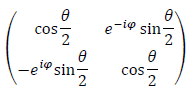
I tried to start with the matrix derived from the Bloch vector, but I doubt, that it's the most general case:
upload_2016-1-29_14-44-33.png


I expect I just made a mistake somewhere, but I can't find the right place.
Thank you,
Jakub
 
Physics news on Phys.org
They're probably talking self-adjoint unitary matrices, which do have just two real degrees of freedom.

Your formula misses the Pauli Z matrix.
 
  • Like
Likes Jakub Tesar
Self-adjoint is a mathematical description. A general description is as follows:

From Wikipedia, the free encyclopedia
In mathematics, a Hermitian matrix (or self-adjoint matrix) is a square matrix with complex entries that is equal to its own conjugate transpose—that is, the element in the i-th row and j-th column is equal to the complex conjugate of the element in the j-th row and i-th column, for all indices i and j:

047bf7f688e415bf724ddd891712758c.png
or
eaf2c338093020405a336a2ed8ffaf63.png
, in matrix form.
 
  • Like
Likes Jakub Tesar
Sorry, I do not look for self-adjoint matrix, just unitary (wrong title) -- for the general form of transformation between two different bases in the 2x2 Hilbert space.

I was thinking in the same direction Stirlanc, but I wonder how I can add Pauli Z matrix and still have unitary matrix with only 2 real parameters.
 
Let's see. A general ##\mathbb{C}^{2 \times 2}## matrix,
$$M=\begin{pmatrix} a & b \\ c & d \end{pmatrix}$$
has 4 independent complex, i.e., 8 independent real parameters. Now for the matrix to be unitary you must have
$$M^{\dagger} M=\mathbb{1},$$
which implies that both the columns and the rows are two orthonormal vectors. Thus you have the constraints
$$|a|^2+|b|^2=|c|^2+|d|^2=|a|^2+|b|^2=|c|^2+|d|^2=1,$$
i.e., of the 4 moduli of the numbers only 2 are indpendent.
Then you have
$$a^* c + b^* d=a^* b+c^* d=0,$$
which are two more constraints, i.e., of the 8 real parameters only 4 are independent.

Depending on your problem different parametrizations are more or less convenient. One is to use the Lie algebra of the unitary group U(2), leading to
$$M=\exp(\mathrm{i} \varphi) \exp(\mathrm{i} \vec{\alpha} \cdot \vec{\sigma}/2),$$
where ##\vec{\sigma}## are the three Pauli matrices, and ##\vec{\alpha} \in B_{2\pi}(0)##, ##\varphi \in [0,2 \pi[##.
 
  • Like
Likes Jakub Tesar

Similar threads

  • · Replies 1 ·
Replies
1
Views
1K
  • · Replies 4 ·
Replies
4
Views
4K
Replies
2
Views
2K
  • · Replies 4 ·
Replies
4
Views
2K
  • · Replies 2 ·
Replies
2
Views
2K
  • · Replies 12 ·
Replies
12
Views
2K
  • · Replies 2 ·
Replies
2
Views
4K
  • · Replies 0 ·
Replies
0
Views
2K
  • · Replies 4 ·
Replies
4
Views
2K
  • · Replies 1 ·
Replies
1
Views
1K