Self-reference problem in MWI (13yo amateur, be gentle)

M4n90_L3m0n
Messages
6
Reaction score
3
TL;DR
Proposes a 'pseudo-superposition' thought experiment where measuring a quantum system yields 'cake' or 'sofa.' Argues that since the observer is also in superposition, both outcomes must coherently coexist, creating a self-referential paradox rather than a standard quantum collapse.
Hi everyone! I'm a 13-year-old student from China. My English might be rough, and my physics knowledge is just amateur obsession, so please be gentle! 😅

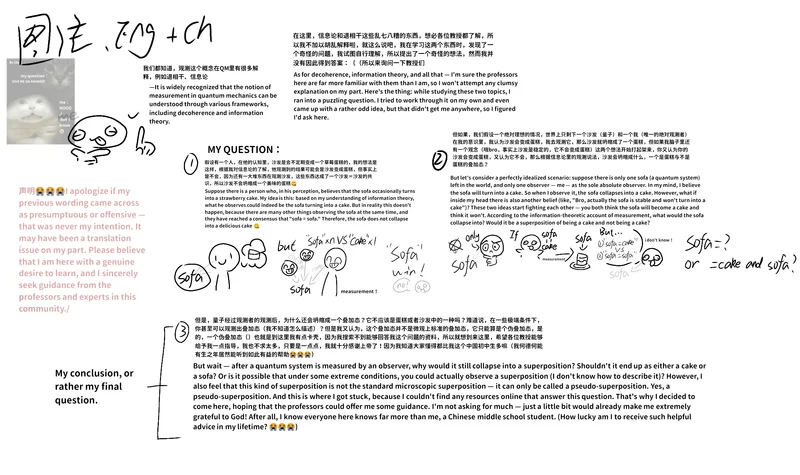
To reiterate: I'm a 13-year-old amateur, so my train of thought might have derailed a bit while writing this down. Please ignore any confusing parts! I promise the diagram on the left does a better job of explaining this "pseudo-superposition" mess than I do. Let's just look at the picture!
无标题900_20260704235358.webp


My core confusion is:

If all branches exist in the Multiverse, then the statement "MWI is correct" must also only be true in some branches, right? This feels self-referential.

Also, looking at the superposition of the cat (Sofa vs Cake), if there is no "conscious observer" (like a human) to ever check the box, does the superposition just stay forever? Would other universes even know what the "true" state is, or is reality just a consensus formed by redundant records?

I know I might be mixing up decoherence and information theory. Is there a paper or a term for this specific "self-reference" paradox in MWI?

Any help or even a good laugh is appreciated! Thanks!

P.S. – A quick note on how this post was written:

My English is really bad (think "I listening music" level), so I wrote the original version in Chinese, then used Google Translate + some light AI polishing to make it readable. If the tone sounds a bit robotic in places — that's why. But every single idea in this post is mine, I swear on my life (or at least on my cat's nine lives). I'm not here to spam or test AI-generated content. I'm genuinely stuck on this self-reference thing and want to learn from people who actually know what they're talking about.Not sure which prefix fits, so I picked one I thought matched. Bear with me, I'm a forum newbie!

Thanks for bearing with me. 🙏
 
  • Agree
Likes   Reactions: Bystander
Physics news on Phys.org
M4n90_L3m0n said:
If all branches exist in the Multiverse, then the statement "MWI is correct" must also only be true in some branches, right?
”All branches exist” isn’t quite right, it’s better to say that there is a branch for every possible outcome, but violating the laws of physics is not a possible outcome. There will be a branch in which a subatomic particle has randomly decayed and there will be a branch in which the particle has not decayed, but there will not be a branch in which the particle turns into a bird and flies away. So if MWI is a correct law of physics it will be true in all branches.
Also, looking at the superposition of the cat (Sofa vs Cake), if there is no "conscious observer" (like a human) to ever check the box, does the superposition just stay forever?
The conscious observer is irrelevant. Branching happens with decoherence happens, and a cat or a camera or pretty much any macroscopic object like a measuring device is complex enough to decohere. So we have two branches, the cat knows which one it is in, and the only reason we don’t is that we haven’t looked.
Decoherence is one of the really important advances in our understanding since Schrodinger proposed the cat thought exper and since Everett came up with what we now call MWI. There’s a good layman-friendly explanation, Lindley’s book “Where does the weirdness go”, but I don’t know if there’s a Chinese translation.
 
  • Informative
Likes   Reactions: berkeman
Thanks for the detailed explanation!!! Through your explanation, I looked up some relevant materials and successfully came to understand decoherence. This has been incredibly helpful to me✨. Also, regarding the book Where Does the Weirdness Go? — I will try to search for it domestically and read it! Thank you very much for the recommendation.
Thank you once again!
 
  • Like
Likes   Reactions: berkeman
M4n90_L3m0n said:
TL;DR: Proposes a 'pseudo-superposition' thought experiment where measuring a quantum system yields 'cake' or 'sofa.' Argues that since the observer is also in superposition, both outcomes must coherently coexist, creating a self-referential paradox rather than a standard quantum collapse.

Hi everyone! I'm a 13-year-old student from China. My English might be rough, and my physics knowledge is just amateur obsession, so please be gentle! 😅

To reiterate: I'm a 13-year-old amateur, so my train of thought might have derailed a bit while writing this down. Please ignore any confusing parts! I promise the diagram on the left does a better job of explaining this "pseudo-superposition" mess than I do. Let's just look at the picture!

View attachment 372880

My core confusion is:

If all branches exist in the Multiverse, then the statement "MWI is correct" must also only be true in some branches, right? This feels self-referential.

Also, looking at the superposition of the cat (Sofa vs Cake), if there is no "conscious observer" (like a human) to ever check the box, does the superposition just stay forever? Would other universes even know what the "true" state is, or is reality just a consensus formed by redundant records?

I know I might be mixing up decoherence and information theory. Is there a paper or a term for this specific "self-reference" paradox in MWI?

Any help or even a good laugh is appreciated! Thanks!

P.S. – A quick note on how this post was written:

My English is really bad (think "I listening music" level), so I wrote the original version in Chinese, then used Google Translate + some light AI polishing to make it readable. If the tone sounds a bit robotic in places — that's why. But every single idea in this post is mine, I swear on my life (or at least on my cat's nine lives). I'm not here to spam or test AI-generated content. I'm genuinely stuck on this self-reference thing and want to learn from people who actually know what they're talking about.Not sure which prefix fits, so I picked one I thought matched. Bear with me, I'm a forum newbie!

Thanks for bearing with me. 🙏
A reply to my own post:First of all, thanks to everyone for the guidance! I've looked up some materials and successfully cleared up many of my earlier confusions. However, there's still one thing I haven't found an answer to, which is the core question in my hand-drawn diagram. Let me summarize it in text:

The core idea in the picture is:

Imagine a quantum system that can be in two states: "Cake" or "Sofa".

When measured, instead of collapsing to one, the observer himself enters a superposition.

This creates a "pseudo-superposition" where both results coexist coherently — but this feels self-referential because the observer is part of the system.

My main question is:

Is there a hidden paradox here that no one has fully addressed? Why doesn't this "pseudo-superposition" behave like the standard wave function collapse?

Sorry for the messy handwriting — I'm 13 and my drawing skills are worse than my English 😅
 
M4n90_L3m0n said:
Why doesn't this "pseudo-superposition" behave like the standard wave function collapse?
Because there is no wave function collapse in the MWI. So you should not expect the wave function in the MWI to behave like there is.
 
Thanks for the reply, PeterDonis! Really appreciate it.

Just to clarify: the "MWI" framing might have sneaked in when I used AI to polish my English — the AI probably summarized my thoughts a bit too freely. My actual question isn't limited to MWI; it's about this "pseudo-superposition" idea in general, across interpretations.

That said, from what I've read, MWI does seem to have something close — the "relative state" (Everett's term, right?). So my follow-up is: is my "pseudo-superposition" just a clumsy way of describing relative states? Or is there something new-ish here that isn't captured yet?

Still 13 and learning, sorry if this is a mess 👉👈

P.S. I wasn't sure if it's proper to address someone by their username directly in forum replies. My AI assistant told me it's the norm here, so I followed that advice. If I accidentally broke any etiquette, please forgive me — I'm still learning how forums work! 🙇‍♂️
 
M4n90_L3m0n said:
it's about this "pseudo-superposition" idea in general, across interpretations.
Not all interpretations even have anything like what you appear to mean by "pseudo-superposition". You would need to be specific about which interpretation you are interested in talking about.

M4n90_L3m0n said:
is my "pseudo-superposition" just a clumsy way of describing relative states?
I couldn't say because I don't know exactly what you mean by "pseudo-superposition". It's not a recognized standard term in QM. You would need to write down some actual math and show in the math what you are referring to by that term, and I'm not sure you have enough knowledge of the math of QM to do that.

I would suggest taking the time to learn basic QM from a standard textbook before even trying to formulate such questions. If you are not comfortable with the basic math of QM and how it is used to make predictions, you are not really ready for any discussion of QM interpretations.

I would also caution you that discussion of personal theories is off limits here at PF. This from your OP, in particular, looks like an attempt at a personal theory:

M4n90_L3m0n said:
TL;DR: Proposes a 'pseudo-superposition' thought experiment where measuring a quantum system yields 'cake' or 'sofa.' Argues that since the observer is also in superposition, both outcomes must coherently coexist, creating a self-referential paradox rather than a standard quantum collapse.
 
PeterDonis said:
Not all interpretations even have anything like what you appear to mean by "pseudo-superposition". You would need to be specific about which interpretation you are interested in talking about.


I couldn't say because I don't know exactly what you mean by "pseudo-superposition". It's not a recognized standard term in QM. You would need to write down some actual math and show in the math what you are referring to by that term, and I'm not sure you have enough knowledge of the math of QM to do that.

I would suggest taking the time to learn basic QM from a standard textbook before even trying to formulate such questions. If you are not comfortable with the basic math of QM and how it is used to make predictions, you are not really ready for any discussion of QM interpretations.

I would also caution you that discussion of personal theories is off limits here at PF. This from your OP, in particular, looks like an attempt at a personal theory:
Thank you for your honest feedback. I apologize for veering into personal theory territory and for not using formal math. I will take your advice to heart and focus on studying the standard textbook QM first. I won't bring up these speculative ideas again until I have a stronger mathematical foundation. Sorry for the trouble!
 
  • Like
Likes   Reactions: PeterDonis
Thanks for the honest feedback. I realize I jumped ahead without enough math foundation. I'll step back and study the basics properly before coming back to these deeper questions. Appreciate the guidance!0.o
 

Similar threads

  • ¡ Replies 4 ¡
Replies
4
Views
3K
  • ¡ Replies 51 ¡
2
Replies
51
Views
7K
  • ¡ Replies 27 ¡
Replies
27
Views
4K
  • ¡ Replies 30 ¡
2
Replies
30
Views
4K
  • ¡ Replies 8 ¡
Replies
8
Views
3K
  • ¡ Replies 15 ¡
Replies
15
Views
4K
  • ¡ Replies 1 ¡
Replies
1
Views
1K
  • ¡ Replies 13 ¡
Replies
13
Views
6K
  • ¡ Replies 1 ¡
Replies
1
Views
4K