Separation of variables in spherical coordinates (electrostatics)

Click For Summary

Homework Help Overview

The discussion revolves around the separation of variables in spherical coordinates within the context of electrostatics, particularly focusing on the potential expressed in terms of Legendre polynomials. Participants are exploring the setup of the problem and the implications of using these polynomials to represent electrostatic potentials.

Discussion Character

  • Exploratory, Conceptual clarification, Mathematical reasoning, Problem interpretation

Approaches and Questions Raised

  • Participants discuss the representation of the potential using Legendre polynomials and question the correctness of their expressions. There are inquiries about the radial dependence and the calculation of coefficients related to the potential. Some participants also explore the implications of having a zero dipole moment and the conditions under which this occurs.

Discussion Status

The discussion is active, with participants providing insights and clarifications regarding the setup of the problem and the mathematical representation of the potential. There are multiple interpretations being explored, particularly concerning the dipole moment and its calculation. Guidance has been offered on how to approach the problem using polynomial expansions and the significance of symmetry in determining the dipole moment.

Contextual Notes

Participants are navigating the complexities of the problem, including the need to express potentials as polynomials and the implications of symmetry in electrostatic configurations. There is mention of homework constraints and the relevance of specific examples from literature, which may influence the understanding of the problem.

milkism
Messages
118
Reaction score
15
Homework Statement
Need help with setting up the first part of the problem.
Relevant Equations
See solution.
Problem:
fa5007c579a379e3e58e9fb1f28e4fd4.png


Solution:
When I looked at an example problem, they started writing the potential in terms of the Legendre polynomials.
The example problem:
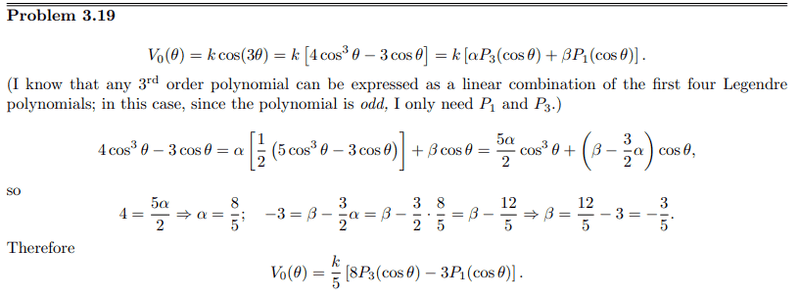
8d13019377fe67349760b37632205e52.png

This is what I did:
$$V_0 \alpha P_2 (\cos(\theta)) \Rightarrow \frac{\alpha 3 \cos ^2 (\theta)}{2} - \frac{\alpha}{2} \Rightarrow \frac{\alpha 3}{2} - \frac{\alpha}{2}= 1 \Rightarrow \alpha = 1$$
Hence,
$$V(\theta) = V_0 P_2 (\cos(\theta)).$$
Have I done right?
 
Physics news on Phys.org
milkism said:
Homework Statement: Need help with setting up the first part of the problem.
Relevant Equations: See solution.

Problem:
View attachment 325294

Solution:
When I looked at an example problem, they started writing the potential in terms of the Legendre polynomials.
The example problem:
View attachment 325295
This is what I did:
$$V_0 \alpha P_2 (\cos(\theta)) \Rightarrow \frac{\alpha 3 \cos ^2 (\theta)}{2} - \frac{\alpha}{2} \Rightarrow \frac{\alpha 3}{2} - \frac{\alpha}{2}= 1 \Rightarrow \alpha = 1$$
Hence,
$$V(\theta) = V_0 P_2 (\cos(\theta)).$$
Have I done right?
Also with radial dependance do they just mean calculate A_l and B_l?
 
Yes you are supposed to find ##A_\ell## and ##B_\ell## and plug them into the generic formula

##V \left(r, \theta \right) = \sum_{\ell = 0}^{\infty} \left( A_\ell r^\ell + \frac{B_\ell}{r^{\ell + 1}}\right) P_\ell \left( \cos \theta\right)##

On physical grounds ##A_\ell = 0## outside and ##B_\ell = 0## inside because we cant have the potential blowing up at infinity or at the origin.
 
  • Like
Likes   Reactions: vanhees71
You may want to start with <br /> \left.\begin{array}{r}<br /> P_2(\cos \theta) = \frac{1}{2}(3 \cos^2 \theta - 1) \\<br /> P_0(\cos \theta) = 1 \end{array}\right\} \quad \Rightarrow\quad<br /> \cos^2 \theta = \frac23P_2(\cos \theta) + \frac13P_0(\cos \theta)
 
  • Like
Likes   Reactions: milkism, vanhees71 and PhDeezNutz
milkism said:
Hence,
$$V(\theta) = V_0 P_2 (\cos(\theta)).$$
Have I done right?
No. Write out the righthand side as a polynomial in ##\cos\theta##, and you'll see it doesn't equal the given ##V(\theta)##.

In the example problem, you have the potential ##V = k \cos 3\theta= k(4\cos \theta^3-3\cos\theta)##, which is a third-order polynomial of ##\cos\theta##. That means it's an element of the vector space consisting of polynomials of degree 3 or fewer.

The first four Legendre polynomials are a basis for this vector space, so any element of the vector space can be expressed as a linear combination of the Legendre polynomials. In other words, you can say
$$4k\cos^3\theta - 3k\cos\theta = c_3 P_3(\cos\theta) + c_2 P_2(\cos\theta) + c_1 P_1(\cos\theta) + c_0 P_0(\cos\theta).$$ The problem is then finding the appropriate values for the ##c_i##'s.

A straightforward way to do that is to simply expand out the righthand side and then equating coefficients from the two sides of the equation. You'll get a system of four linear equations which is simple to solve. Griffiths used a useful shortcut to deduce ##c_0 = c_2 = 0##, so he ended up with a system of two equations and two unknowns.

In your problem, you have ##V=V_0 \cos^2\theta##. It's an element of the vector space consisting of polynomials of degree 2 or fewer, and the first three Legendre polynomials will span that space. So the problem is to find ##c_0##, ##c_1##, and ##c_2## so that
$$V_0 \cos^2\theta = c_2 P_2(\cos\theta) + c_1 P_1(\cos\theta) + c_0 P_0(\cos\theta).$$ Expand the righthand side and then equate coefficients to get the equations you need to solve.
 
  • Like
Likes   Reactions: milkism, PhDeezNutz and vanhees71
Thanks you all, first time doing such problem and I completely understand it now!
 
Also for finding the electrostatic dipole moment of the system can we just use the surface charge density on the surface to calculate it?
 
milkism said:
Also for finding the electrostatic dipole moment of the system can we just use the surface charge density on the surface to calculate it?
I get zero for electrostatic dipole moment of the system, don't know if it's right.
Using this formula:
4c59089647f90ec8a9d86b847cfad38e.png

I get $$\frac{V_0 \epsilon_0}{R} \left( 5\cos ^2 (\theta) - \frac{4}{3} \right)$$.
Then for electrostatic dipole moment in spherical coordinates:
e935e3747ab3f491d60fc6d7b62c88c0.png

Computing the integral I get zero.
 
Having solved this very problem myself, for the outside I do not get a 1/r^2 term for the potential. So I’d have to agree with you about your dipole moment.
 
  • #10
PhDeezNutz said:
Having solved this very problem myself, for the outside I do not get a 1/r^2 term for the potential. So I’d have to agree with you about your dipole moment.
Is it even possible for there to not be a dipole moment?
 
  • #11
Absolutely. The next higher up moment is the quadrupole which in the simplest illustration is two back to back opposing dipoles and therefore the dipole moments cancel out.

The Quadrupole is a 2nd rank (symmetric) tensor and is not so easy to visualize. This moment is scarcely dealt with in Griffiths however there is an exercise pertaining to it.
 
  • Like
Likes   Reactions: milkism
  • #12
PhDeezNutz said:
Absolutely. The next higher up moment is the quadrupole which in the simplest illustration is two back to back opposing dipoles and therefore the dipole moments cancel out.

The Quadrupole is a 2nd rank (symmetric) tensor and is not so easy to visualize. This moment is scarcely dealt with in Griffiths however there is an exercise pertaining to it.
My next problem is to calculate the mono-di and quadrapole of 4 charges haha, luckily no octopole problem.
 
  • Haha
Likes   Reactions: PhDeezNutz
  • #13
PhDeezNutz said:
Absolutely. The next higher up moment is the quadrupole which in the simplest illustration is two back to back opposing dipoles and therefore the dipole moments cancel out.

The Quadrupole is a 2nd rank (symmetric) tensor and is not so easy to visualize. This moment is scarcely dealt with in Griffiths however there is an exercise pertaining to it.
I think the dipole moment is zero because the angular dependent potential is symmetric (even), just like how symmetric molecules have no dipole moment 😅😅
 
  • Like
Likes   Reactions: DrClaude and PhDeezNutz
  • #14
That makes sense to me.

When you calculate the dipole moment of the 4 charges I bet it’s going to be zero.

Edit: your instructor knows how to choose good problems. It’s nice how one leads into the other with emphasis. I’m a fan.
 
  • Haha
Likes   Reactions: vanhees71 and milkism

Similar threads

  • · Replies 4 ·
Replies
4
Views
2K
Replies
6
Views
2K
  • · Replies 21 ·
Replies
21
Views
2K
  • · Replies 1 ·
Replies
1
Views
2K
Replies
13
Views
3K
  • · Replies 12 ·
Replies
12
Views
2K
Replies
1
Views
2K
  • · Replies 9 ·
Replies
9
Views
4K
  • · Replies 1 ·
Replies
1
Views
1K
  • · Replies 19 ·
Replies
19
Views
2K
