Series connected zener diodes problem

  • Thread starter Thread starter saurav106
  • Start date Start date
  • Tags Tags
    Diodes Series
Click For Summary
SUMMARY

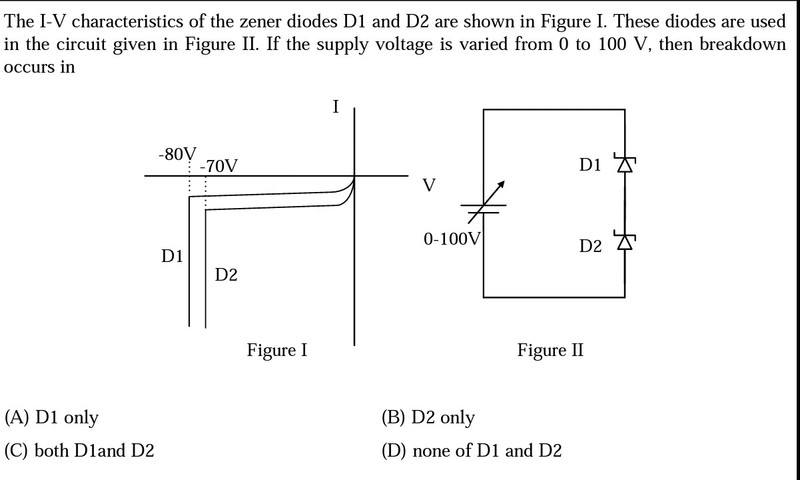
The discussion centers on the behavior of series-connected Zener diodes under varying voltage conditions. It is established that when a combined voltage of 150V is applied, both diodes do not necessarily enter breakdown simultaneously. Specifically, for a supplied voltage less than 100V, the Zener diodes D1 and D2 conduct a small amount of current, with breakdown voltages not being reached. The conclusion drawn is that the answer to the posed question is D, as the diodes exhibit different breakdown characteristics, with D1 breaking down at 80V and D2 at 20V.

PREREQUISITES
  • Understanding of Zener diode operation and breakdown voltage
  • Familiarity with current-voltage characteristic curves of diodes
  • Basic knowledge of series circuit behavior
  • Ability to interpret graphical data related to electronic components
NEXT STEPS
  • Study the current-voltage characteristics of Zener diodes in detail
  • Learn about the impact of series and parallel configurations on diode behavior
  • Explore the concept of avalanche breakdown in Zener diodes
  • Investigate practical applications of Zener diodes in voltage regulation circuits
USEFUL FOR

Electronics students, circuit designers, and engineers interested in understanding Zener diode behavior and applications in voltage regulation.
saurav106
Messages
1
Reaction score
1
I have attached the image with post.

Answer to question is given as A. I am not getting the explanation to how can one zener diodes be in breakdown and other not. I think if the combined voltage of 150V is applied then only breakdown occurrs in both the diodes simultaneously.

SvPyxhW.jpg
 

Attachments

  • IMG_20160302_000628.jpg
    IMG_20160302_000628.jpg
    27 KB · Views: 459
  • Like
Likes   Reactions: Alok Vats
Engineering news on Phys.org
saurav106 said:
I think if the combined voltage of 150V is applied then only breakdown occurrs in both the diodes simultaneously.
You are right: The answer is D) as for Vsupplied < 100 V.

D1 and D2 will conduct some small amount of current, sharing the supplied voltage, but the voltages VD1+VD2 < 100V are not defined as break down voltages.
 
Last edited:
Maybe we should ask the question instead as:
"Does some arbitrarycurrent I100 exist
where the sum of the diode voltages is 100 volts? "
Surely there does.

The diodes see the same current of course ...
Any given current would be a horizontal line on the graph
and where it crosses each diode's characteristic curve is the voltage for that diode at that current.
so let's take a ruler and dividers to it .
Sliding my red horizontal current line down from zero amps
it appears D1 breaks down at 80 volts well before D2 reaches even 20 volts
so if i lay my horizontal current line so it crosses D2's characteristic curve at 20 volts
i have found one possible I100 .
zeners.jpg


It seems strange that those two diodes have such different avalanche currents

but those are the curves we were given.

I'd have to pick answer A.

I think this was more an exercise in graph reading than zener diodes ?

old jim
 
Last edited:
  • Like
Likes   Reactions: cnh1995

Similar threads

Replies
1
Views
2K
Replies
9
Views
4K
  • · Replies 38 ·
2
Replies
38
Views
5K
  • · Replies 14 ·
Replies
14
Views
2K
Replies
7
Views
2K
  • · Replies 7 ·
Replies
7
Views
4K
  • · Replies 1 ·
Replies
1
Views
5K
  • · Replies 10 ·
Replies
10
Views
3K
  • · Replies 6 ·
Replies
6
Views
3K
  • · Replies 8 ·
Replies
8
Views
3K