Shortest distance along the shore and into the lake

  • Thread starter Thread starter brotherbobby
  • Start date Start date
  • Tags Tags
    Distance traveled
Click For Summary
SUMMARY

The discussion focuses on optimizing the travel time for a man running along the shore and swimming to point B. The derived formula for the optimal running distance, given by ##x=s-\dfrac{v_1d}{\sqrt{v_2^2-v_1^2}}##, is valid only when ##x>0##. The participants identified that if the calculated value of ##x## is negative, it indicates that the man should swim directly to A instead of running. The conversation emphasizes the importance of correctly defining variables and equations to avoid inconsistencies in calculations.

PREREQUISITES
  • Understanding of calculus, specifically derivatives for optimization
  • Familiarity with trigonometric functions and their applications in geometry
  • Knowledge of kinematics, particularly speed and distance relationships
  • Ability to interpret and manipulate algebraic equations
NEXT STEPS
  • Study the application of Fermat's principle in physics and its relation to optimization problems
  • Learn about optimization techniques in calculus, focusing on critical points and local minima
  • Explore the geometric interpretation of trigonometric functions in right triangles
  • Investigate real-world applications of kinematic equations in optimizing travel paths
USEFUL FOR

Mathematicians, physics students, engineers, and anyone interested in optimization problems involving motion and geometry.

brotherbobby
Messages
755
Reaction score
170
Homework Statement
A man is on the shore of a lake at point A and has to get to point B on the lake in the shortest possible time (see Fig below). The distance from point B to the shore is ##BC = d## and the distance ##AC=s##. The man can swim in water with a speed of ##v_1## and run along the shore with a speed of ##v_2##, greater than ##v_1##. Which way should he use - swim from point A straight to B or run a certain distance along the shore and then swim to point B?
Relevant Equations
(1) Pythagorean theorem for a right angled triangle with hypotenuse length ##c## and sides ##a,b## : ##c^2=a^2+b^2##
(2) For a function ##f(x)##, minimum value of ##f## can be found by solving ##\dfrac{df}{dx}=0##. At the minimum, the calculated value of ##x##, say some ##x_0##, should have ##\left.\dfrac{d^2f}{dx^2}\right|_{x=x_0}\!\!\!\!\!\!\!\!\!>0##
Attempt : I copy and paste the problem as it appeared in the text below.
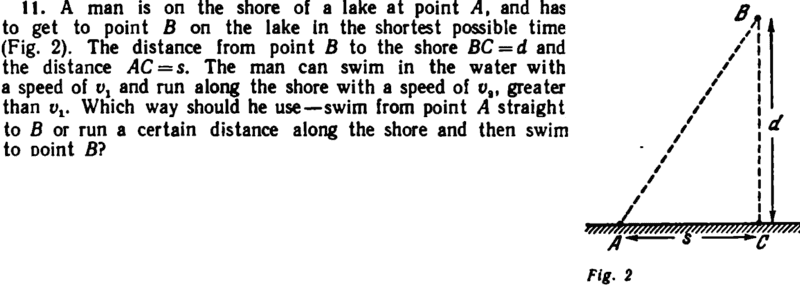
1716009907856.png


1716010143680.png
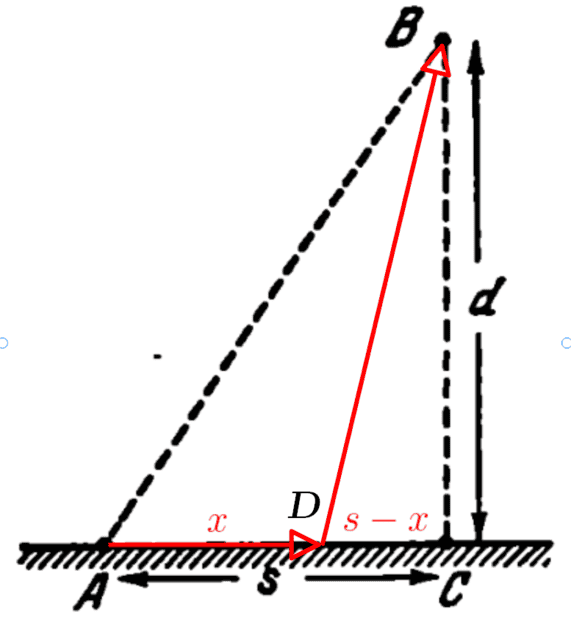
To be sure, of course the man cannot swim directly to B for minimum time of travel. He should run a distance (##x##) to some point D along the shore and then swim to B. I draw those details in the diagram to the right.
The time of travel ##\small{t=\dfrac{x}{v_2}+\dfrac{\sqrt{d^2+(s-x)^2}}{v_1}}##.
For minimum time, ##\small{\dfrac{dt}{dx}=\dfrac{1}{v_2}-\dfrac{s-x}{v_1\sqrt{d^2+(s-x)^2}}=0}##, which, after some elementary algebra, comes out to be ##\boxed{\boldsymbol{x=s-\dfrac{v_1d}{\sqrt{v_2^2-v_1^2}}}}\quad{\color{green}{\Large\checkmark}}\qquad(1)##.

I checked for myself that for this value of ##x##, ##\dfrac{dt^2}{dx^2}>0##

I put the checkmark (##\checkmark##) because the answer checks out with that of the text. Of course the authors have done it without using calculus and that is how one should do it first. I will attempt it presently.

However, if I took values of the different speeds and distances and found out ##x## from equation ##(1)## above, I get a negative answer.

Let the distances and speeds be the following : ##s=2\,\text{km}, \, d=6\,\text{km},\, v_1=4\,\text{km/h},\, v_2=8\,\text{km/h}##.

Then from ##(1)##, ##\small{x=2-\dfrac{4\times 6}{\sqrt{8^2-4^2}}=2-2\sqrt{3}=-\text{ve}\;!}##

This would mean the man should run a distance to the left from A along the shore and then swim to B which cannot be least time. Running the same distance right would lead to a shorter time owing to less distance of swimming.

Request - Where am I going wrong with the numbers?
 
Last edited:
Physics news on Phys.org
The thing to check is whether your first equation represents reality in all cases.
For x<0 it doesn't: it gives a negative time for running on the shore.
Consequently, if there is no local minimum with x>0 you get a crazy answer.
 
haruspex said:
The thing to check is whether your first equation represents reality in all cases.
For x<0 it doesn't: it gives a negative time for running on the shore.
Consequently, if there is no local minimum with x>0 you get a crazy answer.
Yes, I realise it now. The answer ##\boxed{x=s-\dfrac{v_1d}{\sqrt{v_2^2-v_1^2}}}## makes sense for as long as ##x>0##. Put differently, ##x=s-\dfrac{v_1d}{\sqrt{v_2^2-v_1^2}}\Rightarrow \dfrac{v_1d}{\sqrt{v_2^2-v_1^2}}=s-x\ge 0##. If however those v's and d's combine to give an s less than x (but s>0), the man should swim directly to A without running along the shore.
As it happened, for the values I took, s turns out to be less than x.
 
I think your problem was that you measured the "jump in" distance from the starting point. If ##x_{opt}## is the optimum distance from C, the time will be a minimum no matter how far from C the man starts running as long as the starting point is at ##s>x_{opt}##. So it makes more sense to optimize ##x## as measured from point C.

Critical_angle.png
Also note that if I define ##~~\sin\theta\equiv \dfrac{x}{\sqrt{d^2+x^2}},~~## where ##\theta## is the angle opposite to right side CD in triangle BCD (see diagram on the right), your equation $$\frac{dt}{dx}=\frac{1}{v_2}-\frac{s-x}{v_1\sqrt{d^2+(s-x)^2}}=0$$becomes $$\frac{1}{v_2}-\dfrac{\sin\theta}{v_1}=0\implies \sin\theta=\frac{v_1}{v_2}.$$ Thus, from the right triangle $$\frac{\sin\theta}{\sqrt{1-\sin^2\theta}}=\tan\theta =\frac{x_{opt}}{d}\implies x_{opt}=\frac{v_1}{\sqrt{v_2^2-v_1^2}}d.$$You might also recognize the path followed by the man as the path of light incident at grazing incidence on a dielectric interface from an optically rarer to an optically denser medium. According to Fermat's principle, when light travels from point A to point B it does so in the least possible time. Angle ##\theta## in this case is the critical angle for total internal reflection.

On edit
I corrected the defining equation of ##\sin\theta## to make it consistent with the text, where it is stated that ##\theta## is the angle opposite to right side CD in triangle BCD and that ##x## is measured from point C. I also added a diagram to make the situation clearer. My thanks to @haruspex for pointing out the inconsistency in post #5. The corrected version does not lead to a solution to the left of A. With the definition of ##x## as the distance from C point A becomes irrelevant. I apologize for the confusion.
 
Last edited:
kuruman said:
If ##x_{opt}## is the optimum distance from C, the time will be a minimum no matter how far from C the man starts running as long as the starting point is at ##s>x_{opt}##. So it makes more sense to optimize ##x## as measured from point C.

Also note that if I define ##~~\sin\theta\equiv \dfrac{s-x}{\sqrt{d^2+(s-x)^2}},~~## where ##\theta## is the angle opposite to right side CD in triangle BCD, your equation $$\frac{dt}{dx}=\frac{1}{v_2}-\frac{s-x}{v_1\sqrt{d^2+(s-x)^2}}=0$$becomes $$\frac{1}{v_2}-\dfrac{\sin\theta}{v_1}=0\implies \sin\theta=\frac{v_1}{v_2}.$$ Thus, from the right triangle $$\frac{\sin\theta}{\sqrt{1-\sin^2\theta}}=\tan\theta =\frac{x_{opt}}{d}\implies x_{opt}=\frac{v_1}{\sqrt{v_2^2-v_1^2}}d.$$
Neat, but it would still have led to an answer that the place to jump in is to the left of A. I would guess @brotherbobby would have been just as puzzled.
Either way, the resolution of the puzzlement is that the time of travel is ##\small{t=\dfrac{|x|}{v_2}+\dfrac{\sqrt{d^2+(s-x)^2}}{v_1}}##.
 
  • Like
Likes   Reactions: kuruman
haruspex said:
Either way, the resolution of the puzzlement is that the time of travel is ##\small{t=\dfrac{|x|}{v_2}+\dfrac{\sqrt{d^2+(s-x)^2}}{v_1}}##.
Also, ##x## should be redefined: instead of
brotherbobby said:
a distance (x)
(which is positive by definition) it is a coordinate of ##D## with the origin in ##A##.
 
haruspex said:
Neat, but it would still have led to an answer that the place to jump in is to the left of A. I would guess @brotherbobby would have been just as puzzled.
Either way, the resolution of the puzzlement is that the time of travel is ##\small{t=\dfrac{|x|}{v_2}+\dfrac{\sqrt{d^2+(s-x)^2}}{v_1}}##.
I messed up the definition of ##\sin\theta## because I copied and pasted from @brotherbobby's expression without changing ##s-x## to ##x## in the numerator. The original equation is inconsistent with the text. See edit note and added figure in post #4. Thanks for the catch.
 

Similar threads

Replies
23
Views
2K
Replies
17
Views
1K
  • · Replies 20 ·
Replies
20
Views
1K
  • · Replies 21 ·
Replies
21
Views
1K
  • · Replies 7 ·
Replies
7
Views
2K
  • · Replies 4 ·
Replies
4
Views
908
  • · Replies 3 ·
Replies
3
Views
1K
Replies
31
Views
2K
Replies
13
Views
1K
  • · Replies 25 ·
Replies
25
Views
2K