Simple electric potential and Laplace equation

Click For Summary
SUMMARY

The discussion focuses on calculating the electric potential generated by four equal point charges located at the corners of a square in two dimensions. The potential is expressed using the formula $$V(x, y) = \sum_i^4 V_i(x,y)$$, where each charge's contribution is given by $$V_i(x, y) = - \frac{k}{|\mathbf{r} - \mathbf{r}_i|}$$. The Laplace equation $$\Delta V = 0$$ is introduced to analyze the potential in regions without charges, emphasizing that extrema must occur at the boundaries. The conversation reveals a misunderstanding regarding the nature of extrema in the context of harmonic functions and the dimensionality of the problem.

PREREQUISITES
  • Understanding of electric potential and point charges
  • Familiarity with the Laplace equation and harmonic functions
  • Basic knowledge of calculus, particularly Taylor series expansions
  • Concept of dimensionality in physics, especially in relation to Maxwell's equations
NEXT STEPS
  • Study the implications of the Laplace equation in three dimensions
  • Explore the relationship between electric potential and Maxwell's equations
  • Learn about harmonic functions and their properties in mathematical physics
  • Investigate the use of Taylor series in approximating functions in multiple dimensions
USEFUL FOR

Students and professionals in physics, particularly those focusing on electromagnetism, mathematical physics, and electrical engineering, will benefit from this discussion.

dRic2
Gold Member
Messages
887
Reaction score
225
Imagine to be in 2 dimensions and you have to find the potential generated by 4 point-charges of equal charge located at the four corners of a square.

To do that I think we simply add all the contributions of each single charge:
$$V_i(x, y) = - \frac k {| \mathbf r - \mathbf r_i|}$$
$$ V(x, y) = \sum_i^4 V_i(x,y)$$
where ##\mathbf r_i## is the location of each charge. In particular if I choose the origin of the cartesian coordinates at the center of the square I get (the side of the square was set equal to 2):
##\mathbf r_1 = (-1, -1)##
##\mathbf r_2 = (-1, +1)##
##\mathbf r_3 = (+1, +1)##
##\mathbf r_4 = (+1, -1)##

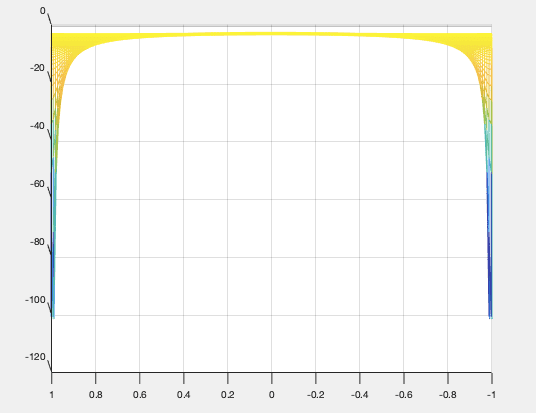
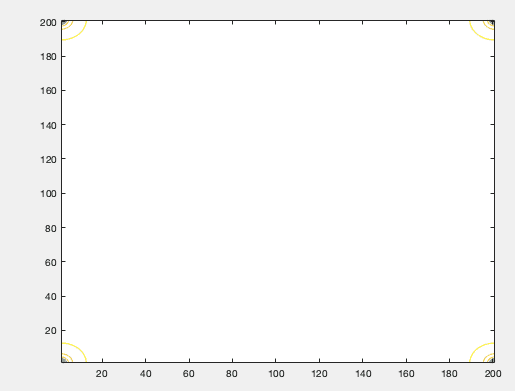
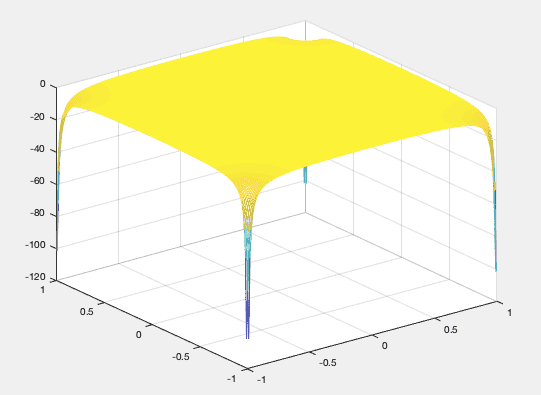
Now. If I plotted it correctly I get something like this:
243082


243083

243084


Which clearly has a maximum.

Now consider a circle centered at the origin but smaller than the square so that it contains no charges. Here I can write the Laplace equation:
$$\Delta V = 0$$
$$ + \text{boundary conditions}$$

A particular property of solutions of the Laplace equation is that they can have no local minimum or maximum: al extrema must occur at the boundary. This follows from the property of harmonic functions.

What am I doing wrong here ?

Thanks fro the help.
 
Last edited:
Physics news on Phys.org
wikipedia said:
other than the exceptional case where f is constant
work out ##V(0,0)## and conclude that ##{\partial^2 V\over\partial x^2} = 0## (idem ##y##) there !

[edit] o:) I missed a ##{1/over 2}## -- twice -- so I ended up with non-zero. Puzzled...

btw: nice picture :smile:
And I dont's see the ##\pm \sqrt 2##, just ##\pm 1## :rolleyes:
 
Last edited:
BvU said:
And I dont's see the ±√2±2\pm \sqrt 2, just ±1±1\pm 1 :rolleyes:

Sorry, I corrected the graphs. It looks flatter but numerically I'm still able to find a maximum value at the origin.

BvU said:
work out ##V(0,0)## and conclude that ##{\partial^2 V\over\partial x^2} = 0## (idem ##y##) there !

[edit] o:) I missed a ##{1/over 2}## -- twice -- so I ended up with non-zero. Puzzled...

Sorry, I'm not following. Can you explain a little more please ?
 
I added the four ##V_i## at ##(\varepsilon,0)## and figured the ##\varepsilon## and ##\varepsilon^2## terms would vanish -- but they don't ...

Let the four charges be located at ##(1, 0), (0,1), (-1,0), (0,-1), ## then $$
V_i(\varepsilon,0)={1\over 1-\mathstrut\varepsilon}+{1\over \sqrt{1+\varepsilon^2}}+{1\over 1+\varepsilon}+ {1\over \sqrt{1+\varepsilon^2}}
$$

use Taylor and I'm left with ##4+\varepsilon^2\qquad## -- logical because of symmetry, but I expected 2nd and 3rd order terms to vanish ... they don't and that leaves me puzzled
 
dRic2 said:
A particular property of solutions of the Laplace equation is that they can have no local minimum or maximum: al extrema must occur at the boundary. This follows from the property of harmonic functions.

What am I doing wrong here ?
You are looking in only 2D for a function which is in 3D. If you plot the solution in the z direction you will see that the origin is not in fact a maximum, it is a saddle point. It is a maximum along lines parallel to x or y, but a minimum along lines parallel to z, thus it is a saddle point. The maxima and minima do indeed occur on the boundaries.

Here is a plot in x and z, where I plotted from -0.5 to +0.5 on each axis instead of -1 to +1 so that the shape is more visible. The same trend holds further out but it is harder to see.

saddle2.jpg
 
  • Like
Likes   Reactions: BvU and dRic2
I see. Thank you. But this leads me to think that I can't write a Laplace equation in 2 dimension for the the above problem, right ?
 
Kudos @Dale !

o:) to forget ##{\partial^2 V\over\partial z^2} < 0 ##
 
dRic2 said:
I see. Thank you. But this leads me to think that I can't write a Laplace equation in 2 dimension for the the above problem, right ?
Well, you certainly can write a Laplace equation in 2 dimensions, but I don't know how you would write Maxwell's equations in 2 spatial dimensions. Also, if you did write Maxwell's equations in 2 dimensions I don't know what the potential would look like and I don't know if it would still satisfy Laplace's equation (I suspect not). So the 2-D issue isn't actually with Laplace's equation but Maxwell's.
 
  • Like
Likes   Reactions: dRic2
Yes, I meant Laplace equation as a consequence of 1st maxwell equation (gauss equation) written for the potential instead.
 

Similar threads

  • · Replies 5 ·
Replies
5
Views
891
  • · Replies 3 ·
Replies
3
Views
754
  • · Replies 1 ·
Replies
1
Views
628
  • · Replies 29 ·
Replies
29
Views
2K
  • · Replies 7 ·
Replies
7
Views
5K
  • · Replies 4 ·
Replies
4
Views
2K
  • · Replies 1 ·
Replies
1
Views
2K
  • · Replies 11 ·
Replies
11
Views
2K
  • · Replies 3 ·
Replies
3
Views
581
  • · Replies 3 ·
Replies
3
Views
1K