Simple Voltaic Cell: Alessando Volta's Electrolytic Cell

  • Context: Undergrad 
  • Thread starter Thread starter sankalpmittal
  • Start date Start date
  • Tags Tags
    Cell
Click For Summary
SUMMARY

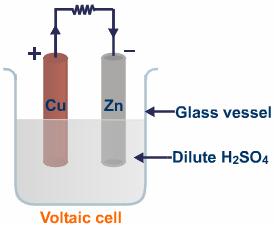
The discussion centers on the construction and functioning of a simple voltaic cell as described by Alessandro Volta. It highlights that Volta used an electrolytic cell filled with dilute sulfuric acid, connecting copper and zinc electrodes to create an electromotive force of approximately 1.10 V. The confusion arises around the polarity of the electrodes, with the textbook stating copper is positive and zinc is negative, while other sources suggest the opposite. The terminology of positive and negative charges originated from Benjamin Franklin, influencing how these electrodes are labeled in modern contexts.

PREREQUISITES
  • Understanding of basic electrochemistry concepts
  • Familiarity with electrode reactions and their roles in voltaic cells
  • Knowledge of electromotive force (EMF) calculations
  • Awareness of historical context regarding electrical terminology
NEXT STEPS
  • Research "Electrochemical series and electrode potentials" to understand electrode behavior
  • Study "Voltaic cell construction and operation" for practical applications
  • Explore "Benjamin Franklin's contributions to electrical terminology" for historical insights
  • Investigate "Half-reactions in electrochemistry" to clarify oxidation and reduction processes
USEFUL FOR

Students of chemistry, educators teaching electrochemistry, and anyone interested in the historical development of electrical concepts will benefit from this discussion.

sankalpmittal
Messages
785
Reaction score
27
In my reference textbook , it was written that while making a simple voltaic cell , Alessando Volta took an electrolytic cell made of glass ad partially filled it by dilute sulphuric acid acting as an electrolyte. Then he took a bulb (or any other resistor) or galvanometer of 1.08 V and connected it by means of insulated copper wire to two electrodes inside electrolyte - one electrode made of copper and other made of zinc. Then he "assumed in his own time" that copper electrode acquired positive charge while zinc electrode acquired negative charge.
voltaic-cell.jpe


My question is that firstly how can a voltaic cell work without connecting it to battery or cell ? Secondly how can he assume copper electrode to be positive and zinc electrode to be negative ? Why is it so ?
 
Physics news on Phys.org
Here is a video that explains the cell.

As the video states a chemical reaction occurs at the copper and at the zinc electrodes, giving an electromotive force between the electrodes.

The voltaic cell works as a cell. Your 1.5 volt dry cell is a voltaic cell working under the same principle but using different materials.

My question is that firstly how can a voltaic cell work without connecting it to battery or cell ?
It is a cell ( battery ) so you do not need to connect anything else.

Secondly how can he assume copper electrode to be positive and zinc electrode to be negative ? Why is it so ?
Take note that this is when the first experiments of electricity were being carried out, so he had to produce some terminology to decribe what was happening and he chose positive and negative, He could have just as well said the zinc and copper acquired square and round charges, or pink and blue charges. Apparantly the terms positive and negative are the terms we still use today.
 
sankalpmittal said:
In my reference textbook , it was written that while making a simple voltaic cell , Alessando Volta took an electrolytic cell made of glass ad partially filled it by dilute sulphuric acid acting as an electrolyte. Then he took a bulb (or any other resistor) or galvanometer of 1.08 V and connected it by means of insulated copper wire to two electrodes inside electrolyte - one electrode made of copper and other made of zinc. Then he "assumed in his own time" that copper electrode acquired positive charge while zinc electrode acquired negative charge.
Is this really said so in your textbook? Do you have a reference?
I mean, do they say that Volta took a bulb or galvanometer of 1.08 V(olts)?
The light bulb was not invented until almost 100 years after Volta invented his cell.
And also there were no galvanometers (electromagnetic effect discovered later) and no one (I suppose) was measuring tension in Volts, yet.
Maybe is just your mixture of information from various references?
 
256bits said:
Take note that this is when the first experiments of electricity were being carried out, so he had to produce some terminology to describe what was happening and he chose positive and negative, He could have just as well said the zinc and copper acquired square and round charges, or pink and blue charges. Apparantly the terms positive and negative are the terms we still use today.

I know this but why did he not say just the opposite that copper electrode is negatively charged and zinc electrode is positive. In my textbook it was also written that ionization potential of zinc is -0.76 V and of copper is +0.34 V . As -0.76 V<+0.34 V so zinc more readily donates electrons. That is why zinc is made negatively charged electrode as "-" charge on electrode means that it has excess of electrons so it donates them or it oxidizes ions. Am I correct ?

nasu said:
Is this really said so in your textbook? Do you have a reference?
I mean, do they say that Volta took a bulb or galvanometer of 1.08 V(olts)?
The light bulb was not invented until almost 100 years after Volta invented his cell.
And also there were no galvanometers (electromagnetic effect discovered later) and no one (I suppose) was measuring tension in Volts, yet.
Maybe is just your mixture of information from various references?

Sure ! It was written in my textbook and I cannot find any reference. And in my textbook it was also written that electromotive force in voltaic cell was 0.34-(-0.76) = 1.10 V which was more or less same as potential difference of resistor.
http://hyperphysics.phy-astr.gsu.edu/hbase/chemical/electrochem.html site says nothing of the sort which my textbook say.

Edit : This thread https://www.physicsforums.com/showthread.php?t=43836 explains a little bit of what I'm asking.
 
Last edited:
sankalpmittal said:
Sure ! It was written in my textbook and I cannot find any reference. And in my textbook it was also written that electromotive force in voltaic cell was 0.34-(-0.76) = 1.10 V which was more or less same as potential difference of resistor.
http://hyperphysics.phy-astr.gsu.edu/hbase/chemical/electrochem.html site says nothing of the sort which my textbook say.
Edit : This thread https://www.physicsforums.com/showthread.php?t=43836 explains a little bit of what I'm asking.
I did not question the information about the electromotive force of the cell. I was just curios if they really say that Volta took a light bulb and connected it to his cell, for example.
By reference, I mean "what textbook?". Is it a high school text?
 
nasu said:
I did not question the information about the electromotive force of the cell. I was just curios if they really say that Volta took a light bulb and connected it to his cell, for example.
By reference, I mean "what textbook?". Is it a high school text?

Yup , its a high school text of class 9th. I have just passed class 10th. I was just going through it again especially on the things which I failed to understand at that time. It was the book written by an Indian author -V.K. Sally , Goel publications. (saw no need to type this.)

There are somethings which I cannot understand like magnetism , voltaic cell etc..

I googled a lot and the sites hell further confuse the things. They say that zinc electrode is positive and copper one is negative which is opposite of what my textbook say ! Now two things (which carry extremely opposite views) cannot be correct simultaneously. Can they be ?
This is way too confusing for me ! Can someone clarify please ?
 
Last edited:
Sure ! It was written in my textbook and I cannot find any reference. And in my textbook it was also written that electromotive force in voltaic cell was 0.34-(-0.76) = 1.10 V which was more or less same as potential difference of resistor.
http://hyperphysics.phy-astr.gsu.edu...ectrochem.html site says nothing of the sort which my textbook say.

The 'hyperphysics' site says the copper electrode is positive, the zinc electrode is negative, and the cell potential is 1.10 volt. The picture of the cell shows electron flow from the zinc to copper, which is in opposite direction to standard current flow which is from positive to negative or from the copper to zinc electrode.
 
Last edited by a moderator:
sankalpmittal said:
Yup , its a high school text of class 9th. I have just passed class 10th. I was just going through it again especially on the things which I failed to understand at that time. It was the book written by an Indian author -V.K. Sally , Goel publications. (saw no need to type this.)

There are somethings which I cannot understand like magnetism , voltaic cell etc..

I googled a lot and the sites hell further confuse the things. They say that zinc electrode is positive and copper one is negative which is opposite of what my textbook say ! Now two things (which carry extremely opposite views) cannot be correct simultaneously. Can they be ?
This is way too confusing for me ! Can someone clarify please ?
Can you show links to some of these sites?
Wikipedia agrees with what you say is in your book, regarding the polarity. (Cu is positive).
The difference may have to do with the conventional direction of the current.
 
256bits said:
Take note that this is when the first experiments of electricity were being carried out, so he had to produce some terminology to decribe what was happening and he chose positive and negative, He could have just as well said the zinc and copper acquired square and round charges, or pink and blue charges. Apparantly the terms positive and negative are the terms we still use today.

Actually, the "positive" and "negative" terminology came from Benjamin Franklin, about fifty years before Volta's battery. He theorized that after rubbing certain objects together, one object becomes "positively charged" (has an excess of "electric fluid") and the other becomes "negatively charged" (has a deficit of "electric fluid"). He couldn't actually see the "electric fluid" flowing, so he had to guess which objects were positive and which were negative, making them consistent with whether they attracted or repelled each other. Other scientists adopted his terminology, and surely Volta labeled the terminals of his battery correspondingly, according to whether they attracted or repelled positively or negatively charged objects.
 
  • #10
256bits said:
The 'hyperphysics' site says the copper electrode is positive, the zinc electrode is negative, and the cell potential is 1.10 volt. The picture of the cell shows electron flow from the zinc to copper, which is in opposite direction to standard current flow which is from positive to negative or from the copper to zinc electrode.

Yes , I found that but it confuses things which my textbook say and also which I studied since very long time. According to my knowledge "cathode" is negatively charged electrode and here is where , the reduction occurs. So it is reducing electrode as it reduces positive ions to metals with itself being oxidized. Similarly "anode" is positively charged electrode where oxidation occurs. It oxidizes negative ions to neutral atoms with itself being reduced.
Also sometimes anode itself ionizes if its reactive such as copper (according to textbook.)

From hyperphysics : Zn(s) -> Zn2+(aq) + 2e-

The zinc "half-reaction" is classified as oxidation since it loses electrons. The terminal at which oxidation occurs is called the "anode". For a battery, this is the negative terminal.

The copper "half-reaction" is classified as reduction since it gains electrons. The terminal at which reduction occurs is called the "cathode". For a battery, this is the positive terminal.


Cu2+(aq) + 2e- -> Cu(s)


This seems to say opposite of what the textbook say ! Can someone explain ?

nasu said:
Can you show links to some of these sites?
Wikipedia agrees with what you say is in your book, regarding the polarity. (Cu is positive).
The difference may have to do with the conventional direction of the current.

http://www.d-ddm.mb.edus.si/ec/voltaic_cell.htm
http://group.chem.iastate.edu/Green...der/flashfiles/electroChem/voltaicCell20.html
http://www.chem.wisc.edu/deptfiles/genchem/netorial/ROttosen/tutorial/modules/electrochemistry/03voltaic_cells/18_31.htm
http://dl.clackamas.cc.or.us/ch105-09/voltaic.htm

jtbell said:
Actually, the "positive" and "negative" terminology came from Benjamin Franklin, about fifty years before Volta's battery. He theorized that after rubbing certain objects together, one object becomes "positively charged" (has an excess of "electric fluid") and the other becomes "negatively charged" (has a deficit of "electric fluid"). He couldn't actually see the "electric fluid" flowing, so he had to guess which objects were positive and which were negative, making them consistent with whether they attracted or repelled each other. Other scientists adopted his terminology, and surely Volta labeled the terminals of his battery correspondingly, according to whether they attracted or repelled positively or negatively charged objects.

Did he rub zinc with copper ? Zinc has more loosely bound free electrons than copper. So according to this zinc must be positive electrode and copper negative one. But just the opposite is happening in the "textbook" describing the first simple voltaic cell.

Do you people want me to quote whole of the description from my textbook ?
 
Last edited by a moderator:

Similar threads

Replies
4
Views
2K
  • · Replies 7 ·
Replies
7
Views
2K
  • · Replies 23 ·
Replies
23
Views
5K
  • · Replies 12 ·
Replies
12
Views
1K
  • · Replies 2 ·
Replies
2
Views
3K
  • · Replies 26 ·
Replies
26
Views
4K
  • · Replies 14 ·
Replies
14
Views
5K
  • · Replies 2 ·
Replies
2
Views
2K
  • · Replies 3 ·
Replies
3
Views
2K
Replies
20
Views
4K