Slashed fraction instead of vertical one

  • Context:
  • Thread starter Thread starter TheBigBadBen
  • Start date Start date
  • Tags Tags
    Fraction Vertical
Join the discussion
Registration is free. Ask a follow-up in this thread, or start your own.
13 replies · 15K views
TheBigBadBen
Messages
79
Reaction score
0
Is there any way to nicely LaTeX a "slashed" fraction? In other words, if I want to write $a_1/a_2$ instead of $\frac{a_1}{a_2}$ or even $\dfrac{a_1}{a_2}$, is there a way to make it look nice?
 
Physics news on Phys.org
You mean like $$^{a_1}\!\!/\!_{a_2}$$?

It turns out that in real $\LaTeX$, you can use
Code:
\documentclass{article}
\usepackage{units}
\begin{document}

$\nicefrac{a_1}{a_2}$

\end{document}
which looks like:
 

Attachments

  • slashed_fraction.png
    slashed_fraction.png
    242 bytes · Views: 161
Last edited:

Attachments

  • Screen Shot 2013-06-06 at 11.00.02 PM.png
    Screen Shot 2013-06-06 at 11.00.02 PM.png
    540 bytes · Views: 164
Last edited:
TheBigBadBen said:
Is there any way to nicely LaTeX a "slashed" fraction? In other words, if I want to write $a_1/a_2$ instead of $\frac{a_1}{a_2}$ or even $\dfrac{a_1}{a_2}$, is there a way to make it look nice?
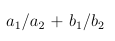
What exactly is ugly about $a_1/a_2$, i.e., what do you want to change? The nicefrac package makes the numerator and denominator smaller and moves them closer to the slash; that's what is calls "nice" as opposed to fractions with regular slash, which it calls "ugly". This is debatable. The StackOverflow method simply makes the height of the slash equal to the height of its arguments.

And how is $a_1/a_2$ different from the following example?

TheBigBadBen said:
A sample result:

View attachment 872

The TeXbook does not recommend any special care with slash in fractions. There is a subtlety, though:

"TEX does not treat $/$ as a binary operation, even though a slash stands for division (which qualifies as a binary operation on mathematical grounds). The reason is that printers traditionally put extra space around the symbols $+$, $−$, and $*$, but not around $/$. If TEX were to typeset $/$ as a binary operation, the formula ‘\$1/2\$’ would come out ‘$1\mathbin{/}2$’, which is wrong; so TEX considers $/$ to be an ordinary symbol."

Another advice from the TeXbook is not to overuse \frac (or, rather, \over in plain TeX). E.g., instead of $\dfrac{\frac{a}{b}}{2}$ it is recommended to type $\dfrac{a/b}{2}$.
 
Evgeny.Makarov said:
Another advice from the TeXbook is not to overuse \frac (or, rather, \over in plain TeX). E.g., instead of $\dfrac{\frac{a}{b}}{2}$ it is recommended to type $\dfrac{a/b}{2}$.
That applies especially in exponents. I always write $x^{1/2}$ in preference to $x^{\frac12}$, also $$\int_{-\pi/2}^{\pi/2}f(t)\,dt$$ rather than $$\int_{-\frac\pi2}^{\frac\pi2}f(t)\,dt$$.
 
Evgeny.Makarov said:
What exactly is ugly about $a_1/a_2$, i.e., what do you want to change? The nicefrac package makes the numerator and denominator smaller and moves them closer to the slash; that's what is calls "nice" as opposed to fractions with regular slash, which it calls "ugly". This is debatable. The StackOverflow method simply makes the height of the slash equal to the height of its arguments.

What annoys me is that the size of the slash doesn't adjust to the size of the numerator and denominator. To me, ${a_1}^2/{B_1^2}$ does not look pretty. I think the StackOverflow method captures my aesthetics.

I think I like Serena's approach is probably what I'll use here.
 
If you are really worried about the aesthetics, you could always do something like this:

Code:
\newcommand{\name}{% name is whatever you want to call it   
   \leavevmode   
   \begingroup   
   \setbox 2 = \hbox {\small \(a_1\)}%   
   \setbox 0 = \hbox {/}%   
   \dimen 0 = \ht 0  \advance \dimen 0 by -\ht 2   
   \raise \dimen 0 \box 2   
   \kern -0.3333\wd0/\kern -0.3333\wd 0   
   \lower \dp 0 \hbox {\small \(a_2\)}%   
   \endgroup 
}
\begin{document}
something \name\space something
\end{document}
 
I like Serena said:
Here's an overview, using MiKTeX.

http://www.mathhelpboards.com/attachment.php?attachmentid=875

I can't view your attachment
 
Anyway, here's the overview as far as it renders here.

\(

\newcommand{\slfrac}[2] { \left.#1\middle/#2\right. }

\verb|\newcommand{\ILS}[2] { ^{#1}\!\!/\!_{#2} }| \\
\newcommand{\ILS}[2] { ^{#1}\!\!/\!_{#2} }
\verb|\newcommand{\dILS}[2] { ^{ \displaystyle #1}\!\!/\!_{ \displaystyle #2} }| \\
\newcommand{\dILS}[2] { ^{ \displaystyle #1}\!\!/\!_{ \displaystyle #2} }
\verb|\newcommand{\xILS}[2] { \left. ^{ \displaystyle #1}\!\!\middle/\!_{ \displaystyle #2} \right. }| \\
\newcommand{\xILS}[2] { \left. ^{ \displaystyle #1}\!\!\middle/\!_{ \displaystyle #2} \right. }

\begin{array}{|l|ccc|}
\hline \\
\verb|\frac{#1}{#2}| & \frac{1}{2} & \frac{a_1}{a_2} & \frac{a_1^2}{B_1^2} \\ \\
\verb|\dfrac{#1}{#2}| & \dfrac{1}{2} & \dfrac{a_1}{a_2} & \dfrac{a_1^2}{B_1^2} \\ \\
\verb|#1/#2| & 1/2 & a_1/a_2 & a_1^2/B_1^2 \\ \\
\verb|\left.#1\middle/#2\right.| & \slfrac{1}{2} & \slfrac{a_1}{a_2} & \slfrac{a_1^2}{B_1^2}\\ \\
\verb|\ILS{#1}{#2}| & \ILS{1}{2} & \ILS{a_1}{a_2} & \ILS{a_1^2}{B_1^2}\\ \\
\verb|\dILS{#1}{#2}| & \dILS{1}{2} & \dILS{a_1}{a_2} & \dILS{a_1^2}{B_1^2}\\
\verb|\xILS{#1}{#2}| & \xILS{1}{2} & \xILS{a_1}{a_2} & \xILS{a_1^2}{B_1^2}\\
\hline
\end{array}

\)
 
Last edited:
Let me retry the attachment.
I was fiddling with it before to get it to show neatly.

http://www.mathhelpboards.com/attachment.php?attachmentid=877&d=1370685379
 

Attachments

  • slashed_fractions.png
    slashed_fractions.png
    5 KB · Views: 136
So before, the attachment just showed up as a "couldn't load image" error at that spot before. Not sure what happened there. At any rate, I can see your latest post just fine. Thank you for the table! I stand by my aesthetic opinion here, so \middle/ seems to work best for me. I think that's what I'm going to be using from now on, if it comes up; I think it will look better for nested fractions too.
 
Last edited: