Smallest Sigma Algebra .... Axler, Example 2.28 ....

  • Context: Undergrad 
  • Thread starter Thread starter Math Amateur
  • Start date Start date
  • Tags Tags
    Algebra Example Sigma
Click For Summary
SUMMARY

The discussion centers on verifying Example 2.28 from Sheldon Axler's "Measure, Integration & Real Analysis," specifically regarding the smallest σ-algebra on a set X containing a collection of singletons A. Participants confirm that the set S, defined as S = {E ⊆ X: |E| < ∞ or |E^c| < ∞}, is indeed a σ-algebra containing A. They establish that S is the smallest σ-algebra containing A by demonstrating that it satisfies the necessary properties of a σ-algebra and includes all countable subsets of X and their complements.

PREREQUISITES
  • Understanding of σ-algebras in measure theory
  • Familiarity with countable sets and their properties
  • Knowledge of the concepts of set complements and unions
  • Basic grasp of the definitions and properties of measures
NEXT STEPS
  • Study the properties of σ-algebras in detail
  • Learn about the construction of σ-algebras generated by collections of sets
  • Explore examples of countable and uncountable sets in measure theory
  • Investigate the implications of the Borel σ-algebra in real analysis
USEFUL FOR

Mathematicians, students of measure theory, and anyone studying real analysis who seeks to understand the foundational concepts of σ-algebras and their applications in measure theory.

Math Amateur
Gold Member
MHB
Messages
3,920
Reaction score
48
TL;DR
I need help in order to make a meaningful start on verifying the first part of Axler, Example 28 ...
I am reading Sheldon Axler's book: Measure, Integration & Real Analysis ... and I am focused on Chapter 2: Measures ...

I need help in order to make a meaningful start on verifying the first part of Axler, Example 28 ...

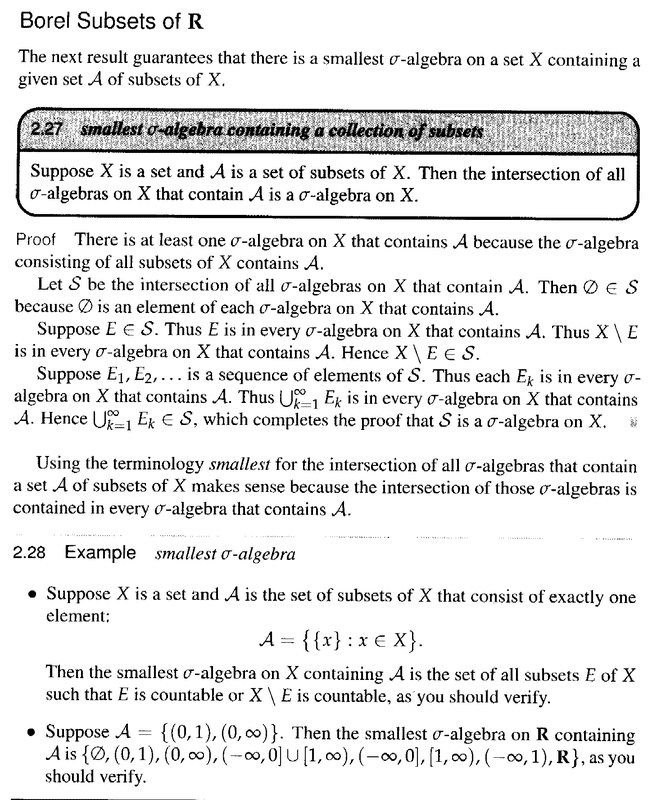
The relevant text reads as follows:
Axler - Borel Subsets of R ... including Example 2.28 .png
Can someone please help me to make a meaningful start on verifying Example 2,28 ... that is, to show that the smallest ##\sigma##-algebra on ##X## containing ##\mathcal{A}## is the set of all subsets ##E## of ##X## such that ##E## is countable or ##X \setminus E## is countable ... ...
Help will be much appreciated ...

Peter
 
Physics news on Phys.org
You should show an attempt.

Can you at least show that ##\mathcal{S}:=\{E \subseteq X: E \mathrm{\ countable \ or \ E^c \ countable}\}## is a ##\sigma##-algebra containing ##\mathcal{A}##? Why is it the smallest?
 
Last edited by a moderator:
  • Like
Likes   Reactions: Math Amateur
Math_QED said:
You should show an attempt.

Can you at least show that ##\mathcal{S}:=\{E \subseteq X: |E| < \infty \lor |E^c| < \infty\}## is a ##\sigma##-algebra containing ##\mathcal{A}##? Why is it the smallest?
Given that ##X## is a set and ##\mathcal{A} = \{ \{ x \} : x \in X \}## ... ...

Require to demonstrate that ##\mathcal{S}:=\{E \subseteq X: |E| < \infty \lor |E^c| < \infty\}## is a ##\sigma##-algebra containing ##\mathcal{A}##Proof:

First show that ##\mathcal{S}## contains ##\mathcal{A}## ...

Now ##E \subseteq \mathcal{A} \Longrightarrow E = \{ x \}## for some ##x \in X## ...

... ##\Longrightarrow \mid E \mid = 0 \lt \infty##

... ##\Longrightarrow E \subseteq \mathcal{S}##
Now ... show ##\mathcal{S}## is a ##\sigma##-algebra ...

##\bullet## Require ##\emptyset \in \mathcal{S}## ...

... suppose ##E = \emptyset## ...

... then ##\mid E \mid = 0 \lt \infty## ...

... so ##\emptyset \in \mathcal{S}## ...##\bullet## Require that if ##E \in \mathcal{S}## then ##E^c \in \mathcal{S}## ...

Suppose ##E \in \mathcal{S}## ...

Then ##E^c \in \mathcal{S}## ... since ##\mid E^c \mid = 0 \lt \infty## or ##\mid (E^c)^c \mid = \mid E \mid \lt \infty## ... one of which is true since ##E \in \mathcal{S}## ...

... so ##E \in \mathcal{S}## then ##E^c \in \mathcal{S}## ...
##\bullet## Require that if ##E_1, E_2##, ... ... is a sequence of elements of ##\mathcal{S}## ... then ##\bigcup_{ k = 1 }^{ \infty } \in \mathcal{S}## ...

Assume that ##E_1, E_2##, ... ... is a sequence of elements of ##\mathcal{S}## ...

Then ##\mid E_1 \mid = n_1 \lt \infty## ... or ... ##\mid E_1^c \mid = m_1 \lt \infty## ... ...

... and ##\mid E_2 \mid = n_2 \lt \infty## ... or ... ##\mid E_2^c \mid = m_2 \lt \infty## ... ...

.. and so on ...

... But how to proceed from here ...?

Can you help further ...?

Peter

===========================================================================

My thoughts on proceeding ...We could divide ##E_1, E_2##, ... ... into two subsequences ##E_{k_1}, E_{k_2}##, ... and ##E_{h_1}, E_{h_2}, ...## where the subsequence ##E_{k_1}, E_{k_2}##, ... is composed of all those elements of ##\mathcal{S}## ... where ##\mid E_k \mid \lt \infty## ... and where the subsequence ##E_{h_1}, E_{h_2}##, ... is composed of all those elements of ##\mathcal{S}## ... where ##\mid E_k^c \mid \lt \infty## ... and try to show using countable additivity that the unions of the elements of both subsequences are less than infinity and try to relate these results to the union of the elements of E_1, E_2, ... ...
 
Last edited:
  • Like
Likes   Reactions: member 587159
I'm very sorry. I made a mistake in my definition of ##\mathcal{S}## in post #2 (now fixed), which is probably why your attempt doesn't work because my definition of ##\mathcal{S}## contained a mistake. I guess that happens when I give hints without writing down anything on paper ;)

But as you observed correctly, the crux is to show that if ##(E_n)_n## is a sequence in ##\mathcal{S}##, then ##E:=\bigcup_n E_n## is also in ##\mathcal{S}##.

Let us show this. Supose that ##E_n## is countable for all ##n##, then ##E## is also countable since countable unions of countable sets remain countable. In that case we are done. In the other case, there exists ##m## such that ##E_m^c## is countable! But then ##E^c = \bigcap_n E_n^c \subseteq E_m^c## is countable so again ##E \in \mathcal{S}##. The other axioms of ##\sigma##-algebra are trivially satisfied and I won't write them down anymore.

Hence, we have established that ##\mathcal{S}## is a ##\sigma##-algebra containing ##\mathcal{A}##. This implies that the ##\sigma##-algebra generated by ##\mathcal{A}##, write it as ##\mathcal{M}(\mathcal{A})##, is contained in ##\mathcal{S}##, that is ##\mathcal{M}(\mathcal{A}) \subseteq \mathcal{S}## (why?).

Now, you also have to show that the other inclusion ##\mathcal{S}\subseteq \mathcal{M}(\mathcal{A})## holds. Can you see why that is true?
 
Last edited by a moderator:
Math_QED said:
I'm very sorry. I made a mistake in my definition of ##\mathcal{S}## in post #2 (now fixed), which is probably why your attempt doesn't work because my definition of ##\mathcal{S}## contained a mistake. I guess that happens when I give hints without writing down anything on paper ;)

But as you observed correctly, the crux is to show that if ##(E_n)_n## is a sequence in ##\mathcal{S}##, then ##E:=\bigcup_n E_n## is also in ##\mathcal{S}##.

Let us show this. Supose that ##E_n## is countable for all ##n##, then ##E## is also countable since countable unions of countable sets remain countable. In that case we are done. In the other case, there exists ##m## such that ##E_m^c## is countable! But then ##E^c = \bigcap_n E_n^c \subseteq E_m^c## is countable so again ##E \in \mathcal{S}##. The other axioms of ##\sigma##-algebra are trivially satisfied and I won't write them down anymore.

Hence, we have established that ##\mathcal{S}## is a ##\sigma##-algebra containing ##\mathcal{A}##. This implies that the ##\sigma##-algebra generated by ##\mathcal{A}##, write it as ##\mathcal{M}(\mathcal{A})##, is contained in ##\mathcal{S}##, that is ##\mathcal{M}(\mathcal{A}) \subseteq \mathcal{S}## (why?).

Now, you also have to show that the other inclusion ##\mathcal{S}\subseteq \mathcal{M}(\mathcal{A})## holds. Can you see why that is true?
No problem ...

I have to say your help has been invaluable to me ...

Reflecting on what you have written ...

Thanks again ...

Peter
 
Math_QED said:
I'm very sorry. I made a mistake in my definition of ##\mathcal{S}## in post #2 (now fixed), which is probably why your attempt doesn't work because my definition of ##\mathcal{S}## contained a mistake. I guess that happens when I give hints without writing down anything on paper ;)

But as you observed correctly, the crux is to show that if ##(E_n)_n## is a sequence in ##\mathcal{S}##, then ##E:=\bigcup_n E_n## is also in ##\mathcal{S}##.

Let us show this. Supose that ##E_n## is countable for all ##n##, then ##E## is also countable since countable unions of countable sets remain countable. In that case we are done. In the other case, there exists ##m## such that ##E_m^c## is countable! But then ##E^c = \bigcap_n E_n^c \subseteq E_m^c## is countable so again ##E \in \mathcal{S}##. The other axioms of ##\sigma##-algebra are trivially satisfied and I won't write them down anymore.

Hence, we have established that ##\mathcal{S}## is a ##\sigma##-algebra containing ##\mathcal{A}##. This implies that the ##\sigma##-algebra generated by ##\mathcal{A}##, write it as ##\mathcal{M}(\mathcal{A})##, is contained in ##\mathcal{S}##, that is ##\mathcal{M}(\mathcal{A}) \subseteq \mathcal{S}## (why?).

Now, you also have to show that the other inclusion ##\mathcal{S}\subseteq \mathcal{M}(\mathcal{A})## holds. Can you see why that is true?
We have that ##X## is a set and ##\mathcal{A}## is the set of subsets of ##X## that contain exactly one element of ##X##; that is

##\mathcal{A} = \{ \{ x \} : x \in X \}##

Now the ##\sigma##-algebra of ##X## generated by ##\mathcal{A}##, denoted ##\mathcal{M}(\mathcal{A})##, is the intersection of all ##\sigma##-algebras of ##X## that contain ##\mathcal{A}##.

Therefore, given ##\mathcal{S}## is a ##\sigma##-algebra of ##X## that contains ##\mathcal{A}##, we have that ##\mathcal{M}(\mathcal{A}) \subseteq \mathcal{S}## ...

But ... ##\mathcal{M}(\mathcal{A})## is a ##\sigma##-algebra of X that contains ##\mathcal{A}## ... and so contains all the countable subsets of ##X## and their complements ... so ##\mathcal{S}\subseteq \mathcal{M}(\mathcal{A})##...is that correct ... ?

Peter
 

Similar threads

  • · Replies 5 ·
Replies
5
Views
2K
  • · Replies 3 ·
Replies
3
Views
2K
  • · Replies 2 ·
Replies
2
Views
1K
  • · Replies 2 ·
Replies
2
Views
4K
  • · Replies 2 ·
Replies
2
Views
3K
  • · Replies 2 ·
Replies
2
Views
2K
  • · Replies 8 ·
Replies
8
Views
4K
  • · Replies 3 ·
Replies
3
Views
1K
  • · Replies 1 ·
Replies
1
Views
2K
  • · Replies 2 ·
Replies
2
Views
2K