Undergrad Solar system simulation errors

Click For Summary
The discussion revolves around the inaccuracies in a solar system simulator created in Python, where the user is comparing simulation results with NASA's Horizon data. The user employs a Verlet integrator but is uncertain about its correctness and the initial values used for the celestial bodies. Despite testing various time steps, discrepancies in the simulated orbits of Earth and Mars persist, suggesting potential issues with gravitational force calculations. Suggestions include ensuring the net force on each planet is computed correctly and considering alternative integration methods for troubleshooting. The consensus is that the problem likely lies in the initial values or force calculations rather than the integrator itself.
madsmh
Messages
32
Reaction score
2
Hi, as a side project I am making a solar system simulator in Python, but I am getting extreme inaccuracies.
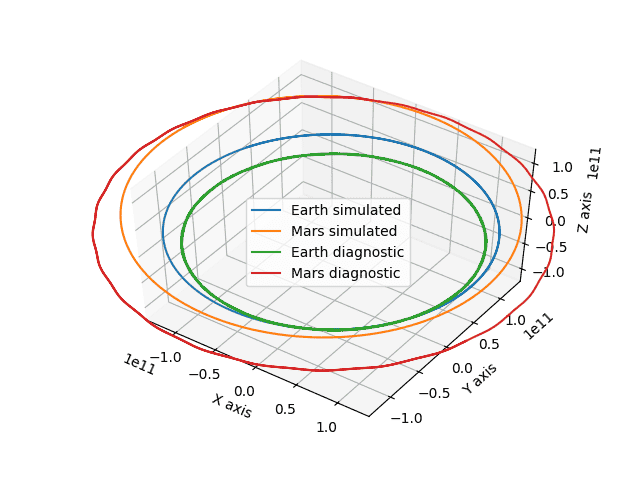
diagnostic.png

As the image shows - I am comparing the simulation to data obtained from NASA's Horizon.

I have written a a basic Verlet integrator in the Python class posten below:
Python:
import numpy as npclass Body:
    """A celestial body class, with all initial values in SI units """

    def __init__(self, name, x0, y0, z0, vx0, vy0, vz0, gm, radius):

        # Gravitational parameter
        self.GM = gm

        # Name of the body (string)
        self.name = name

        # Initial position of the body (m)
        self.x0 = x0
        self.y0 = y0
        self.z0 = z0

        # Position (m). Set to initial value.
        self.x = self.x0
        self.y = self.y0
        self.z = self.z0

        # Initial velocity of the body (m/s)
        self.vx0 = vx0
        self.vy0 = vy0
        self.vz0 = vz0

        # Velocity (m/s). Set to initial value.
        self.vx = self.vx0
        self.vy = self.vy0
        self.vz = self.vz0

        # Radius of the body (m)
        self.radius = radius

        # Storage of last integration results
        self.last_coords = np.zeros(shape=(2, 3), dtype=float)

        # Integration counter
        self.i = 0

    def compute_acceleration(self, x, y, z):
        """Computes the gravitational acceleration due to self at position (x, y) (m)"""
        # Deltas
        delta_x = self.x - x
        delta_y = self.y - y
        delta_z = self.z - z

        # Deltas squared
        delta_x2 = delta_x ** 2
        delta_y2 = delta_y ** 2
        delta_z2 = delta_z ** 2

        # Acceleration in the x-direction (m/s^2)
        ax = self.GM / (delta_x2 + delta_y2 + delta_z2) * \
            delta_x / np.sqrt(delta_x2 + delta_y2 + delta_z2)

        # Acceleration in the y-direction (m/s^2)
        ay = self.GM / (delta_x2 + delta_y2 + delta_z2) * \
            delta_y / np.sqrt(delta_x2 + delta_y2 + delta_z2)

        # Acceleration in the z-direction (ms/s^2)
        az = self.GM / (delta_x2 + delta_y2 + delta_z2) * \
            delta_z / np.sqrt(delta_x2 + delta_y2 + delta_z2)

        return np.array([ax, ay, az])

    def step(self, dt, targets):
        """Verlet integrator"""

        # dt squared
        dt2 = dt ** 2
        x0 = np.array([self.x0, self.y0, self.z0])
        v0 = np.array([self.vx0, self.vy0, self.vz0])

        if self.i == 0:

            self.x = x0[0]
            self.y = x0[1]
            self.z = x0[2]

            self.last_coords[0][:] = x0

        elif self.i == 1:

            a = np.zeros(shape=3, dtype=float)
            for o in targets:
                a += o.compute_acceleration(x0[0], x0[1], x0[2])

            x1 = x0 + v0 * dt + 0.5 * dt2 * a

            self.x = x1[0]
            self.y = x1[1]
            self.z = x1[2]

            self.last_coords[1][:] = x1

        elif (self.i % 2) == 0:
            xnminusone = self.last_coords[0][:]
            xn = self.last_coords[1][:]

            a = np.zeros(shape=3, dtype=float)

            for o in targets:
                a += o.compute_acceleration(xn[0], xn[1], xn[2])

            xnplusone = 2 * xn - xnminusone + dt2 * a

            self.x = xnplusone[0]
            self.y = xnplusone[1]
            self.z = xnplusone[2]

            self.last_coords[0][:] = xnplusone
        elif (self.i % 2) != 0:
            xnminusone = self.last_coords[1][:]
            xn = self.last_coords[0][:]

            a = np.zeros(shape=3, dtype=float)

            for o in targets:
                a += o.compute_acceleration(xn[0], xn[1], xn[2])

            xnplusone = 2 * xn - xnminusone + dt2 * a

            self.x = xnplusone[0]
            self.y = xnplusone[1]
            self.z = xnplusone[2]

            self.last_coords[1][:] = xnplusone

        self.i += 1

And then calling the Body.step() method for each planet individially - but I am unsure whether this is the correct approach. Any advice would be welcome.
 
Physics news on Phys.org
The main loop is missing.
What is the time step?

Are you sure the initial values are accurate and used correctly?
 
mfb said:
The main loop is missing.
What is the time step?

Are you sure the initial values are accurate and used correctly?

The initial values are from the same dataset as the diagnostics. The main loop is given below:
Python:
def gen_coords():
    if not os.path.exists('trajectories/'):
        os.makedirs('trajectories/')
    # Generate coordinates and save to file

    # NumPy arrays for coordinates
    trajectory_earth = np.zeros(shape=(n, 3))
    trajectory_mars = np.zeros(shape=(n, 3))
    trajectory_venus = np.zeros(shape=(n, 3))
    trajectory_jupiter = np.zeros(shape=(n, 3))
    trajectory_mercury = np.zeros(shape=(n, 3))
    trajectory_sun = np.zeros(shape=(n, 3))
    trajectory_saturn = np.zeros(shape=(n, 3))
    trajectory_uranus = np.zeros(shape=(n, 3))
    trajectory_neptune = np.zeros(shape=(n, 3))
    trajectory_pluto = np.zeros(shape=(n, 3))

    for i in range(n):
        trajectory_earth[i][0] = earth.x
        trajectory_earth[i][1] = earth.y
        trajectory_earth[i][2] = earth.z

        trajectory_mars[i][0] = mars.x
        trajectory_mars[i][1] = mars.y
        trajectory_mars[i][2] = mars.z

        trajectory_venus[i][0] = venus.x
        trajectory_venus[i][1] = venus.y
        trajectory_venus[i][2] = venus.z

        trajectory_jupiter[i][0] = jupiter.x
        trajectory_jupiter[i][1] = jupiter.y
        trajectory_jupiter[i][2] = jupiter.z

        trajectory_mercury[i][0] = mercury.x
        trajectory_mercury[i][1] = mercury.y
        trajectory_mercury[i][2] = mercury.z

        trajectory_sun[i][0] = sun.x
        trajectory_sun[i][1] = sun.y
        trajectory_sun[i][2] = sun.z

        trajectory_saturn[i][0] = saturn.x
        trajectory_saturn[i][1] = saturn.y
        trajectory_saturn[i][2] = saturn.z

        trajectory_uranus[i][0] = uranus.x
        trajectory_uranus[i][1] = uranus.y
        trajectory_uranus[i][2] = uranus.z

        trajectory_neptune[i][0] = neptune.x
        trajectory_neptune[i][1] = neptune.y
        trajectory_neptune[i][2] = neptune.z

        trajectory_pluto[i][0] = pluto.x
        trajectory_pluto[i][1] = pluto.y
        trajectory_pluto[i][2] = pluto.z

        earth.step(dt, earth_array)
        mars.step(dt, mars_array)
        venus.step(dt, venus_array)
        jupiter.step(dt, jupiter_array)
        mercury.step(dt, mercury_array)
        sun.step(dt, sun_array)
        saturn.step(dt, saturn_array)
        uranus.step(dt, uranus_array)
        neptune.step(dt, neptune_array)
        pluto.step(dt, pluto_array)

np.savetxt("trajectories/earth.gz", trajectory_earth, delimiter=',')
np.savetxt("trajectories/mars.gz", trajectory_mars, delimiter=',')
np.savetxt("trajectories/venus.gz", trajectory_venus, delimiter=',')
np.savetxt("trajectories/jupiter.gz", trajectory_jupiter, delimiter=',')
np.savetxt("trajectories/mercury.gz", trajectory_mercury, delimiter=',')
np.savetxt("trajectories/sun.gz", trajectory_sun, delimiter=',')
np.savetxt("trajectories/saturn.gz", trajectory_saturn, delimiter=',')
np.savetxt("trajectories/uranus.gz", trajectory_uranus, delimiter=',')
np.savetxt("trajectories/neptune.gz", trajectory_neptune, delimiter=',')
np.savetxt("trajectories/pluto.gz", trajectory_pluto, delimiter=',')

print('Trajectories generated and saved to file')

The image is with a timestep of dt = 86400 seconds (24 hrs) but I have tested down to dt = 86400/256 and there was no visible improvement.
 
Diagnostic is from actual positions at different times? It looks like Mars is too slow and Earth is too fast. That rules out a wrong GM as source.
madsmh said:
The initial values are from the same dataset as the diagnostics.
That doesn't answer my question, as the speed doesn't enter the diagnostics data if I understand that dataset correctly.
 
The initial values for the simulations, x, y, z position and velocities in all three dimensions, are the first entries in the two diagnostic data sets. The simulator does not estimate the velocities, even though the diagnostic data set does include velocities. The two diagnostic data sets where I got the initial values, covers the same time period. In the image I posted the timesteps in the two data sets were identical - 24 hrs. I can only assume that the data provided by Nasa is accurate.
 
I noted that the diameter of the orbit is smaller in both cases. Was wondering if you had correct value for G or wrong calculation for the gravitational force or something like that? I'm not a programmer (Python or otherwise) but are you using gm for the gravitational force or GMm/r2 or ??

Sorry if that's way off beam.

Edit: Actually I'm wrong. The simulated orbit for Earth is bigger but the simulated orbit for Mars is smaller.
 
CWatters said:
I noted that the diameter of the orbit is smaller in both cases. Was wondering if you had correct value for G or wrong calculation for the gravitational force or something like that? I'm not a programmer (Python or otherwise) but are you using gm for the gravitational force or GMm/r2 or ??

Sorry if that's way off beam.

Edit: Actually I'm wrong. The simulated orbit for Earth is bigger but the simulated orbit for Mars is smaller.

I am using GM, I rechecked the values and they seem correct. Thanks for the suggestion :)
 
Hi there. It's not clear to me how you're computing the force on each body. Remember that you have to compute the net force on a planet due to all other planets and the sun at each instant in time. My advice would be create a matrix whose elements are the force vectors on each pairs of objects. For instance the (1,2) element would be (vector) force on 1st object due to second object. By Newton's 3rd law you can immediately conclude that the matrix should be anti-symmetric. And if you want to the net force on anybody (say ith body) you just sum up all elements in ith row. Make sense? The force matrix needs to be updated every timestep.

It would be more useful to present your code structure rather than the code itself because it would be easier for us to read and critique. The structure of your code should look something like this -

1) The Main program where you will run the simulation (i.e. the time integration)
2) A planet class whose each instance defines a particular body (i.e. a mass a name to label the planet and the dynamic info (position, velocity) at each instant of time). You should have a series of methods in this class to compute things like the K.E. (if required), the acceleration (given the net force on the object),
3) A Solar system class whose single instance consists of a number of instances of the planet class. This class defines your system.
 
  • Like
Likes madsmh
madsmh said:
I have written a a basic Verlet integrator [...]

In order to test if the problem comes from the integrator or not, I suggest to replace it with another simple method (e.g. Euler) and then to check if the error remains.
 
  • #10
Thinking aloud.. if the problem was the integrator would you expect to get a spiral rather than a closed eclipse?
 
  • #11
CWatters said:
if the problem was the integrator would you expect to get a spiral rather than a closed eclipse?

I don't think that speculations about the expected output of integrators with unknown errors are a useful strategy to solve this problem.
 
  • #12
No I agree, trying a different integrator as you suggested is the way to go.
 
  • #13
Hi all.
Before I tried Verlet, I had written a RK4 integrator where I got the same results.
I have rewritten the program and (still) get the same results. Would it be helpful for me to post the code for the new integrator (still Verlet) here, or should I post it on the programming forum?
 
  • #14
I still think it is a problem with the initial values. It would help if you could post them.

Do the other planets have similar issues?
 
  • #15
madsmh said:
Before I tried Verlet, I had written a RK4 integrator where I got the same results.

That makes it very unlikely that the problem results from the integrator. The remaining code also seems to be OK. The error is most likely somewhere else. Maybe in the initialisation or in the starting values.
 
  • #16
mfb said:
I still think it is a problem with the initial values. It would help if you could post them.

Do the other planets have similar issues?
Hi,
Below are the starting values, each line is one body and the order is
  1. Sun
  2. Mercury
  3. Venus
  4. Earth
  5. Mars
  6. Jupiter
  7. Saturn
  8. Uranus
  9. Neptune
  10. Pluto
The format is x, y, z, vx, vy, vz and the units are meters and meters/second.
Code:
                    X,                      Y,                      Z,                     VX,                     VY,                     VZ,
0.000000000000000000e+00,0.000000000000000000e+00,0.000000000000000000e+00,0.000000000000000000e+00,0.000000000000000000e+00,0.000000000000000000e+00
-5.800688680354694366e+10,-5.263914309864824295e+09,4.888657867308663368e+09,-5.109148337453860222e+03,-4.468780042797738133e+04,-3.301153657093841957e+03
1.086277585922677917e+11,-1.111676131126495171e+10,-6.466689718936344147e+09,4.254227849581348892e+03,3.644856710598556674e+04,2.240072398777410854e+02
4.686576603567236328e+10,-1.452026741849145813e+11,-7.969451561190932989e+07,2.881751478690566000e+04,1.070411872270270032e+04,-5.981058904023539924e+01
-1.069678494192601013e+11,2.178946590300487976e+11,7.127760024113416672e+09,-1.987968885764122024e+04,-6.890821978535064773e+03,2.692590721284270785e+02
-7.380730089508210449e+11,-3.454859091579780884e+11,1.787694413697813034e+10,6.314240278907134780e+03,-9.470825232410625176e+03,-1.339925757010264817e+02
-1.304888817871955109e+11,-1.499135374963784912e+12,3.118376082520866013e+10,1.003472377895323007e+04,8.797144891037893331e+02,-4.072343316799688182e+02
2.697672386110554199e+12,1.267068661324523926e+12,-3.030033252663791275e+10,-2.004016234153325286e+03,7.595358087569742565e+03,-6.229132445572105325e-01
4.267155615470120117e+12,-1.365384675364279053e+12,-7.030556256294619751e+10,2.561894377946528948e+03,6.958596862656445410e+03,-2.054695549871400999e+02
1.532853186821589111e+12,-4.749999433589528320e+12,6.476653007042766571e+10,6.248392678614260149e+03,2.299716536952594197e+03,-1.656088331201209940e+03
The other planets do have similar issues.

Thanks!
 
  • #17
The speed of Earth (30.74 km/s) is 3% above the average orbital speed, while the distance (152.6 million km) is beyond the aphelion distance. Something is wrong with your initial values.
 
  • Like
Likes madsmh
  • #18
mfb said:
The speed of Earth (30.74 km/s) is 3% above the average orbital speed, while the distance (152.6 million km) is beyond the aphelion distance. Something is wrong with your initial values.

Errh.. I had accidentally chosen a another coordinate center than the one I intended. It simulates beautifully now!
So thank you very much, all of you, for your help.
orbit.png
 
  • Like
Likes CWatters and mfb
  • #19
madsmh said:
Hi, as a side project I am making a solar system simulator in Python, but I am getting extreme inaccuracies.
View attachment 207153
As the image shows - I am comparing the simulation to data obtained from NASA's Horizon.

I have written a a basic Verlet integrator in the Python class posten below:
Python:
import numpy as npclass Body:
    """A celestial body class, with all initial values in SI units """

    def __init__(self, name, x0, y0, z0, vx0, vy0, vz0, gm, radius):

        # Gravitational parameter
        self.GM = gm

        # Name of the body (string)
        self.name = name

        # Initial position of the body (m)
        self.x0 = x0
        self.y0 = y0
        self.z0 = z0

        # Position (m). Set to initial value.
        self.x = self.x0
        self.y = self.y0
        self.z = self.z0

        # Initial velocity of the body (m/s)
        self.vx0 = vx0
        self.vy0 = vy0
        self.vz0 = vz0

        # Velocity (m/s). Set to initial value.
        self.vx = self.vx0
        self.vy = self.vy0
        self.vz = self.vz0

        # Radius of the body (m)
        self.radius = radius

        # Storage of last integration results
        self.last_coords = np.zeros(shape=(2, 3), dtype=float)

        # Integration counter
        self.i = 0

    def compute_acceleration(self, x, y, z):
        """Computes the gravitational acceleration due to self at position (x, y) (m)"""
        # Deltas
        delta_x = self.x - x
        delta_y = self.y - y
        delta_z = self.z - z

        # Deltas squared
        delta_x2 = delta_x ** 2
        delta_y2 = delta_y ** 2
        delta_z2 = delta_z ** 2

        # Acceleration in the x-direction (m/s^2)
        ax = self.GM / (delta_x2 + delta_y2 + delta_z2) * \
            delta_x / np.sqrt(delta_x2 + delta_y2 + delta_z2)

        # Acceleration in the y-direction (m/s^2)
        ay = self.GM / (delta_x2 + delta_y2 + delta_z2) * \
            delta_y / np.sqrt(delta_x2 + delta_y2 + delta_z2)

        # Acceleration in the z-direction (ms/s^2)
        az = self.GM / (delta_x2 + delta_y2 + delta_z2) * \
            delta_z / np.sqrt(delta_x2 + delta_y2 + delta_z2)

        return np.array([ax, ay, az])

    def step(self, dt, targets):
        """Verlet integrator"""

        # dt squared
        dt2 = dt ** 2
        x0 = np.array([self.x0, self.y0, self.z0])
        v0 = np.array([self.vx0, self.vy0, self.vz0])

        if self.i == 0:

            self.x = x0[0]
            self.y = x0[1]
            self.z = x0[2]

            self.last_coords[0][:] = x0

        elif self.i == 1:

            a = np.zeros(shape=3, dtype=float)
            for o in targets:
                a += o.compute_acceleration(x0[0], x0[1], x0[2])

            x1 = x0 + v0 * dt + 0.5 * dt2 * a

            self.x = x1[0]
            self.y = x1[1]
            self.z = x1[2]

            self.last_coords[1][:] = x1

        elif (self.i % 2) == 0:
            xnminusone = self.last_coords[0][:]
            xn = self.last_coords[1][:]

            a = np.zeros(shape=3, dtype=float)

            for o in targets:
                a += o.compute_acceleration(xn[0], xn[1], xn[2])

            xnplusone = 2 * xn - xnminusone + dt2 * a

            self.x = xnplusone[0]
            self.y = xnplusone[1]
            self.z = xnplusone[2]

            self.last_coords[0][:] = xnplusone
        elif (self.i % 2) != 0:
            xnminusone = self.last_coords[1][:]
            xn = self.last_coords[0][:]

            a = np.zeros(shape=3, dtype=float)

            for o in targets:
                a += o.compute_acceleration(xn[0], xn[1], xn[2])

            xnplusone = 2 * xn - xnminusone + dt2 * a

            self.x = xnplusone[0]
            self.y = xnplusone[1]
            self.z = xnplusone[2]

            self.last_coords[1][:] = xnplusone

        self.i += 1

And then calling the Body.step() method for each planet individially - but I am unsure whether this is the correct approach. Any advice would be welcome.
Hello. I'm trying to make the same simulation. If you still have it, can you post you entire code, please?
 
  • #20
madsmh said:
So thank you very much, all of you, for your help.
I'm curious. How are you calculating the net force on each planet? You might for example be calculating the force exerted on each planet by the sun, or you may be adding in the small contribution you'd get from calculating the force exerted by each of the other planets.