Solution of a parametric differential equation

Click For Summary
SUMMARY

The discussion centers on solving the parametric differential equation \(\frac{d^{2}y}{dt^{2}}=-a-k\left(\frac{dy}{dt}\right)^{3}\), which models the motion of a vertical projectile in a cubic resisting medium. The equation is identified as an Abel's nonlinear ODE of the first kind, making it complex to solve. A solution was attempted using Mathematica, yielding a complicated expression involving logarithmic and inverse functions. The community emphasizes the difficulty of this class of differential equations and the need for advanced techniques to approach the solution.

PREREQUISITES
  • Understanding of second-order differential equations
  • Familiarity with Abel's nonlinear ODEs
  • Proficiency in using Mathematica for symbolic computation
  • Knowledge of parametric equations and their applications
NEXT STEPS
  • Study the methods for solving Abel's nonlinear ODEs
  • Learn how to implement numerical solutions for complex differential equations using Mathematica
  • Explore the physical implications of cubic resistance in projectile motion
  • Investigate alternative approaches to solving nonlinear differential equations, such as perturbation methods
USEFUL FOR

Mathematicians, physicists, and engineers interested in advanced differential equations, particularly those dealing with nonlinear dynamics and projectile motion in resisting media.

patric44
Messages
308
Reaction score
40
Homework Statement
solution of a parametric equation related to vertical motion
Relevant Equations
D2y = -a-k*(Dy)^3
hi guys
i was trying to solve this differential equation ##\frac{d^{2}y}{dt^{2}}=-a-k*(\frac{dy}{dt})^{3}## in which it describe the motion of a vertical projectile in a cubic resisting medium , i know that this equation is separable in ##\dot{y}## but in order to solve for ##y## it becomes unsolvable in this form , so i came up with this parametric solution
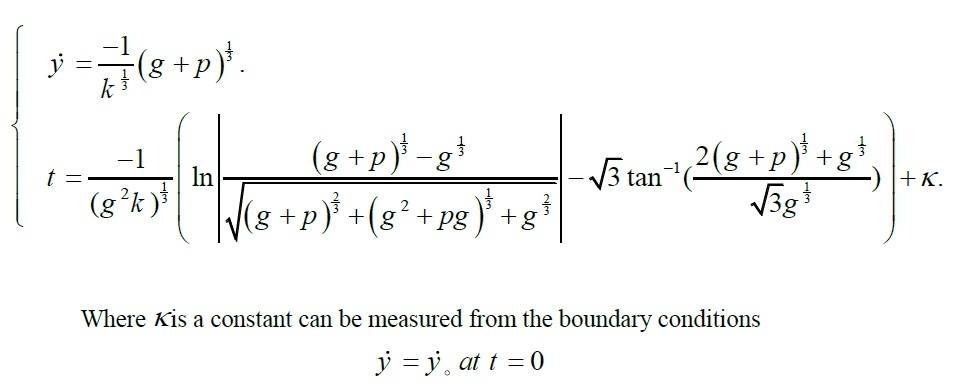
Image 1.jpg

and i would like to solve this parametric differential equation for ##y## but don't know what is the approach for it
i will appreciate any help , thanks
 
Last edited:
Physics news on Phys.org
patric44 said:
...i was trying to solve this differential equation ##\frac{d^{2}y}{dt^{2}}=-a-k*(\frac{dy}{dt})## ...
Your ODE is a second-order linear equation with constant coefficients. It is rather straightforward to solve, simply observe that you can write it in the following form
$$ \big(e^{kt}y^\prime\big)^\prime = - ae^{kt}.$$
Now you simply have to integrate twice.
 
William Crawford said:
Your ODE is a second-order linear equation with constant coefficients. It is rather straightforward to solve, simply observe that you can write it in the following form
(ekty′)′=−aekt.
Now you simply have to integrate twice.
i am sorry i meant to write ##(\frac{dy}{dt})^3## . its not very simple in this case
 
patric44 said:
i am sorry i meant to write ##(\frac{dy}{dt})^3## . its not very simple in this case
No worries! It was me that read your original post in a hurry. Your differential equation in ##y^\prime## belong to a notorious difficult class of ODE's called Abel's nonlinear ODE's of the fist-kind. I haven't had the change nor time to study this class of ODE's, so I'm afraid that I can't provide you with any hint to how to selve it (if possible).
Is this homework?
 
Last edited:
just for kicks, i put the ODE into mathematica and got $$\left\{\left\{y(t)\to \frac{2 \log \left(\sqrt[3]{a}+\sqrt[3]{k} \text{InverseFunction}\left[-\frac{\log \left(\text{$\#$1}^2 k^{2/3}+\text{$\#$1} \left(-\sqrt[3]{a}\right) \sqrt[3]{k}+a^{2/3}\right)-2 \log \left(\text{$\#$1} \sqrt[3]{k}+\sqrt[3]{a}\right)+2 \sqrt{3} \tan ^{-1}\left(\frac{1-\frac{2 \text{$\#$1} \sqrt[3]{k}}{\sqrt[3]{a}}}{\sqrt{3}}\right)}{6 a^{2/3} \sqrt[3]{k}}\&\right][-t+c_1]\right)-\log \left(-\sqrt[3]{a} \sqrt[3]{k} \text{InverseFunction}\left[-\frac{\log \left(\text{$\#$1}^2 k^{2/3}+\text{$\#$1} \left(-\sqrt[3]{a}\right) \sqrt[3]{k}+a^{2/3}\right)-2 \log \left(\text{$\#$1} \sqrt[3]{k}+\sqrt[3]{a}\right)+2 \sqrt{3} \tan ^{-1}\left(\frac{1-\frac{2 \text{$\#$1} \sqrt[3]{k}}{\sqrt[3]{a}}}{\sqrt{3}}\right)}{6 a^{2/3} \sqrt[3]{k}}\&\right][-t+c_1]+k^{2/3} \text{InverseFunction}\left[-\frac{\log \left(\text{$\#$1}^2 k^{2/3}+\text{$\#$1} \left(-\sqrt[3]{a}\right) \sqrt[3]{k}+a^{2/3}\right)-2 \log \left(\text{$\#$1} \sqrt[3]{k}+\sqrt[3]{a}\right)+2 \sqrt{3} \tan ^{-1}\left(\frac{1-\frac{2 \text{$\#$1} \sqrt[3]{k}}{\sqrt[3]{a}}}{\sqrt{3}}\right)}{6 a^{2/3} \sqrt[3]{k}}\&\right][-t+c_1]{}^2+a^{2/3}\right)+2 \sqrt{3} \tan ^{-1}\left(\frac{1-\frac{2 \sqrt[3]{k} \text{InverseFunction}\left[-\frac{\log \left(\text{$\#$1}^2 k^{2/3}+\text{$\#$1} \left(-\sqrt[3]{a}\right) \sqrt[3]{k}+a^{2/3}\right)-2 \log \left(\text{$\#$1} \sqrt[3]{k}+\sqrt[3]{a}\right)+2 \sqrt{3} \tan ^{-1}\left(\frac{1-\frac{2 \text{$\#$1} \sqrt[3]{k}}{\sqrt[3]{a}}}{\sqrt{3}}\right)}{6 a^{2/3} \sqrt[3]{k}}\&\right][-t+c_1]}{\sqrt[3]{a}}}{\sqrt{3}}\right)}{6 \sqrt[3]{a} k^{2/3}}+c_2\right\}\right\}$$
 
Question: A clock's minute hand has length 4 and its hour hand has length 3. What is the distance between the tips at the moment when it is increasing most rapidly?(Putnam Exam Question) Answer: Making assumption that both the hands moves at constant angular velocities, the answer is ## \sqrt{7} .## But don't you think this assumption is somewhat doubtful and wrong?

Similar threads

  • · Replies 8 ·
Replies
8
Views
2K
Replies
3
Views
2K
  • · Replies 10 ·
Replies
10
Views
2K
Replies
10
Views
2K
  • · Replies 7 ·
Replies
7
Views
2K
Replies
7
Views
2K
  • · Replies 7 ·
Replies
7
Views
1K
  • · Replies 4 ·
Replies
4
Views
2K
Replies
3
Views
2K
Replies
2
Views
1K