Solution of silver ions turning amber

Click For Summary
SUMMARY

The discussion centers on the phenomenon of silver ion solutions turning amber after electrolysis with silver electrodes in distilled water. The participants identify that the amber color likely results from the oxidation of silver ions to silver oxide (Ag2O) or the formation of silver nanoparticles, which absorb specific wavelengths of light. The addition of sodium chloride (NaCl) leads to the precipitation of silver chloride (AgCl), confirming the presence of Ag+ ions. The interaction of silver hydroxide with oxygen is also discussed as a contributing factor to the color change.

PREREQUISITES
  • Understanding of electrolysis and its effects on metal ions
  • Knowledge of silver chemistry, specifically Ag+ and Ag2O reactions
  • Familiarity with precipitation reactions involving NaCl and AgCl
  • Basic principles of photochemical reduction and nanoparticle formation
NEXT STEPS
  • Research the electrochemical properties of silver and its oxidation states
  • Learn about the formation and properties of silver nanoparticles
  • Investigate the chemical reactions involved in silver hydroxide and its oxidation
  • Explore the effects of varying voltage on the electrolysis of silver solutions
USEFUL FOR

Chemists, materials scientists, and hobbyists interested in electrochemistry, silver chemistry, and the formation of nanoparticles will benefit from this discussion.

cnidocyte
Messages
34
Reaction score
0
I've been making solutions of silver ions by hooking 20-30V up to 2 silver electrodes in distilled water and noticed something interesting. The solution starts off as clear and by adding a bit of NaCl, AgCl precipitates out so there's definitely Ag+ ions in there. If I leave the solution for a few days it turns amber coloured. This is the colour
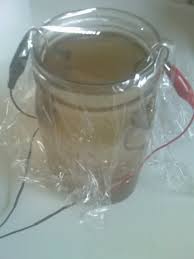
IMAG0177.jpg

whats going on here? I haven't bothered to retest for Ag+ ions but the only theory I've come up with is that the Ag+ ions have been reduced somehow and neutral Ag atoms absorb some light.
 
Chemistry news on Phys.org
Hmm, I'm not sure, but it's likely that it is related to the formation of silver oxides. Add some base and see if the color deepens.
 
Photochemical reduction of the AgCl back to nanoparticles of silver, maybe?
 
Acut: I added NaOH but no color change at all.

minerva: Solutions with no AgCl turn amber.

Oxidation to Ag2O is the best theory so far IMO. I did read that silver nano particles absorb some wavelengths of light and the result is an amber color though so I wonder if the cations could be getting reduced somehow. Does that kinda thing occur? Spontaneous reduction of cations. Enough theorizing though I'll just add some NaCl and look for AgCl precipitate.
 
Hm, I think it's not Ag2O.
Addition of strong base to Ag+ solutions produces silver hydroxide, which, in turn, reacts with oxygen from the air to form the oxide. So addition of silver hydroxide would either deepen the collor or produce more of this amber-collored compound.

I'm not a silver expert, however.
 
Acut said:
Addition of strong base to Ag+ solutions produces silver hydroxide, which, in turn, reacts with oxygen from the air to form the oxide.

Try to write reaction equation.
 
I'd guess this,

2Ag(OH) + O2 -> Ag2O + 2OH-

But I've only read its description, never saw its chemical equation.
 
So you are electrolyzing in distilled water, eh? Not very efficient, at least at first. It is likely that CO2 is being absorbed into the solution and you are making small amounts of silver carbonate.
At 20 to 30 V you are certainly hydrolyzing water as well so your solution and your silver electrodes have oxygen present as well as the reducing hydrogen gas. Hydrogen gas can react with silver to produce silver hydride which can be a variety of colors from red to black.
 
Acut said:
I'd guess this,

2Ag(OH) + O2 -> Ag2O + 2OH-

Check if it can be balanced.
 
  • #10
@Borek: Hm, I never realized that!

But I'm sure I read about this reaction.

It's amazing how much I learn with your posts!
 
  • #11
In short - Ag+ was already oxidized, it doesn't change its oxidation state, so it doesn't need oxidizer.

--
 

Similar threads

  • · Replies 4 ·
Replies
4
Views
8K
Replies
3
Views
8K
  • · Replies 2 ·
Replies
2
Views
2K
  • · Replies 3 ·
Replies
3
Views
16K
Replies
2
Views
4K
  • · Replies 1 ·
Replies
1
Views
4K
Replies
29
Views
23K
  • · Replies 3 ·
Replies
3
Views
6K
Replies
1
Views
3K
Replies
2
Views
11K