Discussion Overview
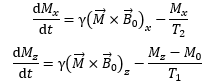
The discussion revolves around the Bloch equations and their solutions, particularly in the context of magnetic resonance techniques. Participants explore the conditions under which certain equations are valid and their relationship to free precession and magnetization components as observed by a detector coil.
Discussion Character
- Technical explanation, Conceptual clarification, Debate/contested
Main Points Raised
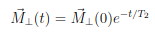
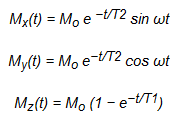
- One participant questions whether specific equations are special solutions of the Bloch equations and seeks clarification on the conditions for their validity.
- Another participant confirms that the equations in question represent free precession when no RF is being transmitted.
- A follow-up inquiry seeks to confirm the validity of the equations after a 90° excitation pulse, which is affirmed by another participant.
- There is a discussion about the lower three solutions being related to the magnetization component from the perspective of the detector coil, with a participant seeking confirmation on this point.
- Clarifications are made regarding the assumptions of the solutions, including that spins are on-resonance and the longitudinal magnetization being zero immediately after a 90° RF pulse.
Areas of Agreement / Disagreement
Participants generally agree on the relationship between the equations and the Bloch equations, as well as the conditions under which they hold. However, there are nuances regarding the assumptions made in the solutions that remain open for further discussion.
Contextual Notes
Limitations include assumptions about resonance and initial conditions, which may affect the applicability of the discussed solutions. The discussion does not resolve all aspects of these assumptions.

 .
.