Solve Boyle's Law Problem: Calculate Atmospheric Pressure

  • Thread starter Thread starter lionely
  • Start date Start date
  • Tags Tags
    Boyle's law Law
Click For Summary

Homework Help Overview

The discussion revolves around a problem related to Boyle's Law, specifically involving the calculation of atmospheric pressure using a glass tube containing air and mercury. The scenario describes the behavior of the air column in the tube when positioned vertically and horizontally.

Discussion Character

  • Exploratory, Assumption checking, Conceptual clarification

Approaches and Questions Raised

  • Participants explore the relationship between the height of the mercury and the pressure exerted by the enclosed air. There are discussions about the forces acting on the mercury and whether to add or subtract certain pressures. Some participants question the effects of the weight of the mercury in different orientations of the tube.

Discussion Status

The discussion includes various interpretations of the problem, with some participants suggesting different approaches to calculating the atmospheric pressure. There is a mix of agreement and exploration of concepts, but no explicit consensus has been reached regarding the final answer.

Contextual Notes

Participants are working within the constraints of the problem setup, including the specific measurements given for the mercury and air column heights. There is an emphasis on understanding the forces involved without providing a definitive solution.

lionely
Messages
574
Reaction score
2
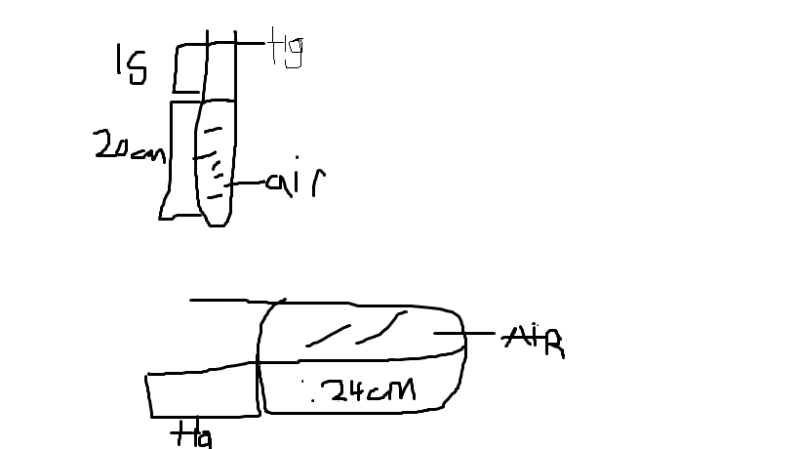
A narrow uniform glass tube contains air enclosed by a thread of mercury 15cm long.
When the tube is held vertically, with the closed end at the bottom,the air column is 20.0cm long, but when it is held horizontally the air column is 24.0cm long. Calculate the atmospheric pressure.
357f5sj.png


I drew a diagram I'm not sure if it's correct, I know that I'm supposed to subtract the mercury height from the barometric height but I don't get the correct answer. Please help me.
 
Physics news on Phys.org
hi lionely! :smile:

call the atmospheric pressure "A" (in cm of mercury)

since the mercury is stationary, what must be the pressure exerted on it by the enclosed air in each case? :wink:
 
A + the mercury heights?
 
(just got up :zzz: …)

what about the weight of the mercury? :confused:
 
Can't we just work it out in cmHg?
 
(just got up :zzz: …)

we are!

but we need to know what forces (or pressures) we have to include, and whether to add or subtract …

for that, you need to decide which forces are acting on the mercury

soo … what about the weight of the mercury (in either case)?​
 
well mg acts down, so in the second case I would assume the effect is not as great.
 
add the forces, luke! o:)
 
P1V1 = P2V2

(p+15)(20A) = P x 24A

20P + 300 = 24P

P = 300/4 = 75cmHg

Is that it ?
 
  • #10
yup! :biggrin:
 
  • #11
Thanks for your help man XD
 

Similar threads

  • · Replies 6 ·
Replies
6
Views
1K
  • · Replies 3 ·
Replies
3
Views
2K
  • · Replies 6 ·
Replies
6
Views
2K
Replies
7
Views
8K
  • · Replies 6 ·
Replies
6
Views
1K
  • · Replies 5 ·
Replies
5
Views
2K
  • · Replies 1 ·
Replies
1
Views
2K
  • · Replies 4 ·
Replies
4
Views
2K
  • · Replies 7 ·
Replies
7
Views
2K
Replies
1
Views
3K