Undergrad Solve Int. Eq.: Exponential Growth Diff. Eq.

  • Thread starter Thread starter mcastillo356
  • Start date Start date
  • Tags Tags
    Calculus
Click For Summary
The integral equation f(x)=2+∫4^x f(t)dt leads to the differential equation f'(x)=3f(x) upon differentiation, indicating exponential growth. The solution is found to be f(x)=2e^(3x-12), with the constant C determined by evaluating the equation at x=4. The discussion explores the relationship between the integral and differential equations, emphasizing that the rate of change in many natural processes is proportional to the size of the quantity. The participants clarify that the constant k in the exponential growth equation can vary, with k=3 in this specific case. Understanding this connection is crucial for solving similar problems involving exponential growth.
mcastillo356
Gold Member
Messages
649
Reaction score
353
TL;DR
I can't understand why the result of this integral equation is the differential equation of exponential growth
Hi, PF

There goes the solved example, the doubt, and the attempt:

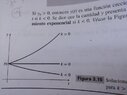
Example 8 Solve the integral equation ##f(x)=2+\displaystyle\int_4^x\,f(t)dt##.

Solution Differentiate the integral equation ##f'(x)=3f(x)##, the DE for exponential growth, having solution ##f(x)=Ce^{3x}##. Now put ##x=4## into the integral equation to get ##f(4)=2##. Hence ##2=Ce^{12}##. So ##C=2e^{-12}##. Therefore, the integral equation has solution ##2e^{3x-12}##.

Doubt Why is the DE for exponential growth when we differentiate the integral equation to get ##f'(x)=3f(x)##?

Attempt It is a shot in the dark. Many natural processes involve quantities that increase or decrease at a rate proportional to their size. All of these phenomena, can be modelled ##\displaystyle\frac{dy}{dt}=ky##, this is, the differential equation of exponential growth or decay.

PD: Post without preview
Greetings!
IMG_20230714_193811.jpg
 
Physics news on Phys.org
mcastillo356 said:
TL;DR Summary: I can't understand why the result of this integral equation is the differential equation of exponential growth

Hi, PF

There goes the solved example, the doubt, and the attempt:

Example 8 Solve the integral equation ##f(x)=2+\displaystyle\int_4^x\,f(t)dt##.

Solution Differentiate the integral equation ##f'(x)=3f(x)##, the DE for exponential growth, having solution ##f(x)=Ce^{3x}##. Now put ##x=4## into the integral equation to get ##f(4)=2##. Hence ##2=Ce^{12}##. So ##C=2e^{-12}##. Therefore, the integral equation has solution ##2e^{3x-12}##.

Doubt Why is the DE for exponential growth when we differentiate the integral equation to get ##f'(x)=3f(x)##?

Attempt It is a shot in the dark. Many natural processes involve quantities that increase or decrease at a rate proportional to their size. All of these phenomena, can be modelled ##\displaystyle\frac{dy}{dt}=ky##, this is, the differential equation of exponential growth or decay.

PD: Post without preview
Greetings!

View attachment 329318
I'm somewhat confused by the details of your question. Like, why do you have the equation ##f(x)=2+\displaystyle\int_4^x\,f(t)dt## and ##f'(x)=3f(x)## related somehow (i.e. where did the "3" come from?).

But, let's take your exponential growth equation ##\displaystyle\frac{dy}{dt}=ky## and integrate both sides to get ##y(t)=C+k\displaystyle\int\,y(t)dt## where C is some constant. Does that look familiar?

What function is the same when you integrate it or take it's derivative?
 
  • Informative
Likes mcastillo356
Hi, PF, @DaveE

DaveE said:
I'm somewhat confused by the details of your question. Like, why do you have the equation ##f(x)=2+\displaystyle\int_4^x\,f(t)dt## and ##f'(x)=3f(x)## related somehow (i.e. where did the "3" come from?).

Ok, I keep on dancing in the dark. Might it be that I must consider the ED like a given default information ?; or, how to say.... A fact of the problem that is not part of the solution; not a deduction, but a premise?. The circumstance that the integral equation involved, ##f(x)=2+3\displaystyle\int_4^x\,f(t)dt## is generic, not precise (the independent variable is ##t##) makes me think that, quoting Wikipedia, a differential equation relates one or more unknown functions and their derivatives.

DaveE said:
But, let's take your exponential growth equation ##\displaystyle\frac{dy}{dt}=ky## and integrate both sides to get ##y(t)=C+k\displaystyle\int\,y(t)dt## where C is some constant. Does that look familiar?

First of all, thanks for explaining from both points of view. I think it is very helpful.

DaveE said:
What function is the same when you integrate it or take it's derivative?

##e^x##. Am I in the path, closer to a right conclusion?

Greetings!
 
mcastillo356 said:
(the independent variable is t) makes me think that, quoting Wikipedia, a differential equation relates one or more unknown functions and their derivatives.
##t## is what I would call a "dummy variable" it is simply describing what the integral applies to. ##\displaystyle\int_4^x\,f(t)dt## is a function of x, not ##t##. ##t## goes away in the evaluation of the integral.

For example consider the function ##\displaystyle\int_4^x\,tdt = \frac{1}{2} [t^2]^x_4 = \frac{1}{2} (x^2 - 4^2) = \frac{1}{2} x^2 - 8 ##

mcastillo356 said:
ex. Am I in the path, closer to a right conclusion?
Yes.
 
  • Like
Likes mcastillo356
Suppose you guessed at a solution of ##f(x) = c + a⋅e^{bx}## where a, b, and c are unknown constants. If you substitute that into your equation can you deduce the values of a, b, and c?

Here is a more complicated example: https://en.universaldenker.org/lessons/1345
 
DaveE said:
Suppose you guessed at a solution of ##f(x) = c + a⋅e^{bx}## where a, b, and c are unknown constants. If you substitute that into your equation can you deduce the values of a, b, and c?

Hi, PF, @DaveE, let me delay this exercise; the reason is that I want to set, fix concepts of the initial doubt.

First, here goes an outlined proof of ##\displaystyle\frac{dy}{dx}=ky\Leftrightarrow{y=Ce^{kx}}##

##\displaystyle\frac{dy}{y}=kdx##

##\displaystyle\int{\displaystyle\frac{dy}{y}}=\displaystyle\int{kdx}##

##\ln{|y|}=kx+C##

##\therefore{y=e^{kx+C}}##

It is not the topic I first proposed. And I still have one doubt now:

When talking about differentiating the integral equation, this is, ##f'(x)=3f(x)##, can I say it is inspired in ##\displaystyle\frac{dy}{dx}=ky##?

Greetings!
 
mcastillo356 said:
When talking about differentiating the integral equation, this is, f′(x)=3f(x), can I say it is inspired in dydx=ky?
yes, sure. k=3, a constant. k can be any constant in that equation.
 
  • Love
Likes mcastillo356
mcastillo356 said:
First, here goes an outlined proof of ##\displaystyle\frac{dy}{dx}=ky\Leftrightarrow{y=Ce^{kx}}##

##\displaystyle\frac{dy}{y}=kdx##

##\displaystyle\int{\displaystyle\frac{dy}{y}}=\displaystyle\int{kdx}##

##\ln{|y|}=kx+C##

##\therefore{y=e^{kx+C}}##
Yes, excellent. The next, simple, step is to bring out the constant to match your original hypothesis. You've used C twice here in different places, so I'll redefine things:
##\displaystyle\frac{dy}{dx}=ky\Leftrightarrow{y=C_1e^{kx}}##

and the result:
##\therefore{y=e^{kx+C_2}} = e^{C_2}e^{kx}## so ##C_1 = e^{C_2}##, an arbitrary constant.

But this implies that ##C_1 > 0##. You have an alternate case, from the intermediate step you left out
##|y|=e^{kx+C_2}##, where ##-y=e^{kx+C_2}##, which will imply ##C_1 < 0##.

You can combine these all of this to allow any value of C_1. The ##C_1 = 0## case can be easily shown as a trivial solution.
 
Last edited:
  • Love
Likes mcastillo356

Similar threads

  • · Replies 52 ·
2
Replies
52
Views
8K
  • · Replies 2 ·
Replies
2
Views
3K
  • · Replies 3 ·
Replies
3
Views
3K
  • · Replies 9 ·
Replies
9
Views
2K
  • · Replies 3 ·
Replies
3
Views
2K
  • · Replies 20 ·
Replies
20
Views
3K
  • · Replies 6 ·
Replies
6
Views
3K
Replies
6
Views
2K
Replies
7
Views
2K
  • · Replies 1 ·
Replies
1
Views
2K