Differential equation using power series method

Join the discussion
Ask a follow-up here, or get your own question answered by working scientists, mathematicians and engineers — people, not an autocomplete.
Real named experts · corrections over time · the nuance an AI answer skips
8 replies · 4K views
Graham87
Messages
72
Reaction score
16
TL;DR
Differential equation using power series method
I am attempting to solve this differential equation with power series
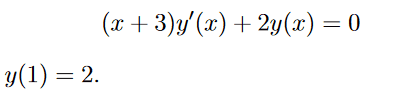
Screenshot 2023-12-20 135848.png


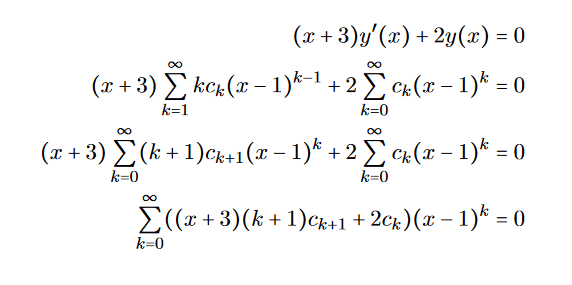
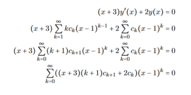
I came with the following solution but I doubt it is correct.
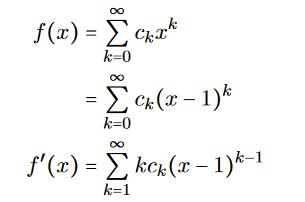
Screenshot 2023-12-20 140010.png

Screenshot 2023-12-20 140022.png


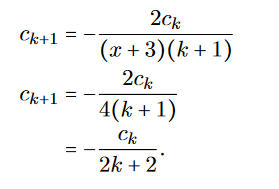
Since x=1 we get:
Screenshot 2023-12-20 140039.png

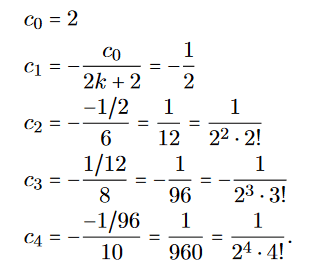
Screenshot 2023-12-20 140053.png

Screenshot 2023-12-20 140111.png

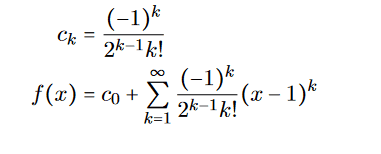
I doubt its correctness because it looks messy. Also the convergence radian R goes to 0, giving only a solution for x=0 which is not correct, since the beginning condition states y(1)=2.
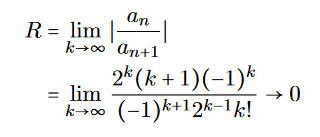
Screenshot 2023-12-20 140120.png
 

Attachments

  • Screenshot 2023-12-20 140022.png
    Screenshot 2023-12-20 140022.png
    9.4 KB · Views: 131
Last edited:
Physics news on Phys.org
If you set [itex]y(x) = \sum_{k=0}^\infty c_k(x - 1)^k[/itex] then [itex]x[/itex] cannot appear in the recurrence relation for [itex]c_k[/itex]; the [itex]c_k[/itex] are supposed to be independent of [itex]x[/itex]. You need to write [tex]\begin{split}(x + 3)y' &= <br /> (x - 1 + 4)\sum_{k=1}^\infty kc_k (x-1)^{k-1} \\<br /> &= \sum_{k=1}^\infty kc_k (x - 1)^k + 4\sum_{k=1}^\infty kc_k (x- 1)^{k-1} \end{split}[/tex] and then compare coefficients of [itex](x-1)^k[/itex].
 
Reply
  • Like
Likes   Reactions: Graham87
pasmith said:
If you set [itex]y(x) = \sum_{k=0}^\infty c_k(x - 1)^k[/itex] then [itex]x[/itex] cannot appear in the recurrence relation for [itex]c_k[/itex]; the [itex]c_k[/itex] are supposed to be independent of [itex]x[/itex]. You need to write [tex]\begin{split}(x + 3)y' &=<br /> (x - 1 + 4)\sum_{k=1}^\infty kc_k (x-1)^{k-1} \\<br /> &= \sum_{k=1}^\infty kc_k (x - 1)^k + 4\sum_{k=1}^\infty kc_k (x- 1)^{k-1} \end{split}[/tex] and then compare coefficients of [itex](x-1)^k[/itex].
Oh, I tried that too but did not go through it completely. So I get thefollowing:
Screenshot 2023-12-20 162206.png

Screenshot 2023-12-20 162211.png

Screenshot 2023-12-20 162217.png

However the general solution formula does not seem obvious. Where might I have gone wrong?
 
Last edited:
You can write the ODE as [tex] \sum_{k=0}^\infty ( kc_k + 4(k+1)c_{k+1} + 2c_k )(x-1)^k = 0[/tex] from which it follows that [tex] c_{k+1} = -\frac{k+2}{4(k+1)}c_k, \quad k \geq 0.[/tex] This linear first-order recurrence can be easily solved, since the general solution of [tex] a_{k+1} = f(k)a_k[/tex] is [tex] a_k = a_0 \prod_{r=0}^{k-1} f(r).[/tex] Note that by inspection [itex]y = A(x + 3)^{-2}[/itex] is the general solution of [itex](x + 3)y' + 2y = 0[/itex] so that you can check your answer against [tex]\begin{split}<br /> y(x) &= 16y(1)(x + 3)^{-2} \\<br /> &= 16y(1)(x - 1 + 4)^{-2} \\<br /> &= y(1) \left(1 + \frac{x-1}{4}\right)^{-2} \\<br /> &= y(1) \left(1 - 2\frac{x-1}4 + \dots<br /> + \frac{(-2)(-3) \cdots (-n - 1)}{n!}\left(\frac{x-1}4\right)^n + \dots \right)\end{split}[/tex]
 
Reply
  • Like
Likes   Reactions: Graham87
pasmith said:
You can write the ODE as [tex] \sum_{k=0}^\infty ( kc_k + 4(k+1)c_{k+1} + 2c_k )(x-1)^k = 0[/tex] from which it follows that [tex] c_{k+1} = -\frac{k+2}{4(k+1)}c_k, \quad k \geq 0.[/tex] This linear first-order recurrence can be easily solved, since the general solution of [tex] a_{k+1} = f(k)a_k[/tex] is [tex] a_k = a_0 \prod_{r=0}^{k-1} f(r).[/tex] Note that by inspection [itex]y = A(x + 3)^{-2}[/itex] is the general solution of [itex](x + 3)y' + 2y = 0[/itex] so that you can check your answer against [tex]\begin{split}<br /> y(x) &= 16y(1)(x + 3)^{-2} \\<br /> &= 16y(1)(x - 1 + 4)^{-2} \\<br /> &= y(1) \left(1 + \frac{x-1}{4}\right)^{-2} \\<br /> &= y(1) \left(1 - 2\frac{x-1}4 + \dots<br /> + \frac{(-2)(-3) \cdots (-n - 1)}{n!}\left(\frac{x-1}4\right)^n + \dots \right)\end{split}[/tex]
I tried that, but I get stuck in the manipulation on the most left sum to k=0?
Screenshot 2023-12-20 162206.png

From your answer it turned to this somehow?
Screenshot 2023-12-20 181951.png

Shouldn't the most left term be
Screenshot 2023-12-20 183210.png
 
Last edited:
pasmith said:
No; [tex] (x-1)y' = \sum_{k=1}^\infty kc_k(x-1)^k = \sum_{k=0}^\infty kc_k(x-1)^k[/tex] because [itex]0c_0(x-1)^0 = 0[/itex].
Yeah, I realised that too! Thanks a lot!
 
pasmith said:
No; [tex] (x-1)y' = \sum_{k=1}^\infty kc_k(x-1)^k = \sum_{k=0}^\infty kc_k(x-1)^k[/tex] because 0c0(x−1)0=0.
Are you sure about this?
I did like this:
Screenshot 2023-12-20 192440.png

And since x=1 we get the following
Screenshot 2023-12-20 192448.png

And eventually
Screenshot 2023-12-20 192615.png

Screenshot 2023-12-20 192625.png