Solve Kinematics Problem Homework: Part B

Click For Summary

Homework Help Overview

The discussion revolves around a kinematics problem related to differential equations, specifically focusing on the relationship between velocity and acceleration in a given context. The original poster is attempting to solve part b of a homework assignment after having completed part a.

Discussion Character

  • Exploratory, Mathematical reasoning, Assumption checking

Approaches and Questions Raised

  • Participants are examining the original poster's steps in solving the differential equation, questioning the assumptions made regarding the acceleration being constant and the substitution of variables. There are suggestions for alternative approaches, including a substitution method to simplify the equation.

Discussion Status

The discussion is active, with participants providing feedback on the original poster's reasoning and suggesting different methods for approaching the problem. There is no explicit consensus on the correctness of the original poster's solution, and various interpretations of the problem are being explored.

Contextual Notes

Participants note the complexity of the differential equation and the implications of assuming constant acceleration, as well as the potential need for additional information or clarification on the problem setup.

Precursor
Messages
219
Reaction score
0
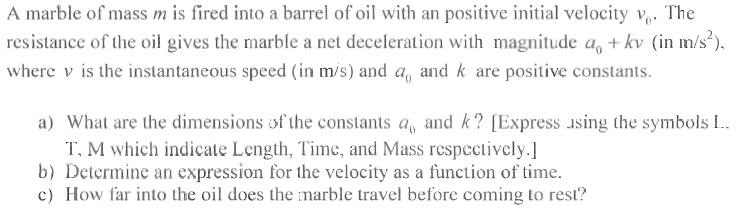
Homework Statement
2v3hrib.jpg
The attempt at a solution

I have already solved for part a. It's part b that I'm having trouble with right now.

Here is what I have for part b:

\frac{\mathrm{d} v}{\mathrm{d} t} = a_{0} + kv

dv = a_{0}dt + kvdt

dv = a_{0}dt + adt

\int dv = \int a_{0}dt + adt

And my final answer is:

v = a_{0}t + at

Is this correct?
 
Last edited:
Physics news on Phys.org
I don't understand the 3rd step where you replace kv with a.
Are you assuming that the acceleration is kv ?

Also in the final step, you assume that "a" is a constant.
Acceleration can't be constant; it is proportional to the velocity and the velocity is decreasing.

I have forgotten how to solve differential equations, but you might try a substitution to make it look easier. If you let v = u + b where b is a constant, then your dv/dt = ao + kv will change to
du/dt = ao +kb + ku
and you can choose b = -ao/k so
du/dt = ku.
This is the equation for radioactive decay, and it can easily be integrated to get u as an exponential function. Change variables back to v to get an exponential function for v.
 
I made kv = a because the dimension of k is 1/T, where T is time, and v is simply velocity. Therefore, the product of these two variables will be acceleration.
 
But kv is not a constant, so your "a" is not a constant and its integral over time is not at.
 
Does this mean that the integral of adt is equal to v.
 
Your "a" is really "k*v" so its integral over time would be k*distance + constant, where distance is a function of time. I don't think this does any good. Better to leave the kv in the differential equation and make the substitution I suggested in the 2nd post.
 
I don't think your integration is correct. Go to Wolframalpha and use Mathematica's DSolve command for v'[t]=a+k*v[t] I think the solution is v[t]=-a/k + e^(k*t) C1 but not 100% sure since I'm not a regular user of Mathematica
 

Similar threads

  • · Replies 8 ·
Replies
8
Views
1K
Replies
1
Views
824
  • · Replies 5 ·
Replies
5
Views
1K
  • · Replies 6 ·
Replies
6
Views
2K
  • · Replies 33 ·
2
Replies
33
Views
5K
  • · Replies 42 ·
2
Replies
42
Views
6K
  • · Replies 9 ·
Replies
9
Views
9K
  • · Replies 10 ·
Replies
10
Views
2K