Solve Resistor Problem: Imagine Voltage Source from a to b

  • Thread starter Thread starter BigFlorida
  • Start date Start date
  • Tags Tags
    Resistor
Join the discussion
Registration is free. Ask a follow-up in this thread, or start your own.
4 replies · 1K views
BigFlorida
Messages
41
Reaction score
1
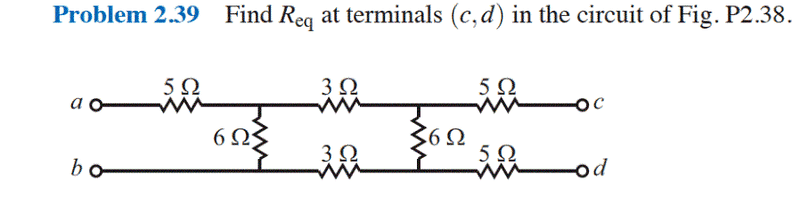
For this problem I am just wondering if it is proper to "imagine" there is a voltage source from a to b so that one may say the 5 ohm resistor right after a is in parallel with the 6 ohm resistor connecting the two wires. If not, how would I go about solving this?
upload_2015-9-5_14-2-10.png


Thank you in advance.
 
Physics news on Phys.org
Why a and b? You are looking for the equivalent resistance between c and d. There you can add a voltage source.

There is no 5 ohm resistor in parallel to a 6 ohm resistor indepenent of the points you consider.
 
BigFlorida said:
one may say the 5 ohm resistor right after a is in parallel with the 6 ohm resistor connecting the two wires.
You could substitute the two resistors with a Thevenin-equivalent with a voltage source, VT and a resistor, RT:

VT = Vab * 6Ω / ( 5Ω + 6Ω )

RT = 5Ω || 6Ω

. . . and so on.
BigFlorida said:
If not, how would I go about solving this?
Use Kirchhoffs laws ( KVL and KCL ), set Vab = 100V, then calculate Vcd when cd is unloaded.
Then calculate ( KVL and KCL ) Icd when cd is short circuited.
Req = Vcd / Icd
 
Are a and b connected to anything? The problem statement does not mention this.
If they are not connected, the problem can be solved with parallel and series resistances only.
If they are connected, the posted problem statement is incomplete.
 
bigFlorida... You might be over thinking the problem.

a and b are open circuit so the 5R can be ignored.

The approach you suggested could be applicable _if_ there was a voltage source connected but you can't just add one.