Solve the given problem involving probability without replacement

10 replies · 5K views · last reply
chwala
Gold Member
Messages
2,854
Reaction score
436
Homework Statement
This is apast paper question. Allow me to post it as it is.
Relevant Equations
Probability
Exam question 25(c): bag of 5 red, 4 blue and 3 green balls, picking without replacement until green; find n where P(green on pick n) = 21/220, with a mark scheme table showing answer 5 worth 2 marks.


Okay, i was able to solve it by trial and error, i am seeking for a more concrete approach. Can combination work here? or a more solid approach using sequences? or probability itself?

My trial and error,
##P_{green} = \dfrac{9}{12}×\dfrac{8}{11} ×\dfrac{7}{10}×\dfrac{6}{9}×\dfrac{3}{8} = \dfrac{21}{220}##

##n=5##.

and why 2 marks? or there is a shorter method.
 
chwala said:
and why 2 marks?
And how should we know how many marks there are supposed to be? Is 2 not a perfect score for this question?
 
  • Like
Likes   Reactions: chwala and SammyS
chwala said:
a more concrete approach
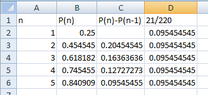
Excel:
Excel spreadsheet with columns n, P(n), P(n)-P(n-1) and 21/220. Rows n=1 to 5 show P(n) values 0.25, 0.454545, 0.618182, 0.745455, 0.840909; column D shows 0.09545455 in every row.


The calculated value in C6 equals the target value in D6 when n=5.
 
Attachments
  • Excel spreadsheet with columns n, P(n), P(n)-P(n-1) and 21/220 for n = 1 to 5; P(n) values 0.25, 0.454545, 0.618182, 0.745455, 0.840909; differences end at 0.09545455 matching 21/220 in column D.
    1728096320696.png
    2.9 KB · Views: 138
Hill said:
Excel:
View attachment 351877

The calculated value in C6 equals the target value in D6 when n=5.
ok @Hill, I can see that you're still using the same approach as I am, but you're doing it differently. For instance, following your method,

##P(2) = \dfrac{9}{12}×\dfrac{3}{11}=0.204525##

and so on.

Cheers man!
 
chwala said:
ok @Hill, I can see that you're still using the same approach as I am, but you're doing it differently. For instance, following your method,

##P(2) = \dfrac{9}{12}×\dfrac{3}{11}=0.204525##

and so on.

Cheers man!
These formulas are behind my numbers:
Spreadsheet screenshot with columns A to C and a header of 21/220 in column D: column A lists n from 1 to 5, column B holds formulas for P(n) such as =3/(13-A3)+(10-A3)/(13-A3)*B2, and column C holds differences such as =B3-B2, with 21/220 repeated in column D.


I.e., ##P(n)=\frac {3}{13-n}+\frac{10-n}{13-n}*P(n-1)##

In my approach, ##P(2) = 0.454545##, but rather ##P(2)-P(1)=0.204545##.
 
Last edited:
## \begin{align}
P(n)&=\frac{9!}{(10-n)!}\cdot \frac{(12-n)!}{12!}\cdot3\nonumber\\
&=\frac{(12-n) \cdot (11-n)}{12\cdot 11\cdot 10}\cdot 3\nonumber\\
&=\frac{n^2-23n+132}{440}\nonumber
\end{align} ##

where ## P(n) ## is the probability that Marie picks a green ball on pick ## n ##.
 
I forgot to say that in my posts 3 and 5, ##P(n)## is the probability of picking a green ball on picks ##1## - ##n##. Thus, ##P(n)-P(n-1)## is the probability of picking a green ball on pick ##n##.
 
  • Like
Likes   Reactions: chwala and Gavran
chwala said:
Homework Statement: This is apast paper question. Allow me to post it as it is.
Relevant Equations: Probability

View attachment 351870

Okay, i was able to solve it by trial and error, i am seeking for a more concrete approach. Can combination work here? or a more solid approach using sequences? or probability itself?

My trial and error,
##P_{green} = \dfrac{9}{12}×\dfrac{8}{11} ×\dfrac{7}{10}×\dfrac{6}{9}×\dfrac{3}{8} = \dfrac{21}{220}##

##n=5##.

and why 2 marks? or there is a shorter method.
I would do it this way.
 
We can work backwards from [itex]\frac{21}{220}[/itex] until we get something we can recognise as [itex]P(n)[/itex] for some [itex]n[/itex]. We have a factor of 7 and a factor of 3 in the numerator, so we need at least factors of 9 and 8, which we get by multiplying by 9/9 = 1 and 8/8 = 1. We don't hae a factor of 12 in the denominator, but we can get that by mupltiying by 6/6 = 1 and combining the 6 with a factor of 2. Hence
[tex]\begin{split}<br /> \frac{21}{220} &= \frac{7 \times 3}{2 \times 10 \times 11} \\<br /> &= \frac{9}{9} \times \frac88 \times \frac{6}{6} \times \frac{7 \times 3}{2 \times 10 \times 11} \\<br /> &= \frac{9}{6 \times 2} \times \frac{8}{11} \times \frac{7}{10} \times \frac{6}{9} \times \frac{3}{8} \\<br /> &= P(5).\end{split}[/tex]
 
Last edited:
phinds said:
And how should we know how many marks there are supposed to be? Is 2 not a perfect score for this question?
I agree that 2 marks is sufficient. Question requires logical thinking.
 
chwala said:
I agree that 2 marks is sufficient. Question requires logical thinking.
As I understand it, there can be three cases.

The first case is a complete solution. That means there is a correct trial for n=5 (the fifth ball is green). In this case a student scores the mark 2.
The second case is an incomplete solution. That means there is a correct trial for n=4 (the fourth ball is green) or n=3 (the third ball is green) or n=2 (the second ball is green). In this case a student scores the mark 1.
The third case is an incomplete solution too. But in this case that means there is only 1 correct trial for n=1 (the first ball is green) or there is not a correct trial. In this case a student does not score a mark.
 
  • Like
Likes   Reactions: WWGD and chwala