Solve the heat equation having Dirichlet boundary conditions

Click For Summary
SUMMARY

The discussion focuses on solving the heat equation with Dirichlet boundary conditions, specifically analyzing the impact of initial conditions on the solution. The initial condition given is f(x)=\dfrac{1}{2}\sin\left[\dfrac{4πx}{l}\right], leading to the solution U(x,t)=\dfrac{1}{2} e^{\left[\dfrac{-16π^2kt}{l^2}\right]} ×\sin\left[ \dfrac{4πx}{l}\right] for n=4 and b_4=\dfrac{1}{2}. The discussion emphasizes the necessity of using eigenfunctions, which must be sine or cosine functions, and explores the implications of non-trigonometric initial conditions on eigenfunction behavior.

PREREQUISITES
  • Understanding of the heat equation and its boundary conditions
  • Familiarity with eigenfunctions and their properties
  • Knowledge of Fourier series and their applications in solving differential equations
  • Basic calculus, particularly integration techniques
NEXT STEPS
  • Study the properties of eigenfunctions in the context of differential equations
  • Learn about the principle of superposition in relation to non-eigenfunction initial conditions
  • Explore the derivation and application of Fourier series for both odd and even periodic extensions
  • Investigate the implications of different boundary conditions on heat diffusion in various materials
USEFUL FOR

Mathematicians, physicists, and engineers working on heat transfer problems, particularly those dealing with boundary value problems and Fourier analysis.

chwala
Gold Member
Messages
2,828
Reaction score
420
TL;DR
See attached.
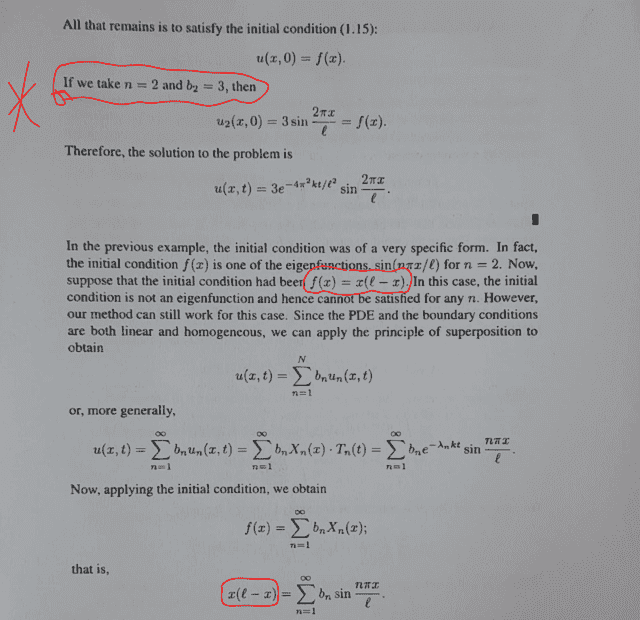
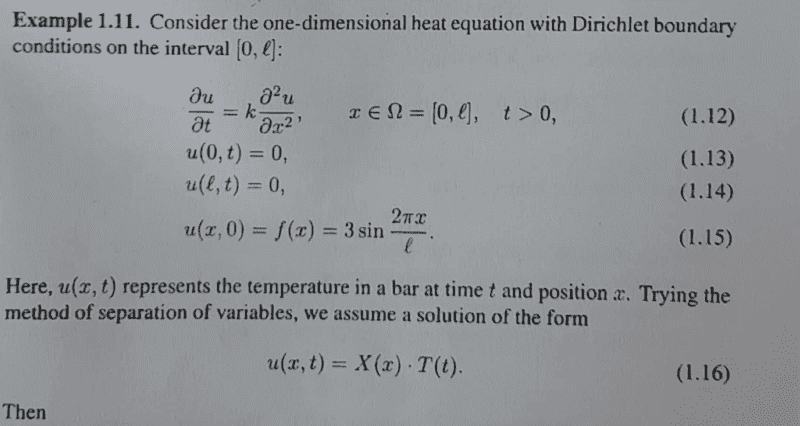
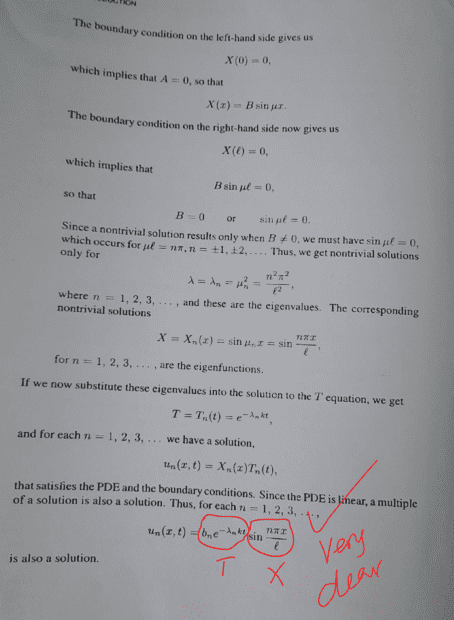
I am going through these notes...they are pretty easy to follow. I would like more insight on the initial condition. In this problem, (attachment below), i guess the choice of initial condition is convenient as its easier to plug in the values of ##n=2## and ##b=3## (highlighted on the attachment) to realize the required solution. My question is? supposing we had the initial condition being;

##f(x)=\dfrac{1}{2}\sin\left[\dfrac{4πx}{l}\right]## where then our ##n=4## and ##b_4=\dfrac{1}{2}##

then our solution would be;

##U(x,t)##= ##\dfrac{1}{2} e^{\left[\dfrac{-16π^2kt}{l^2}\right]} ×\sin\left[ \dfrac{4πx}{l}\right]## correct?

I think the other highlighted part is now clear to me i.e when the initial condition is not an eigen function, then we have to make use of the principle of superposition. (one thing that is clear to me here is that for us to have the eigen function then the initial condition has to be either a function of sine or cosine).

Can we have the initial condition being a non-trigonometric function which would give us an eigenfunction?

Cheers!

Find the problem and solution here from textbook;
1664017264211.png


1664017427007.png

1664017475893.png
 
Last edited:
Physics news on Phys.org
The operator X&#039;&#039; + \lambda X is self-adjoint with respect to the inner product <br /> \langle f, g \rangle = \int_0^\ell f(x)g(x)\,dx, so eigenfunctions corresponding to different eigenvalues will be orthogonal with respect to this inner product, and you can recover the b_n from <br /> \int_0^{\ell} f(x)X_m(x)\,dx = b_m \int_0^{\ell} X_m(x)^2\,dx as long as you can do the integrals.
 
  • Like
Likes   Reactions: chwala
pasmith said:
The operator X&#039;&#039; + \lambda X is self-adjoint with respect to the inner product <br /> \langle f, g \rangle = \int_0^\ell f(x)g(x)\,dx, so eigenfunctions corresponding to different eigenvalues will be orthogonal with respect to this inner product, and you can recover the b_n from <br /> \int_0^{\ell} f(x)X_m(x)\,dx = b_m \int_0^{\ell} X_m(x)^2\,dx as long as you can do the integrals.
Thanks @pasmith . Let me read more on this.
 
chwala said:
Summary: See attached.

I am going through these notes...they are pretty easy to follow. I would like more insight on the initial condition. In this problem, (attachment below), i guess the choice of initial condition is convenient as its easier to plug in the values of ##n=2## and ##b=3## (highlighted on the attachment) to realize the required solution. My question is? supposing we had the initial condition being;

##f(x)=\dfrac{1}{2}\sin\left[\dfrac{4πx}{l}\right]## where then our ##n=4## and ##b_4=\dfrac{1}{2}##

then our solution would be;

##U(x,t)##= ##\dfrac{1}{2} e^{\left[\dfrac{-16π^2kt}{l^2}\right]} ×\sin\left[ \dfrac{4πx}{l}\right]## correct?

I think the other highlighted part is now clear to me i.e when the initial condition is not an eigen function, then we have to make use of the principle of superposition. (one thing that is clear to me here is that for us to have the eigen function then the initial condition has to be either a function of sine or cosine).

Can we have the initial condition being a non-trigonometric function which would give us an eigenfunction?

Cheers!

Find the problem and solution here from textbook;
View attachment 314544

View attachment 314545
View attachment 314546
I have been doing further reading on this by looking at heat diffusivity on insulated wire. I have noted that in general if the initial condition ##f(x)## is a sine series then the homogenous Dirichlet boundary conditions will apply for insulated wire (with non-insulated ends) resulting into a Fourier series of the odd periodic extension ##f(x)##. I have also noted that for an insulated wire (with insulated ends), the homogenous Neumann boundary conditions will apply and the ensuing solution would be Fourier series of the even peridic extension ##f(x)##...
 

Similar threads

  • · Replies 22 ·
Replies
22
Views
4K
  • · Replies 4 ·
Replies
4
Views
4K
  • · Replies 2 ·
Replies
2
Views
3K
  • · Replies 8 ·
Replies
8
Views
4K
  • · Replies 6 ·
Replies
6
Views
3K
Replies
3
Views
3K
  • · Replies 2 ·
Replies
2
Views
2K
  • · Replies 1 ·
Replies
1
Views
3K
  • · Replies 16 ·
Replies
16
Views
3K
  • · Replies 4 ·
Replies
4
Views
2K