Solve ##z^2(1-z^2)=16## using Complex numbers

Click For Summary
SUMMARY

The discussion focuses on solving the equation ##z^2(1-z^2)=16## using complex numbers. Participants explore the transformation of the equation into ##z^4 + 8z^2 + 16 - 9z^2 = 0## through algebraic manipulation and the method of completing the square. The systematic approach involves factoring the polynomial and comparing coefficients to derive values for A and B, ultimately leading to the solutions for z. The use of complex numbers is highlighted, particularly in the substitution of ##w = z^2## to simplify the problem.

PREREQUISITES
  • Understanding of complex numbers and their properties
  • Familiarity with polynomial equations and factoring techniques
  • Knowledge of completing the square method
  • Ability to manipulate algebraic expressions and coefficients
NEXT STEPS
  • Study the method of completing the square in polynomial equations
  • Learn about complex number operations and their applications in algebra
  • Explore polynomial factorization techniques and coefficient comparison
  • Investigate the geometric interpretation of complex solutions
USEFUL FOR

Mathematicians, students studying algebra, and anyone interested in solving polynomial equations using complex numbers.

chwala
Gold Member
Messages
2,827
Reaction score
415
Homework Statement
See attached
Relevant Equations
Complex numbers
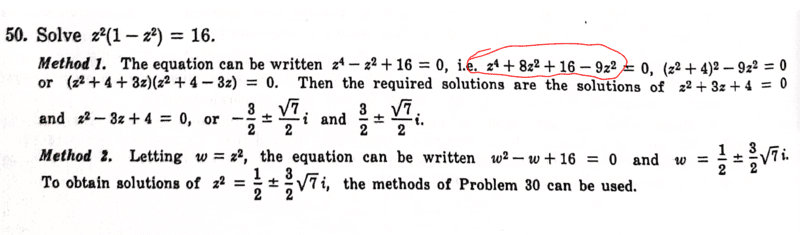
The problem is as shown...all steps are pretty easy to follow. I need help on the highlighted part in red. How did they come to;
##z^4+8z^2+16-9z^2=0## or is it by manipulating ##-z^2= 8z^2-9z^2?## trial and error ...
1665319812803.png
 
Physics news on Phys.org
The idea is to make formula of
A^2=B^2
. Let us see.
z^4+16=z^2
(z^2+4)^2=9z^2=(3z)^2
z^2+4=\pm 3z
 
A systematic approach is to factorize <br /> z^4 - z^2 + 16 = (z^2 + Az + 4)(z^2 + Bz + 4) and compare coefficients of powers of z to get three equations for A and B: <br /> \begin{split}<br /> z^3 \quad &amp;: \quad A + B = 0 \\<br /> z^2 \quad &amp;: \quad 8 + AB = -1 \\<br /> z \quad &amp;: \quad 4A + 4B = 0<br /> \end{split} Since the first and third are really the same equation, we can solve this system to obtain (A, B) = (3, -3).
 
  • Like
Likes PeroK and chwala
chwala said:
How did they come to

completion of the square
 
  • Like
Likes fresh_42
malawi_glenn said:
completion of the square
How did they come to ##z^4+8z^2+16-9z^2##?...of course the step after is complete square method...no problem there. Or it was just simply identifying that;

##-9z^2+8z^2=-z^2##
 
Last edited:
  • Like
Likes malawi_glenn
chwala said:
How did they come to ##z^4+8z^2+16-9z^2##?
##z^4-z^2+16 = z^4-z^2+16 + 0 = z^4-z^2+16 +8z^2 - 8z^2 = z^4+8z^2+16-9z^2 ##
 
  • Like
Likes chwala
malawi_glenn said:
##z^4-z^2+16 = z^4-z^2+16 + 0 = z^4-z^2+16 +8z^2 - 8z^2 = z^4+8z^2+16-9z^2 ##
@malawi_glenn smart move there mate!
 
Here's another approach. Let ##w = z^2##:$$ww^* = |w|^2 = 16\frac{|w|^2}{16} = w(1-w)\frac{|w|^2}{16}$$ $$\Rightarrow w^* = (1-w)\frac{|w|^2}{16}$$Comparing the real and imaginary parts with ##w = a + ib## gives:$$-b = -b\frac{|w|^2}{16} \Rightarrow |w|^2 = 16 \Rightarrow a^2 + b^2 = 16$$$$a = 1-a \Rightarrow a = \frac 1 2 \Rightarrow b^2 = -\frac{63}{4}$$$$\Rightarrow z^2 = \frac 1 2 \pm \frac{3\sqrt 7}{2}i$$
 
  • Love
  • Like
Likes chwala and malawi_glenn
chwala said:
@malawi_glenn smart move there mate!
And you do this in order to complete the square adding and subtracting the same thing so it fits
 
  • Like
Likes chwala

Similar threads

  • · Replies 17 ·
Replies
17
Views
3K
Replies
2
Views
2K
  • · Replies 6 ·
Replies
6
Views
2K
  • · Replies 3 ·
Replies
3
Views
2K
  • · Replies 3 ·
Replies
3
Views
1K
  • · Replies 9 ·
Replies
9
Views
5K
  • · Replies 20 ·
Replies
20
Views
2K
  • · Replies 10 ·
Replies
10
Views
2K
  • · Replies 7 ·
Replies
7
Views
2K
  • · Replies 1 ·
Replies
1
Views
3K