Solving $(a+b+c)^2$ for Positive $a,b,c$

  • Context:
  • Thread starter Thread starter anemone
  • Start date Start date
  • Tags Tags
    Positive
Join the discussion
Ask a follow-up here, or get your own question answered by working scientists, mathematicians and engineers — people, not an autocomplete.
Real named experts · corrections over time · the nuance an AI answer skips
4 replies · 2K views
anemone
Gold Member
MHB
POTW Director
Messages
3,851
Reaction score
115
Given positive real values $a,\,b,\,c$ such that

$a^2+b^2+ab=9$

$b^2+c^2+bc=16$

$c^2+a^2+ca=25$

Evaluate $(a+b+c)^2$.

Note:

If you've noticed that I've already posted this problem before, please kindly send me a PM so I could delete this one. Thanks in advance.
 
Mathematics news on Phys.org
anemone said:
Given positive real values $a,\,b,\,c$ such that

$a^2+b^2+ab=9\ \qquad (1)$

$b^2+c^2+bc=16\qquad(2)$

$c^2+a^2+ca=25\qquad(3)$

Evaluate $(a+b+c)^2$.
[sp]Let $\Sigma = a+b+c.$ Subtract (1) from (2): $c^2-a^2 + (c-a)b = 7,$ which can be written as $(c-a)\Sigma = 7.$ Thus $(c-a)^2 = \dfrac{49}{\Sigma^2}.$ Next, (3) can be written as $(c-a)^2 + 3ca = 25.$ Therefore $3ca = 25 - \dfrac{49}{\Sigma^2}.$

Applying the same tactics to the other pairs of variables, we get $3ab = 9 - \dfrac{81}{\Sigma^2}$ and $3bc = 16 - \dfrac{256}{\Sigma^2}.$

Next, add the three equations (1), (2), (3): $2(a^2+b^2+c^2) + ab + bc + ca = 50$, which can be written as $2\Sigma^2 - 3(ab+bc+ca) = 50.$ Subsitute the above expressions for $ca$, $ab$ and $bc$ to get $2\Sigma^2 - 50 + \dfrac{386}{\Sigma^2} = 50$, which reduces to $\Sigma^4 - 50 \Sigma^2 + 193 = 0.$ That quadratic equation has solutions $\Sigma^2 = 25 \pm 12\sqrt3.$ But $\Sigma^2 > (a+c)^2 > c^2+a^2 + ca = 25$, so $\Sigma^2$ cannot be equal to $25 - 12\sqrt3.$ Therefore $\Sigma^2 = 25 + 12\sqrt3.$[/sp]
 
Well done, Opalg! And thanks for participating!:)

I've another good solution to share with the members at MHB:
Note that the system of equations can be transformed into$a^2+b^2-2ab\cos 120^{\circ}=9$

$b^2+c^2-2bc\cos 120^{\circ}=16$

$c^2+a^2-2ca\cos 120^{\circ}=25$

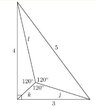
We can then transform the problem into one of a geometrical nature by constructing segments of length $a,\,b$ and $c$ inside a $3-4-5$ triangle as shown:

View attachment 2861
Next, using the fact that the area of any triangle is $\dfrac{xy\sin Z}{2}$, we get that

$\dfrac{ab\sin 120^{\circ}}{2}+\dfrac{bc\sin 120^{\circ}}{2}+\dfrac{ca\sin 120^{\circ}}{2}=\dfrac{\sqrt{3}(ab+bc+ca)}{2(2)}=6$ and so $ab+bc+ca=8\sqrt{3}$.

Adding all three original equations together yields

$2(a^2+b^2+c^2)+ab+bc+ca=50$

Plugging the value of $ab+bc+ca$ in and simlyflying gives $a^2+b^2+c^2=25-4\sqrt{3}$, finally,

$(a+b+c)^2=a^2+b^2+c^2+2(a+bc+ca)=25-4\sqrt{3}+2(8\sqrt{3})=25+12\sqrt{3}$.
 

Attachments

  • Find (a+b+c)^2.JPG
    Find (a+b+c)^2.JPG
    8.2 KB · Views: 129
anemone said:
Well done, Opalg! And thanks for participating!:)

I've another good solution to share with the members at MHB:
Note that the system of equations can be transformed into$a^2+b^2-2ab\cos 120^{\circ}=9$

$b^2+c^2-2bc\cos 120^{\circ}=16$

$c^2+a^2-2ca\cos 120^{\circ}=25$

We can then transform the problem into one of a geometrical nature by constructing segments of length $a,\,b$ and $c$ inside a $3-4-5$ triangle as shown:

https://www.physicsforums.com/attachments/2861
Next, using the fact that the area of any triangle is $\dfrac{xy\sin Z}{2}$, we get that

$\dfrac{ab\sin 120^{\circ}}{2}+\dfrac{bc\sin 120^{\circ}}{2}+\dfrac{ca\sin 120^{\circ}}{2}=\dfrac{\sqrt{3}(ab+bc+ca)}{2(2)}=6$ and so $ab+bc+ca=8\sqrt{3}$.

Adding all three original equations together yields

$2(a^2+b^2+c^2)+ab+bc+ca=50$

Plugging the value of $ab+bc+ca$ in and simlyflying gives $a^2+b^2+c^2=25-4\sqrt{3}$, finally,

$(a+b+c)^2=a^2+b^2+c^2+2(a+bc+ca)=25-4\sqrt{3}+2(8\sqrt{3})=25+12\sqrt{3}$.
Very elegant solution! I suspected that the numbers 9, 16, 25 ought to have some significance in this problem, but I could not see how.
 
Opalg said:
Very elegant solution! I suspected that the numbers 9, 16, 25 ought to have some significance in this problem, but I could not see how.

Thank you, Opalg for your compliment! I know I'm not the solver, but when you or any other members who liked my shared solutions (that are of others' production), I feel very delighted and happy! The number one and foremost reason that fuels my happiness is I love to be acknowledged by the fact that there are members who also liked and enjoyed that particular challenge problem as much as I did!:o