Solving a First Order Inhomogeneous ODE for a Regular LR Circuit with AC Voltage

  • Context: Graduate 
  • Thread starter Thread starter Waxterzz
  • Start date Start date
  • Tags Tags
    First order Ode
Click For Summary
SUMMARY

This discussion focuses on solving a first-order inhomogeneous ordinary differential equation (ODE) for a regular LR circuit with alternating current (AC) voltage. The user initially attempted to derive the solution using undetermined coefficients and Cramer's Rule, ultimately arriving at a general solution comprising exponential, cosine, and sine terms. A key insight shared involves utilizing the cosine difference identity to express the solution in a desired form, with specific attention to the parameters R (resistance), ω (angular frequency), and L (inductance). The user corrected a mistake regarding the evaluation of the sine term at t=0, leading to a more accurate solution.

PREREQUISITES
  • Understanding of first-order ordinary differential equations (ODEs)
  • Familiarity with LR circuits and AC voltage concepts
  • Knowledge of undetermined coefficients and Cramer's Rule
  • Proficiency in trigonometric identities, specifically the cosine difference identity
NEXT STEPS
  • Study the application of Cramer's Rule in solving differential equations
  • Learn about the behavior of LR circuits under AC voltage
  • Explore the derivation and application of trigonometric identities in circuit analysis
  • Investigate numerical methods for comparing analytical solutions in electrical engineering
USEFUL FOR

Electrical engineers, physics students, and anyone involved in circuit analysis or differential equations will benefit from this discussion, particularly those working with LR circuits and AC voltage solutions.

Waxterzz
Messages
82
Reaction score
0
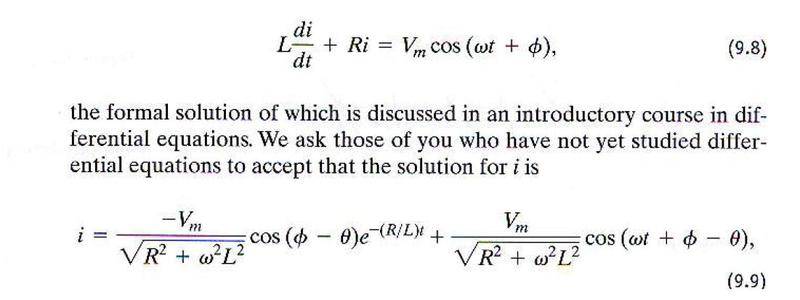
For a regular LR circuit (L and R in series) and with a AC voltage:
R8yRjNY.jpg


I tried to derive the solution myself.

https://www.dropbox.com/s/jmsu9j0vt91ze8x/LRcircuit.jpg

So first I solved with undetermined coefficients, plugged them in, and then solved with Cramer's Rule.

Then I added the term (the solution for the homogeneous case) with the solution I got with undertermined coefficients.

Then I used initial value: the current i(t) at t=0 is 0.

Then I got the general solution: an exponential term, a cosine term and a sine term. But my solution is quite different from the book.


Can anyone help me?
 
Physics news on Phys.org
Your solutions looks correct.

To get it into the above form you have to use the cos difference identity...

[itex]\cos {\left(\left(\omega t + \phi\right) - \theta\right)}=\cos {\left(\omega t + \phi\right)}\cos {\theta}+\sin {\left(\omega t + \phi\right)} \sin {\theta}[/itex]

The trick is to figure out what [itex]\theta[/itex] is in terms of [itex]R,\omega, L[/itex]. To do this think of a right triangle with sides [itex]R[/itex] and [itex]\omega L[/itex].
 
  • Like
Likes   Reactions: 1 person
the_wolfman said:
Your solutions looks correct.

To get it into the above form you have to use the cos difference identity...

[itex]\cos {\left(\left(\omega t + \phi\right) - \theta\right)}=\cos {\left(\omega t + \phi\right)}\cos {\theta}+\sin {\left(\omega t + \phi\right)} \sin {\theta}[/itex]

The trick is to figure out what [itex]\theta[/itex] is in terms of [itex]R,\omega, L[/itex]. To do this think of a right triangle with sides [itex]R[/itex] and [itex]\omega L[/itex].

I made a mistake in my solution bye the way.

In evaluating the coefficient of C of the exponential term, when I took t = 0 I let the sine term vanishes but that doesn't vanishes sin (wt + q) it become sin (q). I was thinking about sin (wt) becomes zero, yes but not with a phase angle between the brackets. Stupid mistake.

This the correct one:

https://www.dropbox.com/s/ne1wo9wknk3s1mw/20140711_121219~2.jpg

Then I used a numerical example to comparize mine solution with the one for the book.

No idea how I will get it in that form from the book. :) I'm going to try later this day. Thanks for your identity.Edit: I got it! Thanks again for your identity. I will post solution to be complete soon. :)
 
Last edited:

Similar threads

  • · Replies 2 ·
Replies
2
Views
2K
  • · Replies 5 ·
Replies
5
Views
2K
  • · Replies 3 ·
Replies
3
Views
3K
  • · Replies 2 ·
Replies
2
Views
4K
  • · Replies 4 ·
Replies
4
Views
3K
  • · Replies 6 ·
Replies
6
Views
2K
  • · Replies 2 ·
Replies
2
Views
3K
  • · Replies 1 ·
Replies
1
Views
2K
Replies
1
Views
2K
  • · Replies 36 ·
2
Replies
36
Views
6K