Solving Problem 4 of DJ Griffiths Electrodynamics Chapter 9

Click For Summary

Homework Help Overview

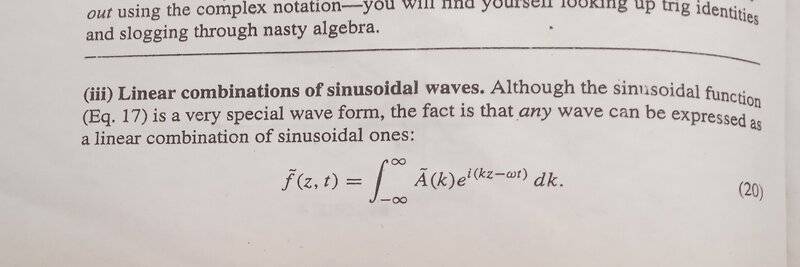
The discussion revolves around Problem 4 from Chapter 9 of DJ Griffiths' Electrodynamics, specifically focusing on deriving equation 20 from the wave equation using the method of separation of variables.

Discussion Character

  • Exploratory, Conceptual clarification, Mathematical reasoning

Approaches and Questions Raised

  • Participants discuss the steps involved in applying the separation of variables method to the wave equation, with some questioning the familiarity with this technique. Others express a desire for guidance rather than direct solutions.

Discussion Status

Some participants have offered general steps to approach the problem, emphasizing the importance of understanding the separation of variables method. There is acknowledgment of prior attempts by the original poster, indicating ongoing engagement with the problem.

Contextual Notes

The original poster seeks assistance without wanting a complete solution, indicating a preference for guidance that fosters independent problem-solving.

Zeeshan Ahmad
Gold Member
Messages
24
Reaction score
9
Thread moved from the technical forums, and the OP has been reminded to show their work.
Homework Statement
Obtain eq 20(show in the below picture)
Directly from the waves equation by separation of variable
Relevant Equations
linear combinations of sinusoidal waves
While I was doing a problems of chapter 9 of DJ griffith electrodynamics

I came across this problem 4
Problem statement
Obtain eq 20(show in the below picture)
Directly from the waves equation by separation of variable
IMG_20210916_113300.jpg

Could I have a straight solution in your word
Thank you
 
Physics news on Phys.org
No, but some help to find the solution yourself. Roughly speaking you just need to do two steps (which are always the same for such linear partial differential equations!):

(a) write down the wave equation
(b) write down the separation ansatz, plug it into the wave equation and find the corresponding mode functions
 
  • Like
Likes   Reactions: vela and berkeman
Are you familiar with the method of separation of variables for solving PDEs? It's definitely something you should learn, if not.
 
I have posted it in the morning and done it up till when I got response to it
But thanks for the response 😊
From mr vanhees and vela
 
Last edited:

Similar threads

  • · Replies 45 ·
2
Replies
45
Views
5K
  • · Replies 6 ·
Replies
6
Views
3K
  • · Replies 3 ·
Replies
3
Views
4K
  • · Replies 3 ·
Replies
3
Views
622
  • · Replies 6 ·
Replies
6
Views
991
  • · Replies 2 ·
Replies
2
Views
2K
  • · Replies 7 ·
Replies
7
Views
2K
  • · Replies 1 ·
Replies
1
Views
671
  • · Replies 10 ·
Replies
10
Views
2K
  • · Replies 8 ·
Replies
8
Views
2K