Telemachus
- 820
- 30
Hi there. I'm starting with the Fourier transforms, and I'm having some trouble with my first exercise on this topic.
The problem says: Given [tex]f(x)=H(x)-H(x-l)[/tex] (H(x) is the Heaviside unit step function).
a) Consider the odd extension for f and find its Fourier integral representation.
b) Using the previous incise calculate the value for [tex]\int_0^{\infty}\frac{1-cos (\omega l)}{\omega}\sin (\omega l) d\omega[/tex]
Well, for a) I think I should get the Fourier transfor for the sign function, I don't know if this is right, but anyway I've defined the function like this:
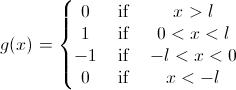
Then the Fourier integral representation:
[tex]g(x)=\displaystyle\frac{1}{2\pi}\displaystyle\int_{-\infty}^{\infty}\displaystyle\int_{-\infty}^{\infty}g(x)e^{-i \omega x}dx e^{i \omega x}d\omega[/tex]
But g(x) is odd, then:

And the thing is that the integral for the cosine diverges as I see it, but I'm probably doing something wrong.
Help please :)
PD, I don't know why latex isn't working in some cases, so I've attached some images.
The problem says: Given [tex]f(x)=H(x)-H(x-l)[/tex] (H(x) is the Heaviside unit step function).
a) Consider the odd extension for f and find its Fourier integral representation.
b) Using the previous incise calculate the value for [tex]\int_0^{\infty}\frac{1-cos (\omega l)}{\omega}\sin (\omega l) d\omega[/tex]
Well, for a) I think I should get the Fourier transfor for the sign function, I don't know if this is right, but anyway I've defined the function like this:
Then the Fourier integral representation:
[tex]g(x)=\displaystyle\frac{1}{2\pi}\displaystyle\int_{-\infty}^{\infty}\displaystyle\int_{-\infty}^{\infty}g(x)e^{-i \omega x}dx e^{i \omega x}d\omega[/tex]
But g(x) is odd, then:
And the thing is that the integral for the cosine diverges as I see it, but I'm probably doing something wrong.
Help please :)
PD, I don't know why latex isn't working in some cases, so I've attached some images.
Attachments


Last edited:
