Solving Acceleration Problem: Find a3 Differently

  • Thread starter Thread starter varunKanpur
  • Start date Start date
  • Tags Tags
    Acceleration
Join the discussion
Ask a follow-up here, or get your own question answered by working scientists, mathematicians and engineers — people, not an autocomplete.
Real named experts · corrections over time · the nuance an AI answer skips
1 reply · 1K views
varunKanpur
Messages
7
Reaction score
0
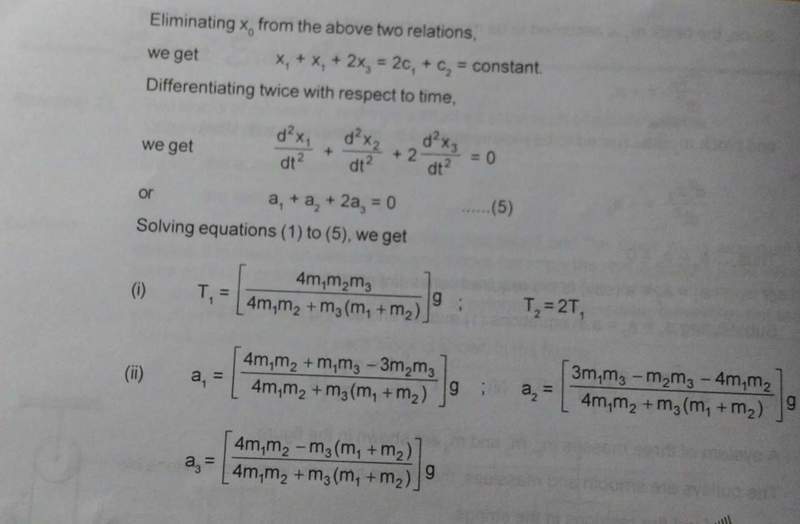
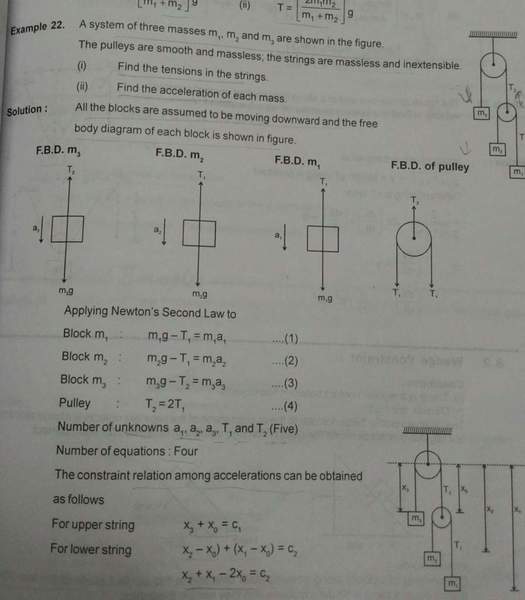
I am thinking of finding a3 through another way in this solved question
attachment.php?attachmentid=72787&stc=1&d=1410005214.jpg

attachment.php?attachmentid=72783&stc=1&d=1410005022.jpg


I am thinking of considering m2 and m1 as one mass but answer in not matching. I couldn't find what I am doing wrong.
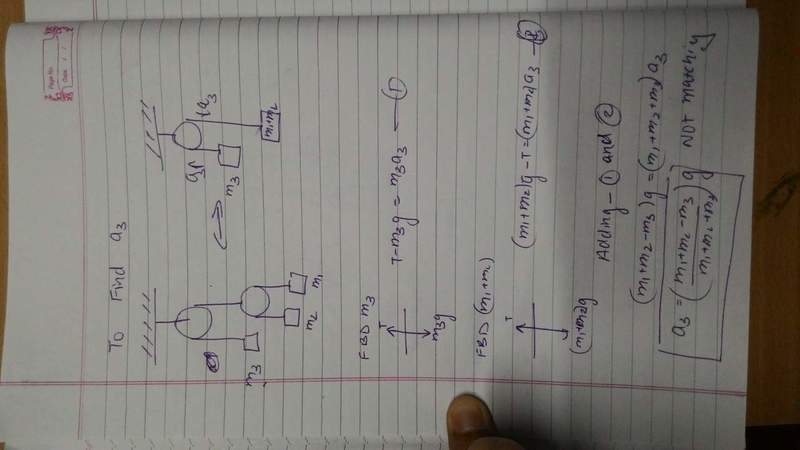
attachment.php?attachmentid=72782&stc=1&d=1410005022.jpg


Thanx in advance .
 

Attachments

  • P_20140906_170407.jpg
    P_20140906_170407.jpg
    29.5 KB · Views: 441
  • P_20140906_170708_1.jpg
    P_20140906_170708_1.jpg
    25.6 KB · Views: 441
  • P_20140906_165444_1.jpg
    P_20140906_165444_1.jpg
    25.9 KB · Views: 457
Physics news on Phys.org
varunKanpur said:
I am thinking of considering m2 and m1 as one mass but answer in not matching. I couldn't find what I am doing wrong.
The problem with treating m1 and m2 as a single system is that the acceleration you'll find (using Newton's 2nd law) will be the acceleration of their center of mass. That acceleration is not the same as the acceleration of the pulley.

If m1 and m2 were fixed together, instead of in relative motion, then you'd be fine. (Obviously, that is not the case here.)