Graduate Solving an Equation: Overcoming the r's

  • Thread starter Thread starter mhirschb
  • Start date Start date
Click For Summary
SUMMARY

This discussion clarifies the steps involved in solving an equation related to magnetic vector potentials, specifically transitioning from Aθ to Bz and vice versa. The key steps include multiplying by r, differentiating or integrating with respect to r, and dividing by r. The introduction of r' as a dummy variable during integration is essential to avoid confusion and potential infinities at r = 0. This method ensures clarity in the evaluation of the magnetic vector potential.

PREREQUISITES
  • Understanding of magnetic vector potentials
  • Familiarity with calculus, particularly differentiation and integration
  • Knowledge of dummy variables in integration
  • Basic concepts of definite integrals
NEXT STEPS
  • Study the use of dummy variables in calculus
  • Learn about magnetic vector potentials in electromagnetism
  • Explore definite integrals and their applications
  • Review differentiation techniques in multivariable calculus
USEFUL FOR

Students and professionals in physics, particularly those focusing on electromagnetism, as well as mathematicians and engineers dealing with vector calculus and integration techniques.

mhirschb
Messages
3
Reaction score
0
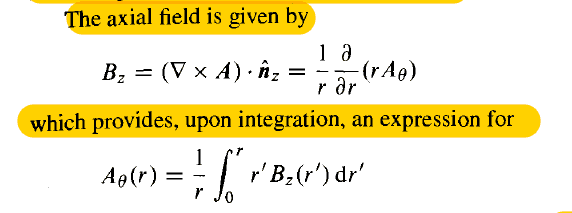
I feel silly but I've been looking at this equation for a while and I don't fully understand the individual steps taken to go from the top line to the bottom line:
MVP theta component.png


I think I am getting caught up with all the r's in the equation. I recognize that on the second line "r" describes the point at which we are evaluating the MVP, and r' is the domain of r that we're integrating over.
I'm confused because it looks like they've taken the 1/r and changed it to r' on the other side.
 
Physics news on Phys.org
The first equation obtains B_z from A_\theta bythe following steps:
  • Multiply by r.
  • Differentiate with respect to r.
  • Divide by r.

Therefore A_\theta is obtained from B_z by reversing these steps:
  • Multiply by r.
  • Integrate with respect to r. This is done as a definite integral with lower limit 0, because any other choice of lower limit would make A_\theta potentially infinite at r = 0. This definite integration requires the introduction of r' as a dummy variable of integration, because it is bad practise to use r as both a limit of the integral and the dummy variable of integration.
  • Divide by r.
 
pasmith said:
The first equation obtains B_z from A_\theta bythe following steps:
  • Multiply by r.
  • Differentiate with respect to r.
  • Divide by r.

Therefore A_\theta is obtained from B_z by reversing these steps:
  • Multiply by r.
  • Integrate with respect to r. This is done as a definite integral with lower limit 0, because any other choice of lower limit would make A_\theta potentially infinite at r = 0. This definite integration requires the introduction of r' as a dummy variable of integration, because it is bad practise to use r as both a limit of the integral and the dummy variable of integration.
  • Divide by r.
Ah! It makes so much sense now I wanna facepalm!

Thank you for the explanation. It became clear when I needed to introduce the dummy variable r'.
 

Similar threads

  • · Replies 11 ·
Replies
11
Views
3K
Replies
3
Views
1K
  • · Replies 1 ·
Replies
1
Views
3K
  • · Replies 9 ·
Replies
9
Views
2K
Replies
7
Views
2K
  • · Replies 7 ·
Replies
7
Views
2K
  • · Replies 1 ·
Replies
1
Views
2K
  • · Replies 1 ·
Replies
1
Views
1K
  • · Replies 7 ·
Replies
7
Views
2K
  • · Replies 5 ·
Replies
5
Views
4K