nacho-man
- 166
- 0
This one is bugging me!
Let ${Z_t}$ ~ $(0, \sigma^2)$
And $X_t = Z_t + \theta Z_t$
im trying to find the autocovariance function $\gamma(t+h,t)$ And nearly have it, but am struggling with some conceptual issues :S
$\gamma(t+h,t) = \text{COV}[Z_{t+h} + \theta Z_{t-1+h}, Z_t + \theta Z_t-1]$
= $\text{COV}(Z_{t+h}, Z_t) + \theta \text{COV}(Z_{t+h}, Z_{t-1}) + \theta \text{COV}(Z_{t-1+h}, Z_t) + \theta^2 \text{COV}(Z_{t-1+h}, Z_{t-1})$
$\text{COV}(Z_{t+h}, Z_t) = \sigma^2$ (at $h=0$)
$\theta \text{COV}(Z_{t+h}, Z_{t-1})$ = $\theta \sigma^2$ (at $h=-1$)
$ \theta \text{COV}(Z_{t-1+h}, Z_t)$ = $\theta \sigma^2$ (at $h=1$)
$ \theta^2 \text{COV}(Z_{t-1+h}, Z_{t-1})$ = $\theta^2 \sigma^2$ (at $h=0$)
So, to summarise,
for h = 0, autocovariance = $\sigma^2 + \theta^2 \sigma^2$
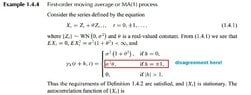
for h = |1|, autocovariance = $\theta \sigma^2 + \theta \sigma^2$ = $2 \theta \sigma^2$ <<< textbook disagrees here!
f0r h>|1|, autocovariance = 0
The answers are attached to this post, I have a discrepancy for h=|1| and cannot see why. Is there a typo in the book?I Have an additional follow up question, depending on the response i receive for this initial post!
Any help very much appreciated as always,
thank you in advance.
Let ${Z_t}$ ~ $(0, \sigma^2)$
And $X_t = Z_t + \theta Z_t$
im trying to find the autocovariance function $\gamma(t+h,t)$ And nearly have it, but am struggling with some conceptual issues :S
$\gamma(t+h,t) = \text{COV}[Z_{t+h} + \theta Z_{t-1+h}, Z_t + \theta Z_t-1]$
= $\text{COV}(Z_{t+h}, Z_t) + \theta \text{COV}(Z_{t+h}, Z_{t-1}) + \theta \text{COV}(Z_{t-1+h}, Z_t) + \theta^2 \text{COV}(Z_{t-1+h}, Z_{t-1})$
$\text{COV}(Z_{t+h}, Z_t) = \sigma^2$ (at $h=0$)
$\theta \text{COV}(Z_{t+h}, Z_{t-1})$ = $\theta \sigma^2$ (at $h=-1$)
$ \theta \text{COV}(Z_{t-1+h}, Z_t)$ = $\theta \sigma^2$ (at $h=1$)
$ \theta^2 \text{COV}(Z_{t-1+h}, Z_{t-1})$ = $\theta^2 \sigma^2$ (at $h=0$)
So, to summarise,
for h = 0, autocovariance = $\sigma^2 + \theta^2 \sigma^2$
for h = |1|, autocovariance = $\theta \sigma^2 + \theta \sigma^2$ = $2 \theta \sigma^2$ <<< textbook disagrees here!
f0r h>|1|, autocovariance = 0
The answers are attached to this post, I have a discrepancy for h=|1| and cannot see why. Is there a typo in the book?I Have an additional follow up question, depending on the response i receive for this initial post!
Any help very much appreciated as always,
thank you in advance.
Attachments
Last edited: