libelec
- 173
- 0
I have these two circuits with permanent rule:
a)
b)
I'm asked to find:
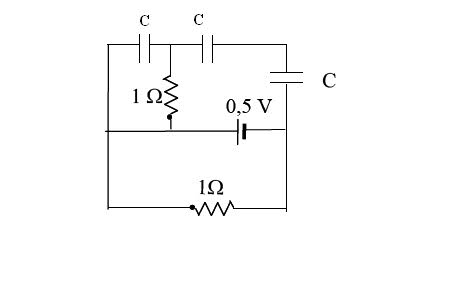
For a): the charges of each capacitor (C = 1 [tex]\mu[/tex]F)and the currents in each resistance.
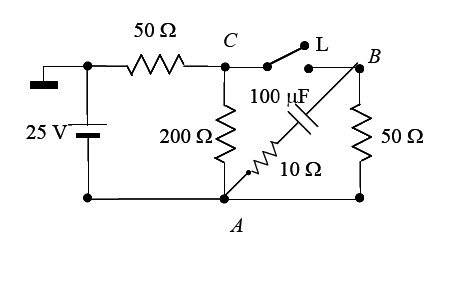
For b): the currents in each branch with the L switch on and off, the difference of potential between A and C, A and B and C and B with the L switch on and off. The power given by the battery with L on and off and finally the charge of the capacitor with the switch on
Here's my problem: I believe that, after a capacitor is charged, current doesn't flow through the branch that it's in, since after it's charged, it adquires the diference of potential of the battery (between its plaques) and therefore current shouldn't flow there. Is this correct?
Now, in each problem I have questions:
For a): Does each capacitor have the same difference of potential between its plaques, that of the battery (0,5V)? Is it OK to say that current isn't flowing through the 1 ohm resistance because it's connected to a branch that has a capacitor in it, and then current wouldn't be able to "escape" there?
For b): If the switch is off, is the equivalent circuit that square formed by the battery, the 50 ohm resistance and the 100 ohm resistance? Or does current somehow pass through the capacitor's branch (this relates to my original question).
Then, when the switch is on, should I consider each subdivision created by the diagonal branch in the second "square" for the Kirchhoff's Circuits Rule, or should I assume there's no current going through that branch (because the capacitor is charged?) and therefore I consider the whole square as the circuit?
Thanks.
a)
b)
I'm asked to find:
For a): the charges of each capacitor (C = 1 [tex]\mu[/tex]F)and the currents in each resistance.
For b): the currents in each branch with the L switch on and off, the difference of potential between A and C, A and B and C and B with the L switch on and off. The power given by the battery with L on and off and finally the charge of the capacitor with the switch on
The Attempt at a Solution
Here's my problem: I believe that, after a capacitor is charged, current doesn't flow through the branch that it's in, since after it's charged, it adquires the diference of potential of the battery (between its plaques) and therefore current shouldn't flow there. Is this correct?
Now, in each problem I have questions:
For a): Does each capacitor have the same difference of potential between its plaques, that of the battery (0,5V)? Is it OK to say that current isn't flowing through the 1 ohm resistance because it's connected to a branch that has a capacitor in it, and then current wouldn't be able to "escape" there?
For b): If the switch is off, is the equivalent circuit that square formed by the battery, the 50 ohm resistance and the 100 ohm resistance? Or does current somehow pass through the capacitor's branch (this relates to my original question).
Then, when the switch is on, should I consider each subdivision created by the diagonal branch in the second "square" for the Kirchhoff's Circuits Rule, or should I assume there's no current going through that branch (because the capacitor is charged?) and therefore I consider the whole square as the circuit?
Thanks.