Solving Complex Number With Negative Fractional Exponent: i^(-21/2)

Join the discussion
Ask a follow-up here, or get your own question answered by working scientists, mathematicians and engineers — people, not an autocomplete.
Real named experts · corrections over time · the nuance an AI answer skips
6 replies · 3K views
Asawira Emaan
Messages
12
Reaction score
0
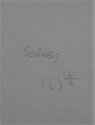
Kindly help me with this.
Solve
i^(-21/2)
Note: i means iota.
 

Attachments

  • WIN_20181114_23_02_32_Pro.jpg
    WIN_20181114_23_02_32_Pro.jpg
    5.3 KB · Views: 155
Physics news on Phys.org
I think I would begin by writing:

$$z=i^{-\frac{21}{2}}=\left(\cis\left(\frac{\pi}{2}\right)\right)^{-\frac{21}{2}}=\cis\left(-\frac{21\pi}{4}\right)=\cis\left(\frac{3\pi}{4}\right)=\frac{-1+i}{\sqrt{2}}$$

Does that make sense?
 
Asawira Emaan said:
Kindly help me with this.
Solve
i^(-21/2)
Note: i means iota.

Hi Asawira Emaan, welcome to MHB!

Are you aware that $i=e^{\frac\pi 2 i}=\cos(\pi/2)+i\sin(\pi/2)$?
It means that we can calculate it as:
$$(i)^{-\frac{21}{2}} = (e^{\frac\pi 2 i})^{-\frac{21}{2}}
= e^{-\frac{21\pi}{4}i} = \cos\left(-\frac{21\pi}{4}\right)+i\sin\left(-\frac{21\pi}{4}\right)
$$
 
MarkFL said:
I think I would begin by writing:

$$z=i^{-\frac{21}{2}}=\left(\cis\left(\frac{\pi}{2}\right)\right)^{-\frac{21}{2}}=\cis\left(-\frac{21\pi}{4}\right)=\cis\left(\frac{3\pi}{4}\right)=\frac{-1+i}{\sqrt{2}}$$

Does that make sense?

Klaas van Aarsen said:
Hi Asawira Emaan, welcome to MHB!

Are you aware that $i=e^{\frac\pi 2 i}=\cos(\pi/2)+i\sin(\pi/2)$?
It means that we can calculate it as:
$$(i)^{-\frac{21}{2}} = (e^{\frac\pi 2 i})^{-\frac{21}{2}}
= e^{-\frac{21\pi}{4}i} = \cos\left(-\frac{21\pi}{4}\right)+i\sin\left(-\frac{21\pi}{4}\right)
$$

but the answer of this question is -i (negative iota)
 
Asawira Emaan said:
but the answer of this question is -i (negative iota)

It is true that:

$$i^{-21}=-i$$

But:

$$i^{-\frac{21}{2}}\ne-i$$
 
Oh yes!
Thanks for help