Solving Double Integral with Polar Coordinates

Click For Summary
SUMMARY

The discussion focuses on the computation of the double integral using polar coordinates, specifically the integral of the function \(\frac{1}{\sqrt{x^2+y^2}}\). The correct solution is provided by Mathematica, while an incorrect approach using polar coordinates leads to an infinite result due to the improper handling of the limits at the origin. Participants highlight the necessity of addressing the singularity at the origin by restricting the radius of integration.

PREREQUISITES
  • Understanding of double integrals in calculus
  • Familiarity with polar coordinates and their application in integration
  • Knowledge of Mathematica for computational verification
  • Concept of handling singularities in integrals
NEXT STEPS
  • Study the correct application of polar coordinates in double integrals
  • Learn about handling singularities in integration, particularly in polar coordinates
  • Explore Mathematica's capabilities for solving integrals and verifying results
  • Research techniques for setting limits in integrals to avoid infinite results
USEFUL FOR

Students and professionals in mathematics, particularly those studying calculus and integral equations, as well as anyone interested in computational tools like Mathematica for solving complex integrals.

asmani
Messages
104
Reaction score
0
Hi all.

Suppose that we want to compute the following indefinite integral:

attachment.php?attachmentid=44459&stc=1&d=1330362487.png


The correct solution by Mathematica:

attachment.php?attachmentid=44460&stc=1&d=1330362487.png


Now here is the (apparently) incorrect solution by using polar coordinates:
[tex]\iint\frac{1}{\sqrt{x^2+y^2}}dxdy=\iint\frac{1}{r}rdrd\theta=(r+c_1)(\theta+c_2)[/tex]
If c1=c2=0, then one solution is:
[tex]r\theta=\sqrt{x^2+y^2}\tan^{-1}\left ( \frac{y}{x} \right )[/tex]
But it isn't:
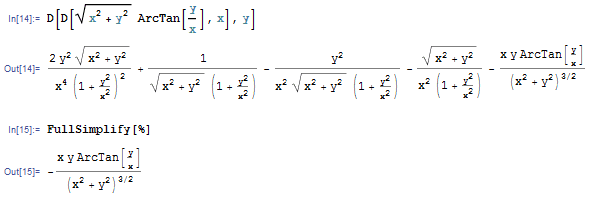
attachment.php?attachmentid=44461&stc=1&d=1330362487.png


What's wrong with this solution?

Thanks in advance.
 

Attachments

  • 1.png
    1.png
    839 bytes · Views: 586
  • 2.png
    2.png
    881 bytes · Views: 574
  • 3.png
    3.png
    4 KB · Views: 609
Physics news on Phys.org
## \iint\frac{1}{r}rdrd\theta ## looks good to me but that would just be ## \iint drd\theta ## with ## 0<r<\infty ## and ## 0<\theta<2\pi ## which is ## \infty ##. I was already worried about that when I saw the pole at the origin but apparently you can fix it by chopping the radius of interest.
 

Similar threads

  • · Replies 1 ·
Replies
1
Views
3K
  • · Replies 2 ·
Replies
2
Views
3K
  • · Replies 2 ·
Replies
2
Views
2K
  • · Replies 8 ·
Replies
8
Views
3K
  • · Replies 4 ·
Replies
4
Views
2K
  • · Replies 1 ·
Replies
1
Views
2K
  • · Replies 5 ·
Replies
5
Views
2K
  • · Replies 29 ·
Replies
29
Views
5K
  • · Replies 6 ·
Replies
6
Views
3K
  • · Replies 3 ·
Replies
3
Views
2K
