Solving Equations: Does Squaring Make False True?

Click For Summary
SUMMARY

This discussion centers on the introduction of extraneous solutions when squaring equations, specifically in the context of the equation 2x - 1 = -√(2 - x). The participants clarify that while squaring both sides can yield new potential solutions, such as x = 1, these solutions must be verified against the original equation. The final conclusion is that x = -1/4 is a valid solution, while x = 1 is not, highlighting the necessity of checking solutions after manipulating equations.

PREREQUISITES
  • Understanding of algebraic manipulation, including squaring equations.
  • Familiarity with solving quadratic equations and factoring.
  • Knowledge of extraneous solutions and their implications in algebra.
  • Basic comprehension of square roots and their properties.
NEXT STEPS
  • Study the implications of squaring both sides of an equation in algebra.
  • Learn about the process of verifying solutions after solving equations.
  • Explore the concept of extraneous solutions in greater depth.
  • Practice solving quadratic equations using various methods, including factoring and the quadratic formula.
USEFUL FOR

Students and educators in mathematics, particularly those focusing on algebra and equation solving, as well as anyone interested in understanding the nuances of extraneous solutions in mathematical equations.

mark2142
Messages
228
Reaction score
42
Homework Statement
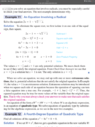
“We know extraneous solutions may get introduced when we square the two sides of an equation because the operation of squaring can turn a false equation into true one”.
Relevant Equations
##2x-1= -\sqrt{2-x}##
Does this mean for x=1 , ##2(1)-1= -\sqrt{2-1}## is false. x=1 is not a solution.
But as we square the above equation , ##(2(1)-1)^2=(-\sqrt{2-1})^2## , false equation becomes true. So now x=1 is solution to the new equation ?

(Here is the paragraph attached) from book James Stewart.
 

Attachments

  • IMG_0013.png
    IMG_0013.png
    53 KB · Views: 129
Physics news on Phys.org
This is a common mistake. It is perfectly valid to square the equation. But what does that mean?
$$
2x-1=-\sqrt{2-x}\;\Longrightarrow \; (2x-1)^2=4x^2-4x+1=2-x \;\Longrightarrow \;4x^2-3x-1=(x-1)(4x+1)=0
$$
and ##x=1## is a possible solution. The misconception, however, is that we deduced a necessary condition by every single step. The full conclusion reads ##x\in \left\{1, -\frac{1}{4}\right\}.## This is necessary. It is NOT sufficient! Squaring prevents us from reversing the steps to the left, so we have only a necessary, no sufficient solution.

We always have to make sure, that the solutions, here ##1## and ##-1/4## are indeed solutions. We have to put it into our first equation so that we find:
\begin{align*}
2\cdot 1-1&=1\neq -1=-\sqrt{2-1}\\
2\cdot (-1/4)-1&=-3/2= -\sqrt{2-(-1/4)}=-\sqrt{2.25}=-1.5
\end{align*}
and only ##x=-1/4## is also a sufficient condition for our primary equation to hold.
 
mark2142 said:
So now x=1 is solution to the new equation ?
Yes it is. It's just that the new equation is not equivalent to the old one !

[edit]typed far less than Fresh but took a lot longer to do it :nb)

##\ ##
 
I don’t understand. I am asking how are extraneous solutions introduced? Does anyone get what I am saying?
 
mark2142 said:
I don’t understand. I am asking how are extraneous solutions introduced? Does anyone get what I am saying?
If you have ##x=1## as equation, then it is ##x-1=0.## Building
$$
(x-1)\cdot (x-a_1)\cdot \ldots\cdot(x-a_n)=0
$$
gets you as many solutions as you want.
 
mark2142 said:
Does anyone get what I am saying?
I think I do. And I surely know what you are asking:
mark2142 said:
So now x=1 is solution to the new equation ?
And the answer is 'Yes it is'.

Do you understand your own question and the affirmative answer ?

Now you have another question
mark2142 said:
I am asking how are extraneous solutions introduced?
which is answered in the homework statement already.

How can we help ?

##\ ##
 
mark2142 said:
I am asking how are extraneous solutions introduced?

BvU said:
which is answered in the homework statement already.
And here is the homework statement @BvU referred to:
“We know extraneous solutions may get introduced when we square the two sides of an equation because the operation of squaring can turn a false equation into true one”.
A better way to say the last part is that the operation of squaring changes the degree of the equation we're trying to solve to a higher power, which means that it will have additional solutions that aren't solutions of the lower-degree equation.
Very simple example:
##x = -2## -- solution set {-2}
Square both sides to get
##x^2 = 4 \Rightarrow x^2 - 4 = 0 \Rightarrow (x - 2)(x + 2) = 0## -- solution set {-2, 2}
 
mark2142 said:
Homework Statement: “We know extraneous solutions may get introduced when we square the two sides of an equation because the operation of squaring can turn a false equation into true one”.
Relevant Equations: ##2x-1= -\sqrt{2-x}##

Does this mean for x=1 , ##2(1)-1= -\sqrt{2-1}## is false. x=1 is not a solution.
But as we square the above equation , ##(2(1)-1)^2=(-\sqrt{2-1})^2## , false equation becomes true. So now x=1 is solution to the new equation ?

(Here is the paragraph attached) from book James Stewart.
Try a simpler example.

##x=1##
##x^2=1##
##x=1## and ##-1##

So yes, squaring introduces a new potential solution that needs to be tested. In this case ##x=-1## is not a solution because ##-1≠1##.

Is this what you are asking?
 
  • Like
Likes   Reactions: PeroK
YouAreAwesome said:
Try a simpler example.

##x=1##
##x^2=1##
##x=1## and ##-1##

So yes, squaring introduces a new potential solution that needs to be tested. In this case ##x=-1## is not a solution because ##-1≠1##.

Is this what you are asking?
Let me give it a try. Lets take ##x=-1##. I added -ve sign to make it analogous to our original equation ##2x-1=-\sqrt {2- x}##
##2x-1=-\sqrt {2- x}## equivalent to ##x=-1=-\sqrt 1##
(Here ##2x-1## expression is ##x## and ##2-x## expression is ##1##)
Solution: x=-1/4 and x=-1
Squaring both sides-
##(2x-1)^2=2- x## equivalent to ##x^2=1##
Factoring the left side:
##(x-1)(4x+1)=0## equivalent to ##(x-1)(x+1)=0##
Solutions: ##x=1,-1/4## and ##x=\pm1##
 
Last edited:
  • #10
@mark2142
Yes that is right.
In my simple example the ## x=-1 ## extraneous solution is introduced when we square both sides of ## x=1 ##.
And in your case the ## x=1 ## extraneous solution is introduced when we square both sides of ## 2x-1=-\sqrt{2-x} ##.
 
  • #11
YouAreAwesome said:
@mark2142
Yes that is right.
In my simple example the ## x=-1 ## extraneous solution is introduced when we square both sides of ## x=1 ##.
And in your case the ## x=1 ## extraneous solution is introduced when we square both sides of ## 2x-1=-\sqrt{2-x} ##.
Please verify each step so that I am sure I understood it in depth and not superficially.
 
  • #12
mark2142 said:
Please verify each step so that I am sure I understood it in depth and not superficially.
I'm not quite sure what you mean by in depth, and maybe someone higher up in the mathematics food chain can show this more precisely but I would say:

If ## x=a ## then ## a ## is the only solution.
However, if ## (x)^2=(a)^2 ## then both ## x=a ## and ## x=-a ## are solutions.

I don't know if this will help, but ## y=ax ## is a linear function i.e. a straight line where for every ## x ## there exists exactly one ## y ## and vice versa (one to one). While for the function ## y=\sqrt{(ax)^2}## for every ## x ## there exists exactly one ## y ## but for every ## y ## there exists exactly two value of ## x ## (many to one).
 
  • #13
YouAreAwesome said:
I'm not quite sure what you mean by in depth, a
I mean my all lines are right especially where I said ##2x-1## can be taken as ##x## and ##2-x## is ##1##?
 
  • #14
Actually I was searching for you, person whom I can understand because they are talking in the same language as my current maths book. So it becomes very easy to follow up. I don't understand much when people talk in high level language. You know what that means. HaHA :)
 
  • Like
Likes   Reactions: YouAreAwesome
  • #15
mark2142 said:
I mean my all lines are right especially where I said ##2x-1## can be taken as ##x## and ##2-x## is ##1##?
Yes, to me post #9 looked fine assuming I read it correctly. The part that was a little unclear was in your first solution ## x=-1/4 ## and ## x=-1 ##. I read this to mean that the ## x=-1 ## solution is in regard to my example and not meant to be a solution to your original equation.

mark2142 said:
Actually I was searching for you, person whom I can understand because they are talking in the same language as my current maths book. So it becomes very easy to follow up. I don't understand much when people talk in high level language. You know what that means. HaHA :)
Haha! Yes, I understand what you mean 😀.
 
  • Like
Likes   Reactions: mark2142
  • #16
mark2142 said:
Actually I was searching for you, person whom I can understand because they are talking in the same language as my current maths book. So it becomes very easy to follow up. I don't understand much when people talk in high level language. You know what that means. HaHA :)

You want it simple ?
##x=-x## is an equation with one solution: ##x=0##.

Squaring both sides gives you ##x^2 = x^2## which is a tautology (an equation which is satisfied for all ##x##).

So yes, squaring on both sides introduces extraneous solutions.

:wink:

##\ ##
 
  • Like
Likes   Reactions: YouAreAwesome
  • #17
BvU said:
You want it simple ?
##x=-x## is an equation with one solution: ##x=0##.

Squaring both sides gives you ##x^2 = x^2## which is a tautology (an equation which is satisfied for all ##x##).

So yes, squaring on both sides introduces extraneous solutions.

:wink:

##\ ##
I like when I am able to see in those complicated equations what simple things are going on in terms of ##x## and ##y##.
 
  • #18
YouAreAwesome said:
Haha! Yes, I understand what you mean 😀
By the way in post #9 I factored eqn ##1## (##(2x-1)^2=2- x##)by splitting the middle term and eqn ##2## (##x^2=1##) by the factoring formula ##A^2-B^2##. I don't think that will make any difference how we factor.
 
  • Like
Likes   Reactions: YouAreAwesome
  • #19
Is it possible to find the solution of ##2x-1=-\sqrt {2- x}## in the start without squaring?
I mean we know the solution of ##x=-1## is ##x=-1## at the start. So it would be good if we declare the solution of the original equation in the beginning if we are doing analogies.
 
  • #20
mark2142 said:
Is it possible to find the solution of ##2x-1=-\sqrt {2- x}## in the start without squaring?
I mean we know the solution of ##x=-1## is ##x=-1## at the start. So it would be good if we declare the solution of the original equation in the beginning if we are doing analogies.
I thought you might be able to do this:

## 0=2x - 1 + \sqrt{2-x}##
## 0=(2x - 1 + \sqrt{2-x})(2x - 1 - \sqrt{2-x}) ##
## 0=4x^2 - 4x + 1 - (2-x) ##
## 0=4x^2 - 3x - 1 ##
## 0=(x-1)(4x+1) ##

But by multiplying both sides by the conjugate we are also adding extraneous solutions as it is essentially squaring.

So as far as I know, we have to solve the equation by squaring, followed by a "test and check" to see if what we found were indeed solutions.
 
  • #21
In a more general sense, systems of equations, the equations, allow for some operations on them that preserve solutions, while other operations on them don't preserve the solution set. You may compare to systems of linear equations, where there are just 3 operations preserve solutions: exchanging rows, adding a multiple of a row to another row, and multiplying both sides of an equation by the same non-zero number. The operations that preserve solutions form a group, so, as Fresh pointed out, any such property must be reversible, as each element in a group is invertible.
 

Similar threads

  • · Replies 8 ·
Replies
8
Views
2K
  • · Replies 21 ·
Replies
21
Views
2K
  • · Replies 8 ·
Replies
8
Views
3K
Replies
10
Views
2K
  • · Replies 6 ·
Replies
6
Views
2K
Replies
3
Views
2K
Replies
4
Views
3K
Replies
6
Views
2K
  • · Replies 12 ·
Replies
12
Views
3K
  • · Replies 10 ·
Replies
10
Views
2K