Solving Exact Differentials: Confused by Independent Variables

  • Thread starter Thread starter Saladsamurai
  • Start date Start date
  • Tags Tags
    Differentials
Click For Summary
SUMMARY

The discussion centers on the confusion surrounding the classification of independent and dependent variables in the context of exact differentials. Participants clarify that the designation of variables as independent or dependent is often situational and serves the purpose of defining functions for differentiation. Specifically, the example of the equation x + y + z = 0 illustrates that any variable can be expressed as a function of the others, highlighting the flexibility in variable classification. Ultimately, the conversation emphasizes the importance of context in understanding variable relationships in mathematical equations.

PREREQUISITES
  • Understanding of exact differentials in calculus
  • Familiarity with thermodynamics concepts
  • Basic knowledge of functions and their classifications
  • Proficiency in manipulating algebraic equations
NEXT STEPS
  • Study the concept of exact differentials in calculus
  • Explore the role of independent and dependent variables in thermodynamics
  • Learn about function notation and its implications in mathematics
  • Practice solving equations with multiple variables and their interdependencies
USEFUL FOR

Students and professionals in mathematics, physics, and engineering who seek to deepen their understanding of variable relationships in equations, particularly in the context of thermodynamics and calculus.

Saladsamurai
Messages
3,009
Reaction score
7
I am reading a math review in my thermodynamics text and I a little confused by this. Here is the excerpt:
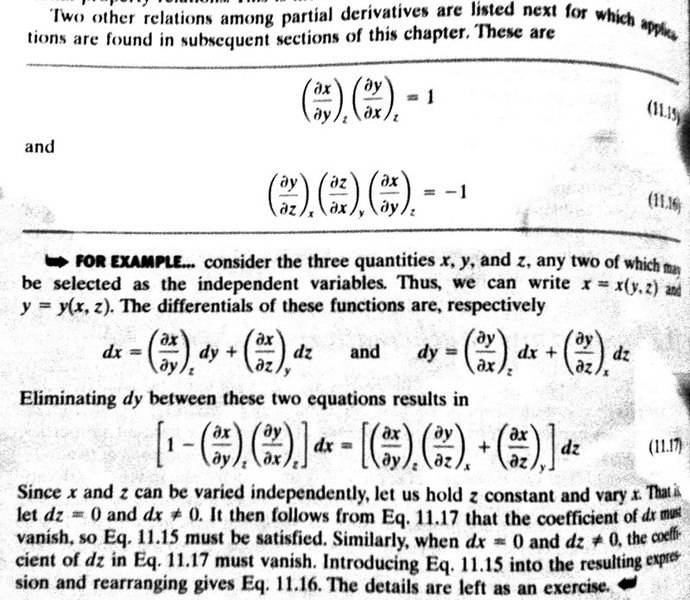
Doc-9_1_104_56PM-page-1.jpg


I am confused by the part where it says
For example ... consider 3 quantities x, y, and z, any of which may be selected as the independent variables. Thus we can write x = x(y, z) and y = y(x, z).

If they selected x = (y, z) then isn't that saying that x is dependent on y? So how can we just turn around and say y = y(x, z) ? That is, if we selected x as dependent in the first function, why can we turn around and call it independent in the second.

Sorry, this might be a stupid question. I just don't see why we bother calling variables independent and dependent in a situation like this?
 
Physics news on Phys.org
As a simple example if you had the equation x+y+z=0 you could write any variable as a function of the other two quite simply.

The dependent/independent lines are obviously blurred here; you just use them for the purposes of being able to describe what counts as a function and what's being considered as a variable when differentiating
 
Office_Shredder said:
As a simple example if you had the equation x+y+z=0 you could write any variable as a function of the other two quite simply.

The dependent/independent lines are obviously blurred here; you just use them for the purposes of being able to describe what counts as a function and what's being considered as a variable when differentiating

Office Shredder strikes again! Thanks boss. This explanation makes great sense. I figured I was over-analyzing the words here.

Thanks again!
~Casey
 

Similar threads

Replies
7
Views
2K
  • · Replies 6 ·
Replies
6
Views
3K
  • · Replies 8 ·
Replies
8
Views
2K
  • · Replies 1 ·
Replies
1
Views
1K
Replies
5
Views
2K
  • · Replies 26 ·
Replies
26
Views
3K
Replies
2
Views
1K
  • · Replies 3 ·
Replies
3
Views
2K
  • · Replies 5 ·
Replies
5
Views
2K