Solving Offset Slider Question: Vbo, Wab, Aba

  • Thread starter Thread starter Niall11
  • Start date Start date
  • Tags Tags
    Slider
Join the discussion
Ask a follow-up here, or get your own question answered by working scientists, mathematicians and engineers — people, not an autocomplete.
Real named experts · corrections over time · the nuance an AI answer skips
18 replies · 5K views
Niall11
Messages
11
Reaction score
0
Thread moved from the technical forums, so no Homework Template is shown
I've been struggling with this question and wondered if anyone could help;
For the mechanism shown determine for the angle θ = 45°:
(I) the velocity of the piston relative to the fixed point O (V bo)
(ii) the angular velocity of AB about point A (Wab)
iii) the acceleration of point B relative to A (Aba)
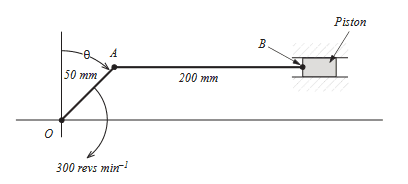
upload_2017-2-22_19-26-20.png


So far I know that Woa = 300 x 2.pi / 60 = 31.42 rad/s^-1

then Voa = r Woa = 50x10^-3 x 31.42 =1.57ms^-1

now I know that I have to use velocity diagrams to calculate Vbo but I'm just confused about how to do it and also how to know what direction each of the velocities are in, this has been stressing me out for a while so any help would be appreciated!
 

Attachments

  • upload_2017-2-22_19-19-7.png
    upload_2017-2-22_19-19-7.png
    4.6 KB · Views: 781
Physics news on Phys.org
thanks for your reply haruspex, I'm not sure how to break it up into horizontal and vertical components I've really hit a blank!
 
I thought that the tangential velocity was the value Voa, the length of the arm multiplied by its angular velocity?
 
Niall11 said:
I'm not sure how to break it up into horizontal and vertical components I've really hit a blank!
You have found the speed, and you know the direction. Do you not know how to find the component of a vector in another direction?
Nidum said:
What is the actual tangential velocity of point A in M/sec ?
Niall did all that in the OP. Am I missing something?
 
Do you mean using V (vertical) = V Sinθ and V (Horizonal) = V Cosθ to calculate the vertical and horizontal components?
 
So V = 1.57 Sin(45) = 1.11 vertical and]
V = 1.57 Cos(45) =1.11 Horizontally,

Assuming that B can only move horizontally then it would have the same velocity as Vao horizontal which = 1.11ms-1, then using this data I could find Wab and the acceleration, am I right in thinking B moves horizontally to A?
 
Niall11 said:
So V = 1.57 Sin(45) = 1.11 vertical and]
V = 1.57 Cos(45) =1.11 Horizontally,

Assuming that B can only move horizontally then it would have the same velocity as Vao horizontal which = 1.11ms-1, then using this data I could find Wab and the acceleration, am I right in thinking B moves horizontally to A?
Yes, its instantaneous motion is just that horizontal component.
 
OK I'm starting to get my head around it now thanks a lot for the help!
 
hi i am struggling with this question the example does not make sense to me in my work its a Teeside uni stuff any help will be appreciated
the rads = 31.42
velocity of the crank os 1.57m/s
and the tangentail velocity is 1.11m/s
but not sure how to work out
the angular velocity of link AB a maximum
and
What is the maximum angular velocity of link AB

thank you
 
haruspex said:
A crank is a rotating line. Different points on it have different speeds. What do you mean here?

Which tangential velocity?
hi
i can't think what i mean anymore as i been trying to solve this question and its not making any sense to me anymore
so the crank rotates at 300 revs a min and so the rads is 31.42 and the velocity of the crank is 1.57 meters. so using your suggestion of how to work out tangential velocity of vertical and horizontal

So V = 1.57 Sin(45) = 1.11 vertical and]
V = 1.57 Cos(45) =1.11 Horizontally,
( i take it that is for the crank not for the link ab)
now i can't seem to work out how to work out (velocity of ab)
and the acceleration either so if you could give me little help and push me in the right direction that would be great
and some help on part b (i)(ii)(iii)
thanks
 
ok i understand that now but how do i draw this
if i was i was to draw a line perpendicular to the crank at 90 degrees that would be end up at 135 degrees sort of. as it must travel trough O and the connecting rod also perpendicular but it must travel trough A but i am unable draw it like that it does not work. could you help
tank you
 
Hi
Am I making this more difficult for myself by looking at the slider crank mechanism examples online as none are the same and they work out the velocity of other vectors by drawing the velocity Diagram
Part a says
(I)Work out the velocity of piston relative to O (VBO)
(ii) angular velocity of link ab about a
(iii) the acceleration of point relative to a

Below the picture it say part
(b) determine the value of the angle
(Measured from vertical) when:
(i) the velocity of point B = 0
(ii) the angular velocity of link AB a maximum.
(c) What is the maximum angular

So the velocity of vbo is 1.11 m/s and the velocity of link an is 1.11 m/s
And velocity of link oa is 1.57 m/s
Or is this wrong
And how do I work out part b and c
Thanks
 
thor55 said:
velocity of link oa is 1.57 m/s
The velocity of point A is 1.57m/s. As I wrote in post #13, other parts of the link have different velocities.
For aii), you are asked for the angular velocity of point A about point B. What component of A's linear velocity is relevant to that?