Solving Spring, Block, Incline & Friction: Help Needed (Pictures Included)

Click For Summary
SUMMARY

The discussion focuses on solving a physics problem involving a block-spring system, specifically addressing the equations related to spring compression and energy conservation. Key equations mentioned include the energy balance equation .5kxi - Fkd = .5MVf^2 and the gravitational potential energy equation h = dsin(tht). The main challenge identified is the ambiguity in the problem statement regarding the spring's equilibrium length, which is crucial for determining the height the block travels. The consensus is that using conservation of energy principles is essential for solving the problem effectively.

PREREQUISITES
  • Understanding of Hooke's Law and spring constants (k)
  • Familiarity with energy conservation principles in physics
  • Knowledge of gravitational potential energy calculations
  • Ability to manipulate algebraic equations for problem-solving
NEXT STEPS
  • Study the principles of conservation of mechanical energy in spring systems
  • Learn how to apply Hooke's Law in practical scenarios
  • Explore the effects of friction on block-spring systems
  • Investigate the significance of equilibrium length in spring mechanics
USEFUL FOR

Students studying physics, particularly those tackling mechanics and energy conservation problems, as well as educators looking for examples of block-spring system dynamics.

jjmont17
Messages
1
Reaction score
0
So we took a quiz in class, no one got it right so now its take home and I am lost.
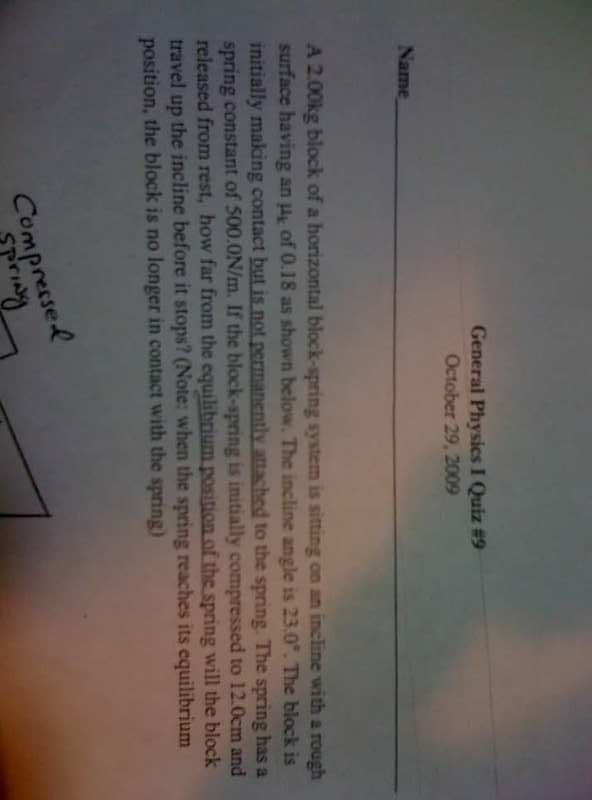
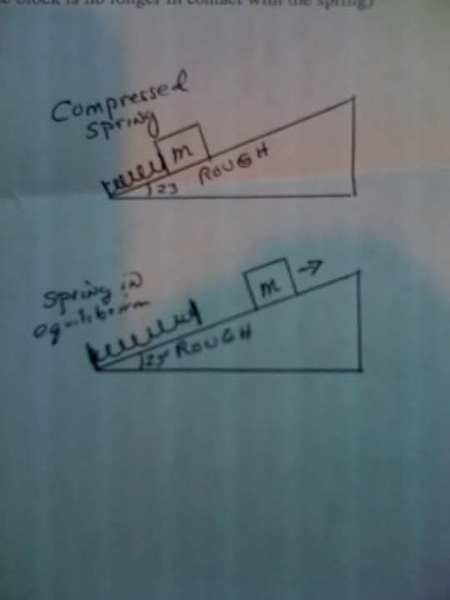
Homework Statement


2rqnlgj.jpg

24lpmya.jpg


Homework Equations


.5kxi -Fkd= .5MVf^2
h=dsin(tht)
umgh=fk
fk=ukN


The Attempt at a Solution


I really do not know where to start i tried
(1/2)(500n/m)(12.0)-(3.25)(500n/m)(d)=.5(2)(vf^2)
 
Physics news on Phys.org


Unless the question was meant to say "the block-spring system is initially compressed by 12.0 cm" rather than "the block-spring system is initially compressed to 12.0 cm", this problem is unsolvable. Without knowing the spring's equilibrium length, it's impossible to find how high it travels; if the equilibrium length is 12.1 cm, that's obviously going to give a different result than if it's 54 cm.

If we assume the spring's compressed 12 cm from equilibrium, conservation of energy is the best way to solve this problem. The spring has no kinetic energy at the bottom and none at the top, but it turned elastic potential energy into gravitational potential energy and heat. Express this as an equation, then solve for the distance travelled.
 

Similar threads

  • · Replies 27 ·
Replies
27
Views
10K
Replies
2
Views
2K
Replies
6
Views
2K
  • · Replies 1 ·
Replies
1
Views
3K
  • · Replies 5 ·
Replies
5
Views
3K
  • · Replies 15 ·
Replies
15
Views
4K
Replies
18
Views
3K
  • · Replies 4 ·
Replies
4
Views
3K
Replies
3
Views
4K
  • · Replies 7 ·
Replies
7
Views
7K