Solving the Convection-Diffusion Equation for this Pipe with a Heat Sink

  • Context: Graduate 
  • Thread starter Thread starter HumanistEngineer
  • Start date Start date
  • Tags Tags
    Heat Heat sink Pipe
Click For Summary
SUMMARY

This discussion focuses on solving the transient temperature propagation through a buried insulated pipe using the convection-diffusion equation, specifically incorporating a heat sink due to heat loss from water to the ground. The initial water temperature is set at 50 °C, increasing to 70 °C at the inlet, while the ground temperature remains constant at 10 °C. The participants analyze finite difference approximations and the derivation of the heat transfer coefficient, emphasizing the importance of the term involving the diameter of the pipe (4/D) in the equation. The conversation highlights the need for clarity on initial and boundary conditions to resolve oscillating results in numerical simulations.

PREREQUISITES
  • Understanding of the convection-diffusion equation
  • Familiarity with finite difference methods for numerical analysis
  • Knowledge of thermal resistance and heat transfer coefficients
  • Basic principles of heat transfer in fluids
NEXT STEPS
  • Review the derivation of heat transfer coefficients in fluid dynamics
  • Study finite difference methods for solving partial differential equations
  • Explore the impact of boundary conditions on numerical simulations
  • Investigate the effects of thermal resistance in heat transfer applications
USEFUL FOR

Engineers, researchers, and students involved in thermal analysis, fluid dynamics, and numerical modeling of heat transfer systems will benefit from this discussion.

HumanistEngineer
Messages
18
Reaction score
2
TL;DR
Temperature propagation through an insulated pipe in time
The solution of convection-diffusion equation with a heat sink (heat loss from pipe to the ground)
Hi Again,

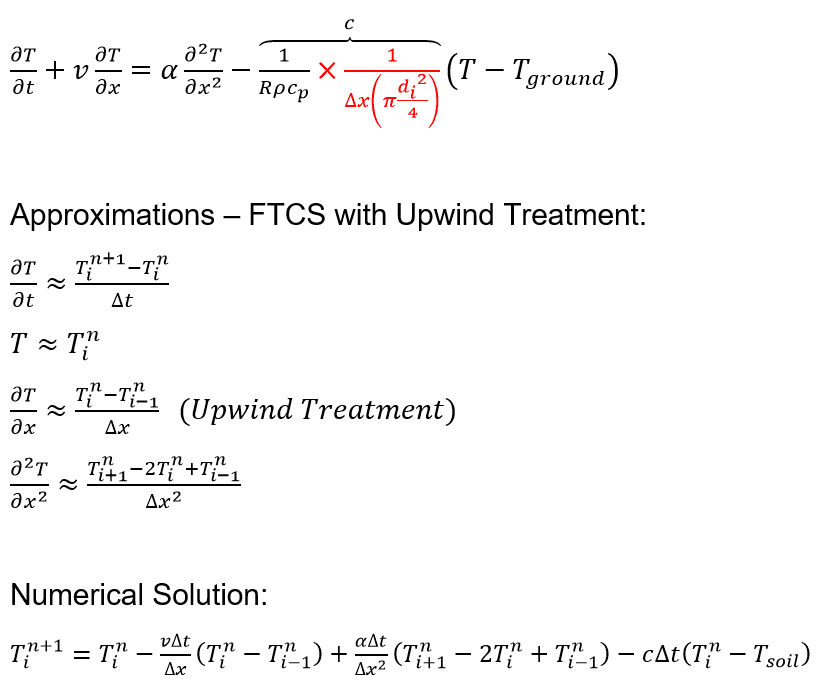
I try to solve the transient temperature propagation through a buried insulated pipe by means of solving the convection-diffusion equation with a heat sink that is the heat loss from the water mass to the ground. Below you can see the details of my calculation steps in my numerical analysis.
The problem is that my results are oscillating and/or abnormal. Would you please check my finite difference approximations, if they are correct or not?

Details:
245081
 
Last edited by a moderator:
Physics news on Phys.org
It looks OK. So??
 
Here is the result (for different mesh numbers). The maximum (steady-state) temperature should be at around 70 °C.
245317
 
That last term in the differential equation should involve a heat transfer coefficient. Please provide the derivation of that last term in the equation. What is the inlet condition and the initial condition? What is the temperature of the ground?

I get $$c=\frac{h}{\rho C}\frac{4}{D}$$where h is the heat transfer coefficient
 
Last edited:
Thank you Chestermiller for your time. You indicated c as c = h/(rho cp) (4/D) . Why is there this 4/D?

I use the thermal resistance, R [K/W], in the last term c, which means that h=1/R. Here how R was derived:
49-09-Technical-Report-Steady-State-Analyses-Gener.png

The initial condition for the pipe is that the water temperature is initially at 50 °C and in my numerical example the inlet water temperature is increased to 70 °C. Then the aim is to see how the temperature propagates through the pipe length in time. The ground temperature is constant at 10 °C.
 
If U is the overall heat transfer coefficient based on the inside diameter of the pipe, then the balance equation over a length ##\Delta x## of pipe, in finite difference form, goes like:
$$\rho C_p\left(\frac{\pi d_i^2}{4}\Delta x\right)\frac{\partial T}{\partial t}+\ ... \ =\ ...\ +\pi d_i\Delta xU(T-T_{ground})$$
If we divide this by ##\rho C_p\left(\frac{\pi d_i^2}{4}\Delta x\right)## and take the limit as ##\Delta x## approaches zero, we obtain: $$\frac{\partial T}{\partial t}+\ ...\ =\ ...\ +\frac{U}{\rho C_p}\frac{4}{d_i}(T-T_{ground})$$
Here, $$\frac{1}{Ud_i}=\frac{1}{h_{flow}d_i}+\frac{1}{2\lambda}\ln{(d_{o}/d_{i})}+...$$

Note that ##\Delta x## is not present here.
 
Last edited:

Similar threads

  • · Replies 7 ·
Replies
7
Views
4K
  • · Replies 23 ·
Replies
23
Views
6K
  • · Replies 1 ·
Replies
1
Views
2K
  • · Replies 4 ·
Replies
4
Views
3K
  • · Replies 1 ·
Replies
1
Views
2K
Replies
10
Views
2K
  • · Replies 2 ·
Replies
2
Views
3K
  • · Replies 1 ·
Replies
1
Views
6K
  • · Replies 9 ·
Replies
9
Views
2K
Replies
6
Views
2K