Solving the Energy Balance Problem

Click For Summary
SUMMARY

The discussion centers on the energy balance problem in fluid dynamics, specifically addressing the terms mCpθ and mCp(θ + dθ/dx θ). Participants clarify that for incompressible steady flow, the energy balance can be expressed as ΔH = Q = mCpΔθ. The confusion arises from interpreting these terms as heat flux, which some find unconventional. The conversation highlights the importance of understanding these equations in the context of heat transfer.

PREREQUISITES
  • Understanding of fluid dynamics principles
  • Familiarity with heat transfer concepts
  • Knowledge of control volume analysis
  • Basic thermodynamics, particularly energy balance equations
NEXT STEPS
  • Study the derivation of the energy balance equation for incompressible fluids
  • Explore the concept of heat flux in fluid systems
  • Learn about control volume analysis in heat transfer
  • Investigate the implications of temperature gradients on energy transfer
USEFUL FOR

Students and professionals in mechanical engineering, thermal engineering, and anyone involved in fluid dynamics and heat transfer analysis.

tonyjk
Messages
227
Reaction score
3
Hello,
I was reading an article, and I found something unfamiliar(sorry I am not into heat transfer a lot) :
Laminar_flow.png


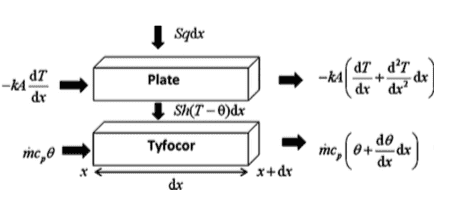
For the energy balance of the fluid, I didn't understand the mCpθ where θ is the temperature and mCp(θ+dθ/dx θ) terms. I know that for a control volume, the energy balance for incompressible steady flow etc.. ΔH = Q = mCpΔθ. I know here we will have the same result at the end but the idea of taking these two terms as heat flux confused me.

Thank you
 
Engineering news on Phys.org
tonyjk said:
Hello,
I was reading an article, and I found something unfamiliar(sorry I am not into heat transfer a lot) :
Laminar_flow.png


For the energy balance of the fluid, I didn't understand the mCpθ where θ is the temperature and mCp(θ+dθ/dx θ) terms. I know that for a control volume, the energy balance for incompressible steady flow etc.. ΔH = Q = mCpΔθ. I know here we will have the same result at the end but the idea of taking these two terms as heat flux confused me.

Thank you
I can see what they are doing, but I don't like it being done this way either.

Chet
 
I have encountered a vertically oriented hydraulic cylinder that is designed to actuate and slice heavy cabling into sections with a blade. The cylinder is quite small (around 1.5 inches in diameter) and has an equally small stroke. The cylinder is single acting (i.e. it is pressurized from the bottom, and vented to atmosphere with a spring return, roughly 200lbs of force on the spring). The system operates at roughly 2500 psi. Interestingly, the cylinder has a pin that passes through its...

Similar threads

  • · Replies 19 ·
Replies
19
Views
3K
Replies
3
Views
2K
  • · Replies 3 ·
Replies
3
Views
3K
  • · Replies 1 ·
Replies
1
Views
1K
  • · Replies 5 ·
Replies
5
Views
3K
  • · Replies 10 ·
Replies
10
Views
3K
Replies
2
Views
2K
  • · Replies 4 ·
Replies
4
Views
2K
  • · Replies 1 ·
Replies
1
Views
2K
  • · Replies 1 ·
Replies
1
Views
2K