Undergrad Solving this system of equations in different ways

Click For Summary
The discussion focuses on finding the values of "a" for a system of equations to yield different types of solutions. For one ordered pair, "a" must be less than or equal to -2 or greater than 0. For exactly two pairs, "a" is determined to be 0. To achieve exactly three pairs, the range is found to be between -2 and 0. The participants conclude that there are no values of "a" that result in more than three pairs, and graphical analysis is emphasized as a helpful tool in understanding the intersections of the curves.
help
Messages
14
Reaction score
0
TL;DR
system of equations, circumference and parable
Good night!
How do I find the values of a (real) so that the solution of this system is?
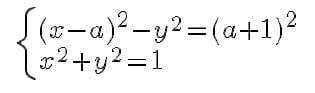
Sistema.jpg

(i) just an ordered pair?
(ii) exactly two pairs.
(iii) exactly 3?
(iv) is there a place where you have more than 3 pairs as an answer?So...
I thought like this: I developed the first part. I solved the system and found x²-ax-a-1 = 0

(i) I made the delta zero by finding a = -2. Point (-1.0)
(ii) I thought about doing a = 0 getting x = + - 1 finding the points (-1,0) and (1,0).

item iii. Making the drawing it is possible to verify -1<a<0 that but I don't know why.

I also know that there is no way but I don't know how to prove it.
 
Last edited by a moderator:
Mathematics news on Phys.org
For (i) there are more solutions. Consider what happens e.g. for a=2. Yes, ##x^2 - 2x - 3 = 0## has more than one solution - but does that lead to more than one intersection of the curves?

(ii) looks good.

(iii) did you draw a sketch? You have a circle and a hyperbola with two sides. Clearly (-1,0) is always a solution, to get three solutions you need the other part of the hyperbola intersect the circle in two more points. What does that mean for the position of the hyperbola where y=0? There are also more solutions here that you didn't find.

Ultimately all real values of "a" should be in one of the answers. If your ranges together don't cover all real values then you missed something.
 
hello, thanks for answering

i) a -1 or a>0 * a=-1asymptote

ii) a=0

iii)-1<a<0

iv) does not existI can see it by looking at the graph, but how can I prove it algebraically?
 
a=-1 has more than one solution. So does the range between -1 and -2.

Looking at the graph tells you which kind of solution to look for and which ranges to look at, you can then study these algebraically.
 
ok
i) a -2 or a>0
when we calculate delta = 0, find a = -2 as the tangency point. But I saw through the graph that the system will have only one ordered pair as a solution for <= - 2 or a> 0

ii) a=0

iii)-2<a<0

iv) does not exist

solving the system we find x²-ax-a-1=0

∆ = (-a)² - 4.1.(- a - 1) = a² + 4.a + 4 = (a + 2)² --->

√∆ = |a + 2 |

How to interpret?

We find roots
-1 and a+1 to a>-2 e

a+1 and -1 to a<-2

how to write?

to a>-2

a=0 2-point intersection

a>0 1-point intersection

-2<a<0 3-point intersection
and to a<-2

1-point intersection
 
Here is a little puzzle from the book 100 Geometric Games by Pierre Berloquin. The side of a small square is one meter long and the side of a larger square one and a half meters long. One vertex of the large square is at the center of the small square. The side of the large square cuts two sides of the small square into one- third parts and two-thirds parts. What is the area where the squares overlap?

Similar threads

  • · Replies 7 ·
Replies
7
Views
2K
  • · Replies 10 ·
Replies
10
Views
1K
  • · Replies 10 ·
Replies
10
Views
2K
  • · Replies 9 ·
Replies
9
Views
3K
  • · Replies 4 ·
Replies
4
Views
1K
  • · Replies 4 ·
Replies
4
Views
1K
  • · Replies 6 ·
Replies
6
Views
2K
  • · Replies 2 ·
Replies
2
Views
1K
  • · Replies 27 ·
Replies
27
Views
3K
  • · Replies 1 ·
Replies
1
Views
1K