Solving this system of equations in different ways

Click For Summary

Discussion Overview

The discussion revolves around finding the values of a real parameter "a" in a system of equations, specifically focusing on the conditions under which the system yields different numbers of solutions: one ordered pair, two pairs, three pairs, or more than three pairs. The conversation includes both graphical interpretations and algebraic reasoning.

Discussion Character

  • Exploratory
  • Technical explanation
  • Mathematical reasoning
  • Debate/contested

Main Points Raised

  • Some participants propose that for one solution, a must be less than or equal to -2 or greater than 0, identifying a = -2 as a tangency point.
  • Others argue that for exactly two solutions, a = 0 is a valid case.
  • There is a suggestion that for exactly three solutions, the range -1 < a < 0 is necessary, though the reasoning behind this is questioned.
  • Some participants mention that there are no values of a that yield more than three solutions, with one participant expressing uncertainty about how to prove this algebraically.
  • Graphical analysis is referenced as a method to understand the nature of the solutions, with some participants indicating that visualizing the curves helps identify solution types and ranges.
  • There is a discussion about the implications of the discriminant (delta) and its role in determining the number of solutions based on the value of a.

Areas of Agreement / Disagreement

Participants express differing views on the ranges of a that yield specific numbers of solutions, with no consensus reached on the exact conditions for each case. The discussion remains unresolved regarding the algebraic proof for the non-existence of more than three solutions.

Contextual Notes

Some participants note that their ranges for a may not cover all real values, suggesting that additional solutions or cases might exist that have not been considered.

help
Messages
14
Reaction score
0
TL;DR
system of equations, circumference and parable
Good night!
How do I find the values of a (real) so that the solution of this system is?
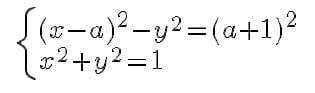
Sistema.jpg

(i) just an ordered pair?
(ii) exactly two pairs.
(iii) exactly 3?
(iv) is there a place where you have more than 3 pairs as an answer?So...
I thought like this: I developed the first part. I solved the system and found x²-ax-a-1 = 0

(i) I made the delta zero by finding a = -2. Point (-1.0)
(ii) I thought about doing a = 0 getting x = + - 1 finding the points (-1,0) and (1,0).

item iii. Making the drawing it is possible to verify -1<a<0 that but I don't know why.

I also know that there is no way but I don't know how to prove it.
 
Last edited by a moderator:
Mathematics news on Phys.org
For (i) there are more solutions. Consider what happens e.g. for a=2. Yes, ##x^2 - 2x - 3 = 0## has more than one solution - but does that lead to more than one intersection of the curves?

(ii) looks good.

(iii) did you draw a sketch? You have a circle and a hyperbola with two sides. Clearly (-1,0) is always a solution, to get three solutions you need the other part of the hyperbola intersect the circle in two more points. What does that mean for the position of the hyperbola where y=0? There are also more solutions here that you didn't find.

Ultimately all real values of "a" should be in one of the answers. If your ranges together don't cover all real values then you missed something.
 
hello, thanks for answering

i) a -1 or a>0 * a=-1asymptote

ii) a=0

iii)-1<a<0

iv) does not existI can see it by looking at the graph, but how can I prove it algebraically?
 
a=-1 has more than one solution. So does the range between -1 and -2.

Looking at the graph tells you which kind of solution to look for and which ranges to look at, you can then study these algebraically.
 
ok
i) a -2 or a>0
when we calculate delta = 0, find a = -2 as the tangency point. But I saw through the graph that the system will have only one ordered pair as a solution for <= - 2 or a> 0

ii) a=0

iii)-2<a<0

iv) does not exist

solving the system we find x²-ax-a-1=0

∆ = (-a)² - 4.1.(- a - 1) = a² + 4.a + 4 = (a + 2)² --->

√∆ = |a + 2 |

How to interpret?

We find roots
-1 and a+1 to a>-2 e

a+1 and -1 to a<-2

how to write?

to a>-2

a=0 2-point intersection

a>0 1-point intersection

-2<a<0 3-point intersection
and to a<-2

1-point intersection
 

Similar threads

  • · Replies 9 ·
Replies
9
Views
3K
  • · Replies 4 ·
Replies
4
Views
1K
  • · Replies 2 ·
Replies
2
Views
1K
  • · Replies 6 ·
Replies
6
Views
2K
  • · Replies 4 ·
Replies
4
Views
2K
  • · Replies 1 ·
Replies
1
Views
1K
Replies
2
Views
3K
  • · Replies 7 ·
Replies
7
Views
2K
  • · Replies 9 ·
Replies
9
Views
2K
  • · Replies 17 ·
Replies
17
Views
3K