Some questions about electromagnetism

  • Context: Graduate 
  • Thread starter Thread starter PainterGuy
  • Start date Start date
  • Tags Tags
    Electromagnetism
Click For Summary
SUMMARY

This discussion centers on the principles of electromagnetism, specifically regarding eddy currents and electromagnetic radiation. It is established that when a disk rotates in a magnetic field, an electromotive force (emf) is induced, but no eddy currents are produced if the entire surface rotates uniformly. The conversation also clarifies that an accelerating charge does not lose its quantity, despite radiating electromagnetic waves. Additionally, the nature of magnetic fields around conductors is explored, emphasizing that they do not conform to simple dipole or monopole classifications.

PREREQUISITES
  • Understanding of Faraday's Law of Electromagnetic Induction
  • Knowledge of electromagnetic wave propagation
  • Familiarity with the concepts of eddy currents and emf
  • Basic principles of magnetic fields and their configurations
NEXT STEPS
  • Study Faraday's Law and its applications in electromagnetic induction
  • Research the behavior of eddy currents in various conductor configurations
  • Explore the relationship between accelerating charges and electromagnetic radiation
  • Investigate the characteristics of multipole magnetic fields beyond dipoles
USEFUL FOR

Students and professionals in physics, electrical engineering, and anyone interested in the applications of electromagnetism in technology and research.

PainterGuy
Messages
938
Reaction score
73
Hi,

Could you please help me with the queries below? Thank you.

Question 1:
Please have a look on this attachment. In the given attachment, the disk is mounted vertically and only a part of the disk passes thru the magnetic field at any instant. If entire surface of the disk was rotating in a uniform magnetic field then I don't think any eddy currents would be produced. Do you agree?

Question 2:
If the disk was instead mounted horizontally but still all of the disk rotating in a uniform magnetic field, would it result into production of any eddy currents?

Question 3:
It is said that an accelerating charge radiates electromagnetic waves, does this mean that the quantity of charge would reduce as a result of emanating electromagnetic waves?

Question 4:
Please have a look on this attachment. If the attachment is not clear please have a look here. I believe that "v" represents the direction of disk rotation. How is the direction of "v" is being determined? The direction of magnetic field is from left to right and disk is rotating clockwise when seen from the left side.

Question 5:
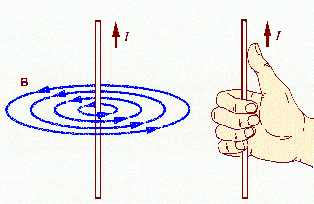
?temp_hash=93270061f59883f029fdcae9d3beec2f.gif

We can see that there is circular magnetic field around wire but where are the north and south poles of this circular magnetic field?

Thanks a lot for your time and help.
 

Attachments

  • 1st_generator.jpg
    1st_generator.jpg
    47.8 KB · Views: 558
  • wire_magnetic field.gif
    wire_magnetic field.gif
    5.3 KB · Views: 636
  • eddy1.jpg
    eddy1.jpg
    38.3 KB · Views: 786
Last edited:
Physics news on Phys.org
PainterGuy said:
If entire surface of the disk was rotating in a uniform magnetic field then I don't think any eddy currents would be produced. Do you agree?
Yes, but there will be a voltage between centre and rim of the disc.
PainterGuy said:
If the disk was instead mounted horizontally but still all of the disk rotating in a uniform magnetic field, would it result into production of any eddy currents?
Yes. Emf will be indued along the thickness of the disc.
PainterGuy said:
It is said that an accelerating charge radiates electromagnetic waves, does this mean that the quantity of charge would reduce as a result of emanating electromagnetic waves?
No.
PainterGuy said:
How is the direction of "v" is being determined?
It is the instantaneous linear velocity of a point on the circular disc (with a direction tangential to the circle).
PainterGuy said:
We can see that there is circular magnetic field around wire but where are the north and south poles of this circular magnetic field?
There cannot be a single isolated current carrying conductor, there's always at least one more conductor that acts as a return path for the current. Together they two form a single-turn coil which acts as a bar magnet and you can find its polarity.
 
  • Like
Likes   Reactions: PainterGuy
PainterGuy said:
We can see that there is circular magnetic field around wire but where are the north and south poles of this circular magnetic field?
It is not a dipole field so it doesn't have a well defined pole.
 
  • Like
Likes   Reactions: PainterGuy
Thank you.

cnh1995 said:
Yes, but there will be a voltage between centre and rim of the disc.

So, no eddy current but an emf will be induced. I was just trying to find some good picture to make my point clear and found out that it used to be called Faraday paradox back in the days. Please check this out: https://en.wikipedia.org/wiki/Homopolar_generator#Disk-type_generator

In the picture below I believe that the rim would have positive potential and the center negative potential. Please let me know if I'm wrong.

?temp_hash=053b97f86e3f3942ee77c4b44cb115c1.jpg


cnh1995 said:
Yes. Emf will be indued along the thickness of the disc.

So, you are saying that the eddy will be produced and an emf will be also induced. I had the construction below in mind.

Using right hand rule, it shows the direction of induced current at points A and B, and it looks like that lower and upper halves of the disk will have different charge distribution.

?temp_hash=053b97f86e3f3942ee77c4b44cb115c1.jpg


cnh1995 said:
No.

So, it means that an an accelerating charge won't loose its charge. As radiating electromagnetic waves is energy therefore the charge must loose something, and I think it would be mass then.

cnh1995 said:
There cannot be a single isolated current carrying conductor, there's always at least one more conductor that acts as a return path for the current. Together they two form a single-turn coil which acts as a bar magnet and you can find its polarity.

Dale said:
It is not a dipole field so it doesn't have a well defined pole.

@cnh1995 : Let's think of an infinite wire and in such a case we can ignore the return path.
@Dale: Yes, it does look like that it's not a dipole field but a magnet cannot exist as a uni-pole which also implies no magnetic field without a 'dipole' magnet.

Thank you for your time and help.
 

Attachments

  • Faraday_disc.jpg
    Faraday_disc.jpg
    7.7 KB · Views: 561
  • vertical_disc.jpg
    vertical_disc.jpg
    11.7 KB · Views: 617
PainterGuy said:
@Dale: Yes, it does look like that it's not a dipole field but a magnet cannot exist as a uni-pole which also implies no magnetic field without a 'dipole' magnet.
Just because there are no magnetic monopoles does not imply that all magnetic fields are dipoles. There are many fields that are neither.
 
  • Like
Likes   Reactions: PainterGuy
PainterGuy said:
So, you are saying that the eddy will be produced and an emf will be also induced. I had the construction below in mind.
You have joined the center and the rim. I was talking about the same configuration, but not with the center and rim connected together like that, just the rotating disc.
In that case, current will flow from A to B on the upper surface and from B to A on the lower surface.
20171012_094324.jpg
 
  • Like
Likes   Reactions: PainterGuy
PainterGuy said:
So, it means that an an accelerating charge won't loose its charge. As radiating electromagnetic waves is energy therefore the charge must loose something, and I think it would be mass then.
I am not sure if I can comment on this since I haven't studied EM radiation in depth, but just because radiating EM waves is radiating energy doesn't mean the charge has to lose something of its own (charge or mass). The charge is accelerated by means of some energy source and this radiation energy should ultimately come from that source.
 
  • Like
Likes   Reactions: PainterGuy
Thank you.

Dale said:
Just because there are no magnetic monopoles does not imply that all magnetic fields are dipoles. There are many fields that are neither.

If you say so, I'd agree with you. But could you please tell me of some fields which are neither monopole or dipole? I'm just curious.

cnh1995 said:
You have joined the center and the rim. I was talking about the same configuration, but not with the center and rim connected together like that, just the rotating disc.

Okay. But in the other configuration where the disc is horizontal, the center and rim were connected too so why is it different for this case when the disc is vertical as shown below?

vertical_disc-jpg.jpg


cnh1995 said:
I am not sure if I can comment on this since I haven't studied EM radiation in depth, but just because radiating EM waves is radiating energy doesn't mean the charge has to lose something of its own (charge or mass). The charge is accelerated by means of some energy source and this radiation energy should ultimately come from that source.

No problem then. But I believe that it should be mass because I did read somewhere in the past that electrically charged body is hard to accelerate compared to an equivalent neutral body, and we can use the relation mass=E/c^2.

Thanks a lot.
 
PainterGuy said:
If you say so, I'd agree with you. But could you please tell me of some fields which are neither monopole or dipole?
The field around a straight wire for one, and all of the multipole fields greater than dipole, and a plane wave.
 
  • Like
Likes   Reactions: PainterGuy
  • #10
PainterGuy said:
But could you please tell me of some fields which are neither monopole or dipole? I'm just curious
Induced electric field in Faraday's law is not a dipole field.
PainterGuy said:
But in the other configuration where the disc is horizontal, the center and rim were connected too
That connection is necessary for a current to flow. Without that connection, there will only be voltage present between center and rim of the disc.
PainterGuy said:
so why is it different for this case when the disc is vertical as shown below?
For the vertical disc in your diagram, no connection is required between center and rim as the current is flowing along the path I've shown in #6. If you connect the center and the rim, you are providing a parallel path for the current and some current will be diverted through that path.
PainterGuy said:
But I believe that it should be mass because I did read somewhere in the past that electrically charged body is hard to accelerate compared to an equivalent neutral body, and we can use the relation mass=E/c^2.
I don't have enough knowledge about EM radiation and mass-energy equivalence. I can't comment on that.
 
Last edited:
  • Like
Likes   Reactions: PainterGuy

Similar threads

  • · Replies 5 ·
Replies
5
Views
614
  • · Replies 5 ·
Replies
5
Views
1K
  • · Replies 7 ·
Replies
7
Views
1K
  • · Replies 1 ·
Replies
1
Views
2K
  • · Replies 6 ·
Replies
6
Views
2K
  • · Replies 4 ·
Replies
4
Views
3K
  • · Replies 7 ·
Replies
7
Views
721
  • · Replies 14 ·
Replies
14
Views
3K
  • · Replies 1 ·
Replies
1
Views
1K
  • · Replies 42 ·
2
Replies
42
Views
3K