Sound wave spreading radially question

Click For Summary

Homework Help Overview

The discussion revolves around sound waves spreading radially from a coherent source, focusing on the intensity and quality of sound at different locations. The original poster poses questions regarding the differences in sound intensity and quality at points A and B, as well as the effects of two-source interference on sound intensity at locations A-D.

Discussion Character

  • Exploratory, Conceptual clarification, Problem interpretation

Approaches and Questions Raised

  • The original poster attempts to understand how sound intensity varies with distance from the source and whether the quality of sound changes based on location. They also explore the implications of two-source interference on sound intensity rankings.

Discussion Status

Some participants provide clarifications regarding the relationship between distance and sound intensity, noting the inverse-square law. There is also a discussion about the definition of "quality" in relation to sound, with some guidance offered on the nature of pure tones. The original poster seeks further validation on their reasoning regarding sound intensity rankings in the context of interference.

Contextual Notes

Participants are working within the framework of sound wave behavior, including intensity variations and interference patterns, while adhering to the constraints of the homework context.

nophun6
Messages
26
Reaction score
0
I have a question dealing with sound waves.
agag.jpg


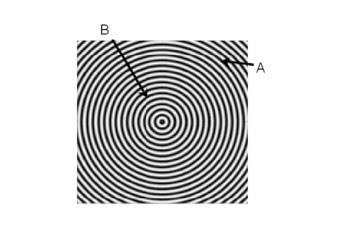
This figure shows waves spreading radially outward from a coherent source located at the center. The center spot represents a coherent source emitting at a constant frequency. Black indicates maxima (positive peaks) and white indicating minima (negative troughs)
a) The source is a speaker emitting a pure tone. Quantitatively speaking, would you hear a different sound intensity at points A and
B?
b) Is the quality of the sound (the tone) dependent
on location? That is, would you expect a
qualitatively different sound at different
locations?

I remember that the intenesity of sound decreases as sound increases because as the wave spreads further from the source to the areas of low and high pressure respecitively gain and lose pressure (compressions and rarefactions)
So would this mean that the sound you hear at point B is more intense than the sound you hear at point A?
And thus the quality of the sound is dependent on location?

thanks for the help;
 
Physics news on Phys.org
A) correct. Since the energy of the wave is spread out over the surface of an ever-increasing sphere, the intensity drops off as an inverse-square proportion with distance from source.

B) No. "Quality" is referring to what combination of frequencies you are hearing. This is a pure tone, and the frequency does not change as a function of distance from source.
 
Ah, I see, thank you for your help. I have another question...
349a8a6e.jpg

This picture depicts 2-source interference. There are 2 coherent sources emitting at the same frequency. Black indicates maxima, white indicates minima and pure gray corresponds to total destructive interference. Rank locations A-D according the intensities that a listener at each
location would experience (loudest to quietest).

So, in order from most intense to least: D(most intense) > C > A > B

I reasoned this from the fact that D is the closest and lies on a black line (maxima) and B, although not the furthest, lies in a grey region which means there is destructive interference.
Is this correct?
Thanks for the help!
 
Yes, that's correct. Cool diagrams, BTW.
 

Similar threads

Replies
20
Views
5K
  • · Replies 23 ·
Replies
23
Views
4K
  • · Replies 1 ·
Replies
1
Views
2K
  • · Replies 5 ·
Replies
5
Views
2K
  • · Replies 5 ·
Replies
5
Views
2K
  • · Replies 1 ·
Replies
1
Views
2K
  • · Replies 1 ·
Replies
1
Views
3K
  • · Replies 1 ·
Replies
1
Views
2K
  • · Replies 2 ·
Replies
2
Views
2K
Replies
1
Views
2K