Speed of a star in Special Relativity

Click For Summary
SUMMARY

The forum discussion centers on a problem from "Special Relativity" by AP French, specifically Exercise 3.3, which involves analyzing the Doppler effect in a double-star system. Participants explore the relationship between the speed of light emitted from star A and its observed Doppler shift as it reaches Earth. The discussion highlights the assumption of classical Doppler shift without considering time dilation, and the need to derive the expression for the Doppler effect using the parameters of the system, including the period T and distance R. Key equations are presented to clarify the relationship between the variables involved.

PREREQUISITES
  • Understanding of Special Relativity principles
  • Familiarity with the Doppler effect in physics
  • Knowledge of circular motion dynamics
  • Ability to manipulate trigonometric functions in physics equations
NEXT STEPS
  • Study the relativistic Doppler effect in detail
  • Learn about the implications of time dilation in moving reference frames
  • Explore the mathematical derivation of the Doppler shift equations
  • Investigate the differences between classical and relativistic physics in wave propagation
USEFUL FOR

Students of physics, particularly those studying Special Relativity, astrophysicists analyzing star systems, and educators seeking to clarify the Doppler effect in a relativistic context.

RafaPhysics
Messages
7
Reaction score
0
Homework Statement
I've been trying to solve this problem but I'm pretty sure there's something more that I could do, but I can't see it.
Relevant Equations
$$v_r=u sin\frac{2\pi}{T}\left(t-\frac{R}{c}+\frac{Rv_r}{c^2}\right)$$
Hey, I have this problem from the Special Relativity by AP. French . Exercise 3.3, Chapter 3.
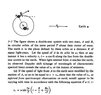
The figure shows a double-star system with two stars, A and B, in circular orbits of the same period T about their center of mass. The earth is in the plane definied by these orbits at a distance R of many light-years. Let the speed of A in its orbit be u; then at any instant it has a velocity ##v_r(=ucos\theta)## along the line from the double-star system to the earth. When light emitted from A reaches the earth, its observed Doppler shift (change of wavelength of characteristic spectral lines) reveals the value of vr at the instant of emission.
If the speed of light from A to the earth were modified by the motion of A, so as to be equal to ##c+v_r##, show that the value of ##v_r##, as inferred from spectroscopic observations on earth, would appear to be varying with time in accordance with the following equation if ##u\ll c##: It's the equation above.
I've tried with the doppler efect, but I can't still see when It turns to ##sin##, there's something more but simply I can't see it. Please I need help.
 

Attachments

  • Problema Relatividad.jpg
    Problema Relatividad.jpg
    42.8 KB · Views: 97
Physics news on Phys.org
I guess only AP French knows what laws of physics apply and which do not in this case! I'd assumed he means using the classical Doppler shift, without time dilation. I.e. assuming Newtonian physics with no invariant speed. Is that what you did?
 
PeroK said:
I guess only AP French knows what laws of physics apply and which do not in this case! I'd assumed he means using the classical Doppler shift, without time dilation. I.e. assuming Newtonian physics with no invariant speed. Is that what you did?
Yes, I did it. But I only come to the expression of the Doppler efect, but from that point to the expression above there's still a world of difference.
 
RafaPhysics said:
Yes, I did it. But I only come to the expression of the Doppler efect, but from that point to the expression above there's still a world of difference.
Why did you choose the AP French book?

I'm must admit, I'm not sure what he's assuming. Perhaps, if we assume that ##f_s## is the frequency at the source, then the crests of a light wave would be emitted at time ##\frac 1 {f_s}## apart. And, in that time, ##v_r## would increase by a tiny amount. The next crest would catch up with the one before it. That would explain why the distance ##R## gets into the equation. If ##R## was too large, then the light wave crests would arrive out of sequence! The assumption ##u \ll c## might be there to ensure that the crests arrive in the correct order?! Or, maybe not! Maybe the observation of adjacent crests coincide?!

If you are not too committed to French, I'd try another book. In any case, I'd be tempted to skip this question.
 
PS and it's not clear what the spectroscopists assume. Do they assume the relativistic Doppler shift? Is that the idea?
 
PeroK said:
PS and it's not clear what the spectroscopists assume. Do they assume the relativistic Doppler shift? Is that the idea?
I think they assume that the velocity of ligth depends of source motion, like It was Galilean, I had an idea, I have to take an infinitesimal time interval, after that take an infinitesimal distance interval, and then divide it by the already calculated time interval, but it still doesn't give the result.
 
RafaPhysics said:
I think they assume that the velocity of ligth depends of source motion, like It was Galilean, I had an idea, I have to take an infinitesimal time interval, after that take an infinitesimal distance interval, and then divide it by the already calculated time interval, but it still doesn't give the result.
It's not to do with infinitesimals For the emission event:
$$\frac{dv_r}{dt} = \frac{d}{dt}(u\cos \theta) = -u(\sin \theta)\frac{d\theta}{dt} = -u(\frac{2\pi}{T})\sin \theta$$$$\Delta v_r = \frac{dv_r}{dt}\Delta t = \frac{dv_r}{dt}\frac 1 {f_s} = $$For the observation event:
$$t_1 = \frac{R}{c + v_r}, \ t_2 = \frac{1}{f_s} + \frac{R}{c +v_r + \Delta v_r}$$$$f_o = \frac{1}{t_2 - t_1}$$And so on ...
 

Similar threads

  • · Replies 7 ·
Replies
7
Views
2K
Replies
14
Views
2K
  • · Replies 19 ·
Replies
19
Views
1K
  • · Replies 1 ·
Replies
1
Views
1K
  • · Replies 35 ·
2
Replies
35
Views
5K
  • · Replies 4 ·
Replies
4
Views
3K
Replies
6
Views
2K
  • · Replies 1 ·
Replies
1
Views
1K
  • · Replies 1 ·
Replies
1
Views
3K
  • · Replies 3 ·
Replies
3
Views
1K