Spherical Coordinates: Understanding Theta Equation

Click For Summary
The discussion centers on the correct formulation of the theta equation in spherical coordinates. The original equation presented on the referenced page is incorrect; the correct equation is θ = tan^(-1)(√(x² + y²)/z). An alternative and more commonly used formulation is θ = cos^(-1)(z/r), where r = √(x² + y² + z²). The preference for the cos^(-1) formulation may relate to its broader applicability in higher mathematics. Overall, the conversation highlights the importance of accurate representations in mathematical equations.
MattRob
Messages
208
Reaction score
29
So, I was curious about this and found more or less what I was looking for here: http://electron9.phys.utk.edu/vectors/3dcoordinates.htm

Except, something is bothering me about those equations. At the very bottom, the equation for Theta in a spherical coordinate system; shouldn't it be
\theta = {tan^{-1}}( \frac{\sqrt{{x^{2}}+{y^{2}}}}{z})
instead of
\theta = {tan^{-1}}( \frac{z}{\sqrt{{x^{2}}+{y^{2}}}})

(The image in question)
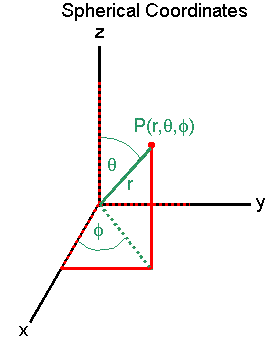
p22.gif


Because {tan^{-1}}( \frac{opposite}{adjacent}) = \theta , and looking at angle \theta , the line opposite of it is exactly equal to \sqrt{{x^{2}}+{y^{2}}} , and the line adjacent to it equal to z.

So I'm wondering if I'm in error (and how so if I am) or if the linked page is.
 
Physics news on Phys.org
You are correct. That equation on that page is in error.
 
It appears that page is wrong. You're right, the correct relation is

##\theta = \tan ^{-1}\left( \frac{\sqrt{x^2 +y^2 }}{z}\right)##.

You could also write it as ##\theta = \cos ^{-1} \left(\frac{z}{\sqrt{x^2 +y^2 +z^2 }}\right)##Edit: Darn you, jtBell, you beat me by seconds!
 
yep... it sure looks like they've got their sides mixed up.
However, it is more usual to use ##\theta = \cos^{-1}(z/r):r=\sqrt{x^2+y^2+z^2}##
 
Thanks very much for all the replies! Are the equations for the x, y, and z components from a spherical coordinate system correct on that page, though?

And why is the ##\theta = \cos ^{-1} \left(\frac{z}{\sqrt{x^2 +y^2 +z^2 }}\right)## approach more common? The \theta = {tan^{-1}}( \frac{\sqrt{{x^{2}}+{y^{2}}}}{z}) one has less terms. Something to do with higher mathematics?
 
I do not have a good working knowledge of physics yet. I tried to piece this together but after researching this, I couldn’t figure out the correct laws of physics to combine to develop a formula to answer this question. Ex. 1 - A moving object impacts a static object at a constant velocity. Ex. 2 - A moving object impacts a static object at the same velocity but is accelerating at the moment of impact. Assuming the mass of the objects is the same and the velocity at the moment of impact...

Similar threads

  • · Replies 1 ·
Replies
1
Views
2K
  • · Replies 7 ·
Replies
7
Views
1K
  • · Replies 9 ·
Replies
9
Views
4K
  • · Replies 16 ·
Replies
16
Views
2K
Replies
3
Views
2K
  • · Replies 1 ·
Replies
1
Views
1K
Replies
1
Views
1K
  • · Replies 12 ·
Replies
12
Views
2K
  • · Replies 1 ·
Replies
1
Views
2K
Replies
8
Views
2K