Spherical Harmonics from operator analysis

Click For Summary

Discussion Overview

The discussion revolves around the derivation of spherical harmonics in quantum mechanics (QM) through operator analysis. Participants explore the validity of a proposed method that involves assumptions about the behavior of derivative operators and their application to the spherical harmonics.

Discussion Character

  • Exploratory
  • Technical explanation
  • Debate/contested
  • Mathematical reasoning

Main Points Raised

  • One participant proposes a fundamental assumption that derivative operators act only on their identical copies, leading to a specific form of spherical harmonics.
  • Another participant challenges this assumption, arguing that operators must act on all terms containing the variables involved, not just their identical copies.
  • It is noted that the operator acts on everything to the right, which contradicts the initial assumption made by the first participant.
  • Some participants express uncertainty about whether the correct results obtained by the first participant were coincidental or indicative of a deeper property of the operators.
  • A later reply discusses the necessity of differentiating all dependencies when applying ladder operators to obtain the correct spherical harmonics.
  • There is a question about the symmetry of the solutions in terms of the azimuthal angle, with participants discussing the implications of this symmetry on the form of the spherical harmonics.
  • Technical details regarding the representation of angular momentum operators in spherical coordinates are provided, along with the eigenvalue equations for spherical harmonics.

Areas of Agreement / Disagreement

Participants express disagreement regarding the initial assumption about operator behavior. While some find the proposed method interesting, others challenge its validity, leading to an unresolved discussion about the correctness of the derivation and the assumptions made.

Contextual Notes

Participants highlight limitations in the initial assumptions regarding operator behavior, noting that the treatment of terms involving variables may not be adequately addressed. The discussion also touches on the complexity of deriving spherical harmonics and the potential for misunderstanding operator properties.

Who May Find This Useful

This discussion may be of interest to those studying quantum mechanics, particularly in the context of angular momentum and spherical harmonics, as well as individuals exploring operator theory in mathematical physics.

davidge
Messages
553
Reaction score
21
I found an interesting thing when trying to derive the spherical harmonics of QM by doing what I describe below. I would like to know whether this can be considered a valid derivation or it was just a coincidence getting the correct result at the end.

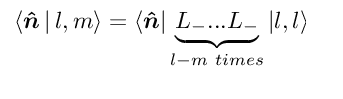
Starting making a Fundamental Assumption that when dealing with the derivative operators, they will act only on their copies; e.g. ##\partial_{\theta}## acts only on ##\partial_{\theta}##.

Knowing that
px8qUGu.png


I got after working out

eQJJAdP.png

where ##C_{lm}## are the coefficients depending only on ##l## and ##m##.

Now comes the crucial point. As by assumption each differential operator acts only on its copy, they will not act on the exponentials. Also, as there is nothing to differentiate w.r.t ##\phi##, there will be no terms left with ##\partial_\phi##. After working out the terms I got (with ##u = Cos(\theta)##)

$$ C_{lm}\ e^{im \phi} \frac{\partial^{l - m}}{\partial u^{l - m}} \sqrt{1-u^2}^l \sqrt{1-u^2}^{\ - m} $$
Now, notice at this point I have worked out all the ##(m-l)## - ##L_{-}## operators. It is as if we were left only with ordinary quantities and therefore, I allowed the "once" differential operators to act on the functions.
If we can use ordinary product rule here, then we have (because the greatest order term for the second term on the right will be of order ##|m|## and the derivatives are of order ##l-m##)

$$C_{lm}\ e^{im \phi} \frac{1}{\sqrt{1-u^2}^m} \frac{\partial^{l - m}}{\partial u^{l - m}} \sqrt{1-u^2}^l$$
as it should be.

If I'm wrong, then this was just a big coincidence!
 
Last edited:
  • Like
Likes   Reactions: Douglas Sunday
Physics news on Phys.org
davidge said:
Fundamental Assumption that when dealing with the derivative operators, they will act only on their copies; e.g. ∂θ\partial_{\theta} acts only on ∂θ
I am afraid that's not true. Anything that contains ##\theta## including the cotangent must be differentiated.
davidge said:
Also, as there is nothing to differentiate w.r.t ϕ\phi,
There is ##e^{il\phi}##.
 
  • Like
Likes   Reactions: davidge
Indeed, an operator operates by definition on everything to the right!
 
  • Like
Likes   Reactions: davidge
blue_leaf77 said:
Anything that contains ##\theta## including the cotangent must be differentiated.
The initial assumption excludes those terms.
blue_leaf77 said:
There is ##e^{il\phi}##.
By the initial assumption, it is just a constant for the operators.
vanhees71 said:
Indeed, an operator operates by definition on everything to the right!
Exactly. That's why it bothers me to make the initial assumption that they will act only on equal operators.

blue_leaf77 and vanhees71,
I think the situation is more like a funny thing that happens when you modify a little bit the definitions.
 
Perhaps, more interesting is the fact that I got similar results, that is, I got the correct results in other areas of QM by using assumptions much like the one that I used for the derivation above.

Maybe am I not realising some property of the operators and thus I'm thinking my initial assumption does the work while in fact, there is another thing happening?
 
davidge said:
If I'm wrong, then this was just a big coincidence!
Can you give an example?
davidge said:
Maybe am I not realising some property of the operators and thus I'm thinking my initial assumption does the work
That's the most likely reason.
 
  • Like
Likes   Reactions: davidge
I don't really understand, what you did, but of course, when applying the "ladder operator" ##\hat{L}_-## succesively to ##Y_l^{l}(\vartheta,\varphi)## you have to differentiate all the dependencies on ##\vartheta## and ##\varphi## to get the correct spherical harmonics ##Y_l^m## for ##m \in \{-l,-l+1,\ldots,l-1,l \}##. You can find the admittedly lengthy calculation in my QM FAQ (sorry for a German reference) here:

http://theory.gsi.de/~vanhees/faq/quant/node53.html

from Eq. (4.1.46) on.
 
  • Like
Likes   Reactions: davidge
blue_leaf77 said:
Can you give an example?
Sorry, I'm not that good in English. What I mean is that if getting the correct result was an accident, then my "derivation" is not really a derivation.
vanhees71 said:
You can find the admittedly lengthy calculation in my QM FAQ (sorry for a German reference)
Thanks. No need to be sorry.

After equation 4.1.71 you say that by iteration one obtains the expression for the ##U_{lm} (u)##; you don't show how to do the iteration, though. Is it hard to do?
 
You just use the recursion relation (4.1.71) starting from (4.1.72). In the following paragraphs I give the proof for (4.1.73) by induction. It's not very difficult but a bit cumbersome to get all the factorials right. The merit of the method compared to the "traditional methods" is that you get these factors right by construction. I take this as an example for how much more transparent the abtract "Dirac formalism" can be compared to "wave mechanics". Of course, the latter methods you need very often for more complicated ("realistic") applications, where the symmetries of the problem are no longer sufficient to stick to the purely algebraic methods.
 
  • Like
Likes   Reactions: davidge
  • #10
Just one more question, Is it okay to argue that the solutions ##Y^{l}{}_{m}(\theta, \varphi)## should be symmetric on ##\varphi## and thus we can choose a specific value of ##\varphi## when solving the differential equations satisfied by ##Y^{l}{}_{m}(\theta, \varphi)## in order to find it?
 
  • #11
What do you mean by "symmetric in ##\varphi##"? Since ##Y_{lm}## is the common eigenfunction of ##\vec{L}^2## and ##L_z##, it's of the form
$$Y_{lm}(\theta,\varphi)=\Theta_{lm}(\theta) \exp(\mathrm{i} m \varphi).$$
 
  • Like
Likes   Reactions: davidge
  • #12
vanhees71 said:
What do you mean by "symmetric in ##\varphi##"?
I mean the solution has the same form for any value of ##\varphi##. Is it not so?

How does the statement
vanhees71 said:
Since ##Y_{lm}## is the common eigenfunction of ##\vec{L}^2## and ##L_z##
implies
vanhees71 said:
it's of the form
$$Y_{lm}(\theta,\varphi)=\Theta_{lm}(\theta) \exp(\mathrm{i} m \varphi).$$
 
  • #13
First you need the operators ##\hat{L}_z## and ##\hat{\vec{L}}^2## in position representation. Since (with ##\hbar=1##)
$$\hat{\vec{L}}=-\mathrm{i} \vec{x} \times \vec{\nabla}$$
you just have to express ##\vec{\nabla}## in spherical coordinates:
$$\vec{\nabla}=\vec{e}_r \partial_r + \frac{\vec{e}_{\vartheta}}{r} \partial_{\vartheta} + \frac{\vec{e}_{\varphi}}{r \sin \vartheta} \partial_{\varphi}.$$
With ##\vec{x}=r \vec{e}_r## and the orthonormality of the spherical basis vectors, ##\vec{e}_r \times \vec{e}_{\vartheta}=\vec{e}_{\varphi}##
you get
$$\hat{\vec{L}}=-\mathrm{i} \vec{r} \times \vec{\nabla} = -\mathrm{i} \vec{e}_{\varphi} \partial_{\vartheta} +\mathrm{i} \frac{\vec{e}_{\vartheta}}{\sin \vartheta} \partial_{\varphi}.$$
Since further ##\vec{e}_z \cdot \vec{e}_{\varphi}=0## and ##\vec{e}_z \cdot \vec{e}_{\vartheta}=-\sin \vartheta##
$$\hat{L}_z=-\mathrm{i} \partial_{\varphi}.$$
This gives the eigenvalue equation
$$\hat{L}_z \mathrm{Y}_{lm}=-\mathrm{i} \partial_{\varphi} \mathrm{Y}_{lm}=m \mathrm{Y}_{lm}$$
with the solution
$$\mathrm{Y}_{lm}(\vartheta,\varphi)=\Theta_{lm} (\vartheta) \exp(\mathrm{i} m \varphi).$$
Since we want unique functions on the unit-sphere surface, we have necessarily ##m \in \mathbb{Z}##.

For the somewhat more cumbersome calculation of ##\hat{\vec{L}}^2##, see my QM manuscript (Eq. 4.1.46 ff),

http://theory.gsi.de/~vanhees/faq/quant/node53.html

or for printout

http://theory.gsi.de/~vanhees/faq-pdf/quant.pdf
 
  • Like
Likes   Reactions: davidge
  • #14
Very good your explanation. Thank you.
 

Similar threads

  • · Replies 1 ·
Replies
1
Views
1K
  • · Replies 13 ·
Replies
13
Views
2K
  • · Replies 8 ·
Replies
8
Views
2K
  • · Replies 14 ·
Replies
14
Views
2K
  • · Replies 10 ·
Replies
10
Views
1K
  • · Replies 14 ·
Replies
14
Views
3K
  • · Replies 10 ·
Replies
10
Views
2K
  • · Replies 6 ·
Replies
6
Views
2K
  • · Replies 12 ·
Replies
12
Views
1K
  • · Replies 5 ·
Replies
5
Views
3K
