Spider Gear Rotation: What Causes It & How Does It Work?

Click For Summary

Discussion Overview

The discussion revolves around the mechanics of spider gear rotation within a differential system, particularly focusing on the forces and torques involved when a vehicle turns. Participants explore the dynamics of inner and outer wheels during cornering, the role of opposing torques, and the behavior of spider gears in response to these forces.

Discussion Character

  • Exploratory
  • Technical explanation
  • Debate/contested
  • Mathematical reasoning

Main Points Raised

  • Some participants describe how the spider gear starts to rotate due to differences in wheel speed when a car turns, with the inner wheel traveling a shorter distance than the outer wheel.
  • Others propose that a force acts on the side gear, slowing down the inner wheel and causing the spider gear to rotate, which in turn affects the outer wheel's speed.
  • It is noted that during a turn, the inner tire experiences opposing torque while the outer tire experiences forward torque, leading to acceleration of the spider gears until a steady state is reached.
  • Some participants question why the inner tires experience more opposing torque and seek clarification on the forces involved.
  • There is discussion about the role of friction forces in creating the necessary torque for spider gear acceleration, with some emphasizing the importance of these forces in achieving the correct RPM for both wheels.
  • Participants mention the need for multiple torques to understand the dynamics, including resistive torque from both wheels and input torque from the driveshaft.

Areas of Agreement / Disagreement

Participants express varying levels of understanding regarding the forces and torques involved in spider gear rotation, with some seeking clarification and others providing explanations. There is no consensus on the exact nature of the forces causing the backward torque or the overall mechanics of the differential system.

Contextual Notes

Some participants express ambiguity regarding the source of backward torque and the interaction of different torques within the system, indicating that further exploration of these concepts may be necessary.

rambharath94
Messages
22
Reaction score
0
Whenever the car goes about a differential comes into action.This action generally starts with the spider gear starts to rotate about its axis,this causes increase in speed in one wheel and decrease in other.I want to how this spider gear starts to rotate about its axis what causes it to rotate ?
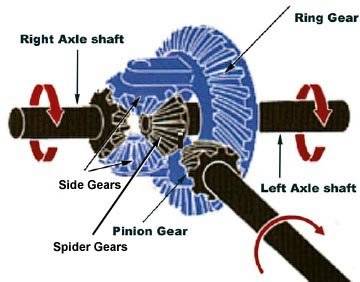
differential%20diagram.jpg
 
Engineering news on Phys.org
If you consider both rear wheels going round an apex of a corner, the inner wheel being closer to the apex than the outer wheel travels less distance through the corner. Imagine the corner is a portion of circumference of a circle, the closer you are to the centre point of the circle, the smaller the circumference will be, and as there is a fixed distance between the two rear wheels, one is traveling further to get around the corner than the other in the same time period. This difference in distance results in differing axle (spider gear) motion from one side to the other.Damo
 
Thank you Damo,
There must be some force acting on the side gear ( slowing it down) which starts the rotation of the spider gear! I'm searching for that force which causes a load to act on the inner wheels thr by slowing it down (this inturn slows down the inner side gear) then the spider gear starts to rotate abt it this causes the other side gear (outer) to rotate fast helping the outer wheels to cover a large distance.
 
update - lost an edit, this post is fixed now.

During the transition into a corner, while the tires accelerate to their steady state speed in a turn, the inner tire is slowed down by an "backwards" (opposing) torque, while the outer tire is sped up by a "forwards" torque. The torques feed back through the spider gears, and the side gears accelerate during the transition until everything reaches some steady state.
 
Last edited:
thank you rcgldr,
y should the inner tires experience more opposing torque?,can u elucidate more on this, please also provide the nesscary terms e.g. name of the force causing opposing torque. if u can draw a diagram.
 
oing into a turn:
  • the inner wheel wants to go faster than it needs to follow the path;
  • the outer wheel want to go slower than it needs to follow the path;
Hence:
  • the inner wheel tends to spin;
  • the outer wheel tends to skid;
Those two extra (opposing) friction forces, create the small torque that makes the spider gears accelerate. Once both wheels reach their correct rpm to follow their respective paths, the small torque disappear, the axles and spider gears stop accelerating and thus their new acquired rpm become constant. And the torque is back to being the same on both wheels.

There are nice animations on HOWSTUFFWORKS to help visualize a working differential.
 
rambharath94 said:
why should the inner tires experience more opposing torque?
Somehow I lost an edit, but jack action's post explains what happens. During the transition, the inner tire is slowed down by an opposing "backwards" torque, while the outer tire is sped up by a "forwards" torque.
 
You had a very good post about this Automotive Forum
see Automotive Differential Dec 31,2011 by bugatti
specifically post #14 from Tea Jay..old engineering film
 
jack action said:
oing into a turn:
  • the inner wheel wants to go faster than it needs to follow the path;
  • the outer wheel want to go slower than it needs to follow the path;
Hence:
  • the inner wheel tends to spin;
  • the outer wheel tends to skid;
Those two extra (opposing) friction forces, create the small torque that makes the spider gears accelerate. Once both wheels reach their correct rpm to follow their respective paths, the small torque disappear, the axles and spider gears stop accelerating and thus their new acquired rpm become constant. And the torque is back to being the same on both wheels.

There are nice animations on HOWSTUFFWORKS to help visualize a working differential.
jack action said:
oing into a turn:
  • the inner wheel wants to go faster than it needs to follow the path;
  • the outer wheel want to go slower than it needs to follow the path;
Hence:
  • the inner wheel tends to spin;
  • the outer wheel tends to skid;
Those two extra (opposing) friction forces, create the small torque that makes the spider gears accelerate. Once both wheels reach their correct rpm to follow their respective paths, the small torque disappear, the axles and spider gears stop accelerating and thus their new acquired rpm become constant. And the torque is back to being the same on both wheels.

There are nice animations on HOWSTUFFWORKS to help visualize a working differential.
Thank you Jack Action you explained very well.i found your view helpful about spinning of spider gear.
 
  • #10
Thank u ppl ,

I watched the videos but I am still ambiguous ab wat causes the backward torque
 
  • #12
jack action said:
oing into a turn:
  • the inner wheel wants to go faster than it needs to follow the path;
  • the outer wheel want to go slower than it needs to follow the path;
Hence:
  • the inner wheel tends to spin;
  • the outer wheel tends to skid;
Those two extra (opposing) friction forces, create the small torque that makes the spider gears accelerate. Once both wheels reach their correct rpm to follow their respective paths, the small torque disappear, the axles and spider gears stop accelerating and thus their new acquired rpm become constant. And the torque is back to being the same on both wheels.

There are nice animations on HOWSTUFFWORKS to help visualize a working differential.
i saw the animations the motion to the rear wheels is provided by the spider gears only,so only one input.may be i think an epicyclic gear train needs 2 inputs to give a positive drive.what about the other input.please explain if i am wrong in any way.
 
  • #13
rohitjinnu16 said:
i saw the animations the motion to the rear wheels is provided by the spider gears only,so only one input.may be i think an epicyclic gear train needs 2 inputs to give a positive drive.what about the other input.please explain if i am wrong in any way.

There is a resistive torque (due to friction) from the inner wheel and another one from the outer wheel and an input torque from the driveshaft; So you have 3 torques working together.

If you remove the driveshaft torque (car in neutral), then you still have the inner and outer wheels' torques. It is the difference between those two torques that will dictate if the spider gears turn or not (whether there is a driveshaft torque or not).
 
  • #14
jack action said:
There is a resistive torque (due to friction) from the inner wheel and another one from the outer wheel and an input torque from the driveshaft; So you have 3 torques working together.

If you remove the driveshaft torque (car in neutral), then you still have the inner and outer wheels' torques. It is the difference between those two torques that will dictate if the spider gears turn or not (whether there is a driveshaft torque or not).
yeah i got it han q
 

Similar threads

  • · Replies 4 ·
Replies
4
Views
3K
  • · Replies 2 ·
Replies
2
Views
5K
Replies
3
Views
2K
  • · Replies 18 ·
Replies
18
Views
3K
  • · Replies 12 ·
Replies
12
Views
3K
  • · Replies 3 ·
Replies
3
Views
4K
Replies
10
Views
3K
Replies
4
Views
5K
Replies
2
Views
4K
  • · Replies 6 ·
Replies
6
Views
2K