Discussion Overview
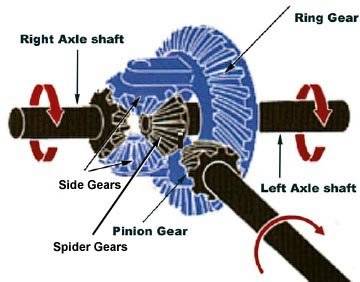
The discussion revolves around the mechanics of spider gear rotation within a differential system, particularly focusing on the forces and torques involved when a vehicle turns. Participants explore the dynamics of inner and outer wheels during cornering, the role of opposing torques, and the behavior of spider gears in response to these forces.
Discussion Character
- Exploratory
- Technical explanation
- Debate/contested
- Mathematical reasoning
Main Points Raised
- Some participants describe how the spider gear starts to rotate due to differences in wheel speed when a car turns, with the inner wheel traveling a shorter distance than the outer wheel.
- Others propose that a force acts on the side gear, slowing down the inner wheel and causing the spider gear to rotate, which in turn affects the outer wheel's speed.
- It is noted that during a turn, the inner tire experiences opposing torque while the outer tire experiences forward torque, leading to acceleration of the spider gears until a steady state is reached.
- Some participants question why the inner tires experience more opposing torque and seek clarification on the forces involved.
- There is discussion about the role of friction forces in creating the necessary torque for spider gear acceleration, with some emphasizing the importance of these forces in achieving the correct RPM for both wheels.
- Participants mention the need for multiple torques to understand the dynamics, including resistive torque from both wheels and input torque from the driveshaft.
Areas of Agreement / Disagreement
Participants express varying levels of understanding regarding the forces and torques involved in spider gear rotation, with some seeking clarification and others providing explanations. There is no consensus on the exact nature of the forces causing the backward torque or the overall mechanics of the differential system.
Contextual Notes
Some participants express ambiguity regarding the source of backward torque and the interaction of different torques within the system, indicating that further exploration of these concepts may be necessary.