Split Epimorphisms .... Bland Proposition 3.2.4 ....

  • Context: Undergrad 
  • Thread starter Thread starter Math Amateur
  • Start date Start date
  • Tags Tags
    Split
Click For Summary

Discussion Overview

The discussion centers on understanding Proposition 3.2.4 from Paul E. Bland's book "Rings and Their Modules," particularly how it relates to Proposition 3.2.3. Participants seek clarification on the implications of these propositions regarding split monomorphisms and epimorphisms within the context of exact sequences in module theory.

Discussion Character

  • Technical explanation
  • Mathematical reasoning
  • Debate/contested

Main Points Raised

  • Peter requests clarification on how Proposition 3.2.3 establishes Proposition 3.2.4.
  • Andrew explains that Proposition 3.2.4's premises involve a split monomorphism and discusses the implications of the author's comments after Definition 3.2.2, noting that the splitting map must be surjective for a split monomorphism.
  • Peter elaborates that if a map is a split epimorphism, it must be injective, providing reasoning based on the properties of the maps involved.
  • Another participant presents a lemma stating that if two maps satisfy a certain condition, one is a monomorphism and the other an epimorphism, linking this to the propositions being discussed.
  • The same participant argues that by applying the lemma to the context of Proposition 3.2.4, one can see how it follows from Proposition 3.2.3 by substituting the relevant terms.

Areas of Agreement / Disagreement

Participants express varying interpretations of the implications of the propositions, with some agreeing on the relationships between the maps and others seeking further clarification. The discussion does not reach a consensus on the best way to understand the connections between the propositions.

Contextual Notes

Participants note the importance of distinguishing between monomorphisms and epimorphisms when discussing splitting maps, indicating potential confusion that could arise from the terminology used in the propositions.

Math Amateur
Gold Member
MHB
Messages
3,920
Reaction score
48
I am reading Paul E. Bland's book "Rings and Their Modules" ...

Currently I am focused on Section 3.2 Exact Sequences in ModR" role="presentation">ModR ... ...

I need some help in order to fully understand Proposition 3.2.4 ...

Proposition 3.2.4 reads as follows:
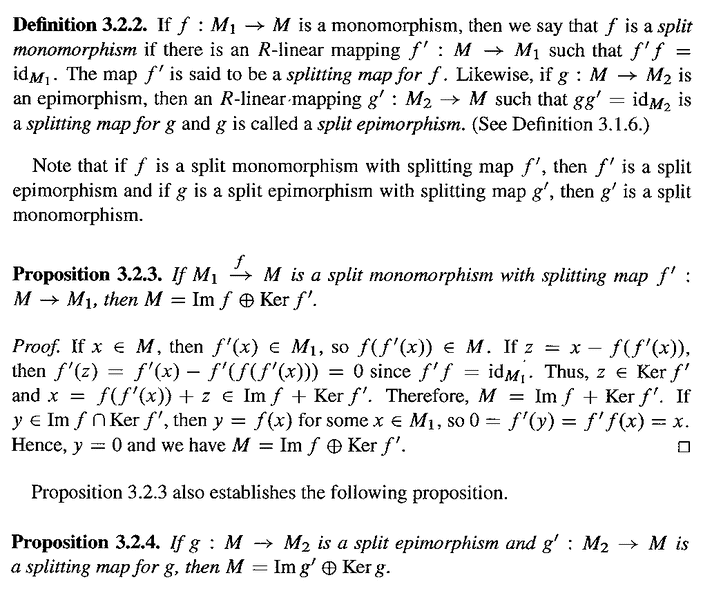
Bland - Prposition 3.2.4 ... ....png

Can someone please explain exactly how Proposition 3.2.3 establishes Proposition 3.2.4 ...
Help will be much appreciated ...

Peter
 

Attachments

  • Bland - Prposition 3.2.4 ... ....png
    Bland - Prposition 3.2.4 ... ....png
    46.3 KB · Views: 592
Physics news on Phys.org
Start with the premises of 3.2.4 about ##g,g'##.

Then, from the author's comment after Definition 3.2.2 we see that ##g'## is a split monomorphism with monomorphism-splitting map ##g##.

Hence by Proposition 3.2.3, the range ##M## of the split monomorphism ##g'## can be written as a direct sum of the split monomorphism's image (##\textrm{Im}\ g'##) and the Kernel of the monomorphism-splitting map ##g##.

I find it helps to attach the word 'epimorphism-' or 'monomorphism-' as a prefix to the words 'splitting map' in order to avoid confusion as to whether the map in question is splitting an epimorphism or a monomorphism.

Are you able to satisfy yourself as to the truth of the author's comment after Definition 3.2.2?
 
  • Like
Likes   Reactions: Math Amateur
Hi Andrew ... thanks for the help ...

Regarding the authors comments after Definition 3.2.2 ...

Firstly, if ##f## is a split monomorphism with splitting map ##f'##... then any point/element of ##M_1##, say ##a##, must be mapped to itself: ... hence ##f'## must be surjective ... that is ##f'## is an epimorphism ...

Secondly if ##g## is a split epimorphism with splitting map ##g'##... then any point ##a \in M_2## will be mapped to ##g'(a)## ... and no other point of ##M_2##, say ##b##, may be mapped to ##g'(a)## ... otherwise ... ##g## must map the point ##g'(a)## back to both ##a## and ##b## ... which is impossible since ##g## is a map ... therefore ##g'## is injective ... that is, ##g'## is a monomorphism ... ...

Peter
 
Yes. A neat way to put the second one is to let ##a,b\in M_2## and assume ##g'(a)=g'(b)##. Then we have

$$a=id_{M_2}(a) = (g\circ g')(a) = g(g'(a)) = g(g'(b)) = (g\circ g')(b) = id_{M_2}(b) = b$$

which gives us the injectivity property of ##g'##.
 
  • Like
Likes   Reactions: jim mcnamara and Math Amateur
The key to your question is this lemma:

If ##f:M \to N## and ##g:N \to M## are R-maps such that ##g \circ f = 1_M## then ##f## is an R-monomorphism and ##g## is an R-epimorphism. You may prove that.
Here we have a sequence

##M\overset{f}{\rightarrow}N\overset{g}{\rightarrow}M##

of R-maps such that ##g \circ f = 1_M##.In proposition 3.2.3. we have this sequence

##M_1\overset{f}{\rightarrow}M\overset{f’}{\rightarrow}M_1##

of R-maps such that ##f’ \circ f = 1_{M_1}##.

By the lemma, ##f## is a monomorphism and we have ##f’ \circ f = 1_{M_1}##: definition 3.2.2. calls ##f## the split monomorphism and calls ##f’## the splitting map for ##f##.

Proposition 3.2.3 says ##M = \text{im } f \oplus \text{ker } f’##


Can you see this:

By the lemma, ##f’## is an epimorphism and we have ##f’ \circ f = 1_{M_1}##: but now definition 3.2.2. calls ##f’## the split epimorphism and ##f## the splitting map for ##f’##.

Proposition 3.2.3 says ##M = \text{im } f \oplus \text{ker } f’##This is exactly the situation we have in proposition 3.2.4. here we have this sequence

##M_2\overset{g’}{\rightarrow}M\overset{g}{\rightarrow}M_2##

of R-maps such that ##g \circ g’ = 1_{M_2}##: ##g## the split epimorphism and ##g’## the splitting map for ##g##.

So change ##f## into ##g’##, and ##f’## into ##g##, and ##M_1## into ##M_2## and proposition 3.2.3 becomes proposition 3.2.4. And the conclusion is ##M = \text{im } g’ \oplus \text{ker } g##
 
  • Like
Likes   Reactions: Math Amateur

Similar threads

  • · Replies 2 ·
Replies
2
Views
1K
Replies
2
Views
1K
  • · Replies 5 ·
Replies
5
Views
2K
  • · Replies 3 ·
Replies
3
Views
2K
  • · Replies 2 ·
Replies
2
Views
1K
Replies
2
Views
2K
  • · Replies 1 ·
Replies
1
Views
1K
  • · Replies 12 ·
Replies
12
Views
3K
  • · Replies 1 ·
Replies
1
Views
1K
Replies
1
Views
1K