Split Monomorphisms .... Bland Defn 3.2.2 & Propn 3.2.3 ....

  • Context: Undergrad 
  • Thread starter Thread starter Math Amateur
  • Start date Start date
  • Tags Tags
    Split
Click For Summary

Discussion Overview

The discussion centers on understanding Definition 3.2.2 and Proposition 3.2.3 from Paul E. Bland's book "Rings and Their Modules," specifically within the context of exact sequences in the category of R-modules. Participants seek clarification on the implications of these definitions and propositions, particularly regarding the behavior of morphisms and the structure of exact sequences.

Discussion Character

  • Exploratory
  • Technical explanation
  • Conceptual clarification
  • Debate/contested

Main Points Raised

  • Peter questions how Definition 3.2.2 applies to elements outside of the image of the morphism f, specifically regarding the definition of f' and its domain.
  • Some participants assert that f' is defined on all of M, not just on Im f, and provide reasoning involving the kernel of f'.
  • Another participant explains the concept of short exact sequences and their properties, emphasizing the conditions for a sequence to be split exact.
  • Clarifications are provided on the notation of injective and surjective mappings in the context of exact sequences, with a focus on the implications of these properties.
  • Peter seeks further clarification on the meaning of special arrows in the notation of exact sequences, prompting additional explanations from other participants.

Areas of Agreement / Disagreement

Participants express differing views on the implications of Definition 3.2.2 and the behavior of morphisms in the context of exact sequences. There is no consensus on the interpretation of certain aspects, particularly regarding elements outside the image of f.

Contextual Notes

The discussion involves complex definitions and properties of exact sequences, with participants referencing specific mathematical structures and relationships that may not be fully resolved or universally accepted among them.

Math Amateur
Gold Member
MHB
Messages
3,920
Reaction score
48
I am reading Paul E. Bland's book "Rings and Their Modules ...

Currently I am focused on Section 3.2 Exact Sequences in ##\text{Mod}_R## ... ...

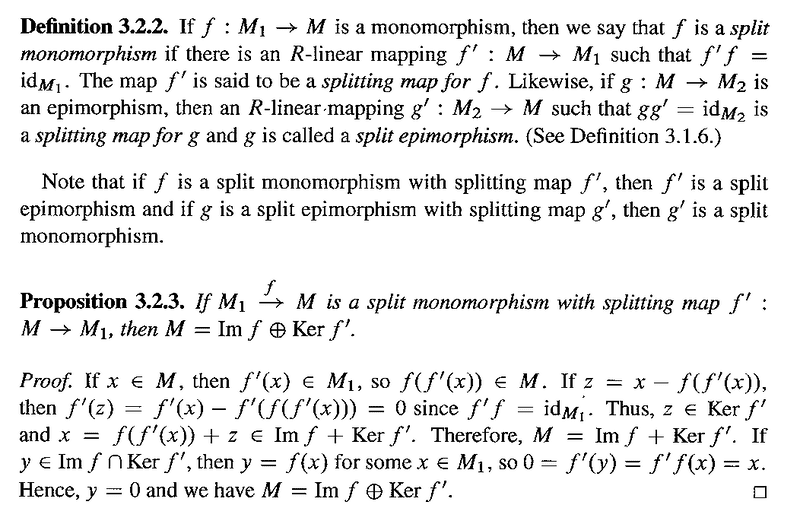
I need some help in order to fully understand Definition 3.2.2 and Proposition 3.2.3 ...

Definition 3.2.2 and Proposition 3.2.3 read as follows:
Bland - Defn 3.2.2 ... ....png

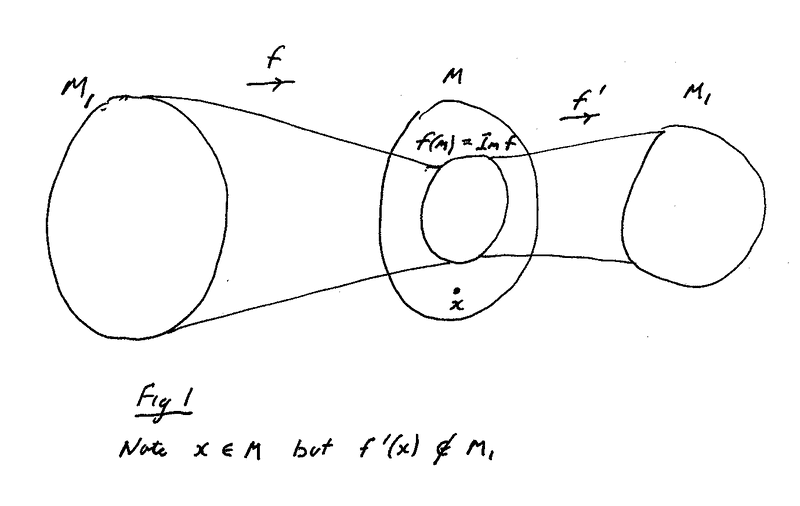
In Definition 3.2.2 we read that ##f'f = \text{id}_{M_1}## ... ... BUT ... ... I thought that ##f'f## was only defined on ##f(M) = \text{Im } f## ... ... what then happens to elements ##x \in M## that are outside of ##f(M) = \text{Im } f## ... ... see Fig. 1 below ...
Bland - Figure 1 ....png


Note that in the proof of Proposition 3.2.3 we read:" ... ... If ##x \in M## then ##f'(x) \in M_1## ... ... "But ... how does this work for ##x## outside of ##f(M) = \text{Im } f## such as ##x## shown in Fig. 1 above?
I would be grateful if someone could explain how Definition 3.2.2 "works" ... ...

Peter
 

Attachments

  • Bland - Defn 3.2.2 ... ....png
    Bland - Defn 3.2.2 ... ....png
    53.9 KB · Views: 679
  • Bland - Figure 1 ....png
    Bland - Figure 1 ....png
    12.6 KB · Views: 556
Physics news on Phys.org
##f'## is described above as having domain ##M## so it is defined on all of ##M##, not just on Im##f##

From the Proposition, we see that any ##x\in M\smallsetminus f(M_1)## can be written as ##a+b## where ##a\in f(M_1)## and ##b\in\mathrm{ker}\ f'##. So there must be some ##m_1\in M_1## such that ##a=f(m_1)## and we will have

$$f'(x) = f'(a+b) = f'(a) + f'(b) = m_1 + 0_{M_1}=m_1$$
 
  • Like
Likes   Reactions: Math Amateur
Math Amateur said:
I would be grateful if someone could explain how Definition 3.2.2 "works" ... ...
The origin are exact sequences (image of the left homomorphism is equal to the kernel of the next). Let's take a short exact sequence. This is a sequence of ##R-##module homomorphisms
$$
0 \longrightarrow M_1 \stackrel{f}{\longrightarrow} M \stackrel{g}{\longrightarrow} M_2 \longrightarrow 0 \Longleftrightarrow M_1 \stackrel{f}{\rightarrowtail} M \stackrel{g}{\twoheadrightarrow} M_2
$$
I have a book, in which the author calls such a sequence exact direct, which is a bit more telling, if one the equivalent conditions hold:
  1. ##\exists \,h: M \longrightarrow M_1 \oplus M_2\, : \,M\cong_h M_1 \oplus M_2##
  2. ##\exists \,g': M_2 \longrightarrow M \, : \, g \circ g' = \operatorname{id}_{M_2}##
  3. ##\exists \,f': M \longrightarrow M_1 \, : \, f' \circ f = \operatorname{id}_{M_1}##
This summarizes the situation of Definition 3.2.2.

In general we speak of a split exact sequence, if ##g'## exists which is called the split. The clue is, that ##M_1 \stackrel{f}{\rightarrowtail} M_1 \oplus M_2 \stackrel{g}{\twoheadrightarrow} M_2## always splits AND all splits take this form. So a split describes in a way the possibility to go back in an exact sequence, to embed ##M_2## in ##M##. This isn't trivial, because ##M_2## is given as an image, so its structure can be rather wild. A split guarantees that it can be embedded ("backwards") anyway: ##g'## splits ##M## into ##M_1## and ##M_2##.
 
Last edited:
  • Like
Likes   Reactions: Math Amateur
fresh_42 said:
The origin are exact sequences (image of the left homomorphism is equal to the kernel of the next). Let's take a short exact sequence. This is a sequence of ##R-##module homomorphisms
$$
0 \longrightarrow M_1 \stackrel{f}{\longrightarrow} M \stackrel{g}{\longrightarrow} M_2 \longrightarrow 0 \Longleftrightarrow M_1 \stackrel{f}{\rightarrowtail} M \stackrel{g}{\twoheadrightarrow} M_2
$$
I have a book, in which the author calls such a sequence exact direct, which is a bit more telling, if one the equivalent conditions hold:
  1. ##\exists \,h: M \longrightarrow M_1 \oplus M_2\, : \,M\cong_h M_1 \oplus M_2##
  2. ##\exists \,g': M_2 \longrightarrow M \, : \, g \circ g' = \operatorname{id}_{M_2}##
  3. ##\exists \,f': M \longrightarrow M_1 \, : \, f' \circ f = \operatorname{id}_{M_1}##
This summarizes the situation of Definition 3.2.2.

In general we speak of a split exact sequence, if ##g'## exists which is called the split. The clue is, that ##M_1 \stackrel{f}{\rightarrowtail} M_1 \oplus M_2 \stackrel{g}{\twoheadrightarrow} M_2## always splits AND all splits take this form. So a split describes in a way the possibility to go back in an exact sequence, to embed ##M_2## in ##M##. This isn't trivial, because ##M_2## is given as an image, so its structure can be rather wild. A split guarantees that it can be embedded ("backwards") anyway: ##g'## splits ##M## into ##M_1## and ##M_2##.
Thanks for the help fresh_42 ...

But just a clarification ...

You write:

"... ... In general we speak of a split exact sequence, if ##g'## exists which is called the split. The clue is, that ##M_1 \stackrel{f}{\rightarrowtail} M_1 \oplus M_2 \stackrel{g}{\twoheadrightarrow} M_2## always splits AND all splits take this form. ... ... "

Can you explain the meaning of the special arrows under the f and under the g in ##M_1 \stackrel{f}{\rightarrowtail} M_1 \oplus M_2 \stackrel{g}{\twoheadrightarrow} M_2## ... ?Thanks again,

Peter
 
andrewkirk said:
##f'## is described above as having domain ##M## so it is defined on all of ##M##, not just on Im##f##

From the Proposition, we see that any ##x\in M\smallsetminus f(M_1)## can be written as ##a+b## where ##a\in f(M_1)## and ##b\in\mathrm{ker}\ f'##. So there must be some ##m_1\in M_1## such that ##a=f(m_1)## and we will have

$$f'(x) = f'(a+b) = f'(a) + f'(b) = m_1 + 0_{M_1}=m_1$$
Thanks Andrew ...

Appreciate the help ...

Peter
 
Math Amateur said:
Can you explain the meaning of the special arrows under the ##f## and under the ##g## in ##M_1 \stackrel{f}{\rightarrowtail} M_1 \oplus M_2 \stackrel{g}{\twoheadrightarrow} M_2## ... ?
Yes. I said that ##M_1 \stackrel{f}{\rightarrowtail} M_1 \oplus M_2 \stackrel{g}{\twoheadrightarrow} M_2## is equivalent to the short exact sequence
$$0 \stackrel{\iota}{\longrightarrow} M_1 \stackrel{f}{\longrightarrow} M = M_1 \oplus M_2 \stackrel{g}{\longrightarrow} M_2 \stackrel{\pi}{\longrightarrow} 0$$
So the sequence is exact at ##M_1## which means ##0 =\operatorname{im}\iota = \operatorname{ker} f ##, i.e. ##f## is injective. ##M_1 \rightarrowtail M## represents an injective homomorphism, an embedding.
And the sequence is exact at ##M_2## which means ##\operatorname{im} g = \operatorname{ker} \pi = M_2 ##, i.e. ##g## is surjective. ##M \twoheadrightarrow M_2## represents a surjective homomorphism, a projection.

The notation with the special arrows simply avoids the need to note the zero modules at the left and at the right and can be used in general to denote injective ##\rightarrowtail ##, resp. surjective ##\twoheadrightarrow ## mappings. If you use both at the same time, then it symbolizes a bijection. Unfortunately, I haven't found the LaTeX code for ##M \twoheadrightarrowtail M_1 \oplus M_2##
 
  • Like
Likes   Reactions: Math Amateur

Similar threads

Replies
2
Views
1K
  • · Replies 4 ·
Replies
4
Views
2K
  • · Replies 2 ·
Replies
2
Views
1K
  • · Replies 3 ·
Replies
3
Views
2K
  • · Replies 2 ·
Replies
2
Views
1K
  • · Replies 1 ·
Replies
1
Views
1K
  • · Replies 25 ·
Replies
25
Views
4K
  • · Replies 12 ·
Replies
12
Views
3K
Replies
2
Views
2K
Replies
3
Views
2K